

Is MicroStrategy’s aggressive Bitcoin strategy setting up an explosive upside breakout or a painful reset for latecomers?

Is MicroStrategy’s BTC pivot moving the stock?
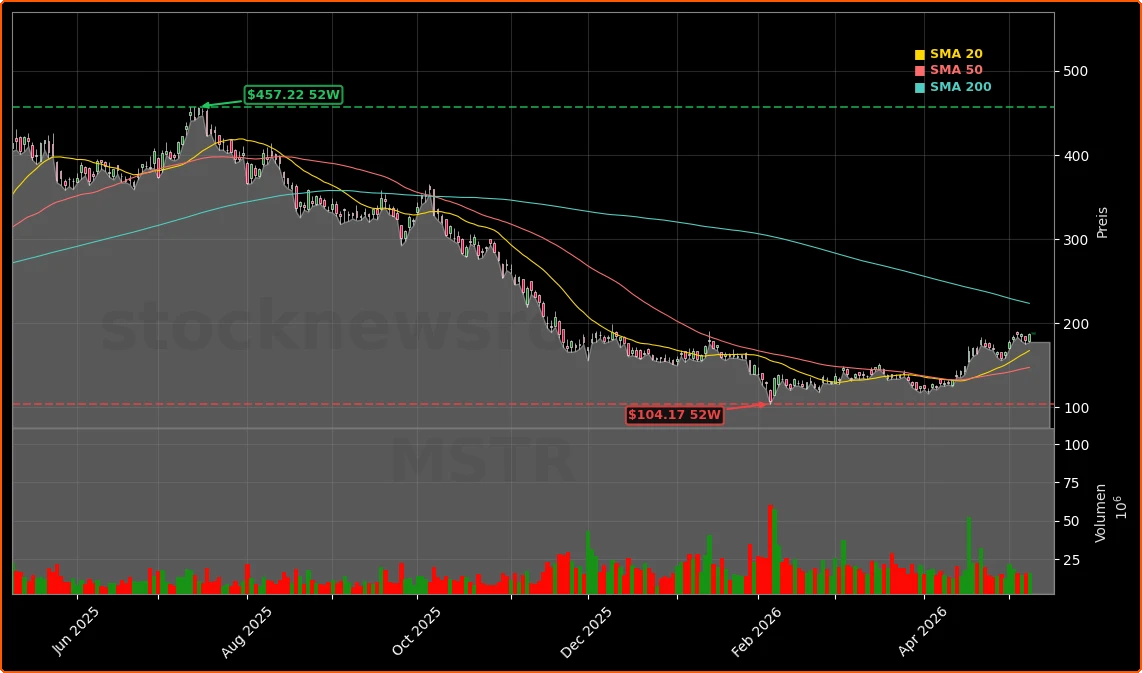
MSTR climbed 4.31% to $187.59 on Friday, with the stock adding another 0.59% to $188.70 in after-hours trading (ET), as traders digested fresh commentary on the company’s Bitcoin plans. Technically, the shares remain stuck in a wide band between $150 and $200, with the 200-day moving average still sloping downward, signaling that the broader downtrend has not yet been fully reversed despite the recent rebound.
At the same time, the weekly chart is drawing growing attention on Wall Street. MSTR is carving out what technicians describe as an ascending triangle, with higher lows pushing up against a relatively flat resistance zone. If that pattern resolves to the upside, the measured move points toward roughly $350, implying upside of around 80% from current levels. A failure, however, could see the stock slide back toward the $150 area and potentially invalidate the bullish setup.
While MSTR is not part of the S&P 500, it has effectively become a high-beta Bitcoin proxy for many U.S. traders, competing for attention with crypto-sensitive names such as Tesla and NVIDIA. For portfolios seeking leveraged exposure to BTC without holding coins directly, the MicroStrategy Bitcoin Strategy remains a focal point of risk-taking.
How is MicroStrategy Bitcoin Strategy changing?
In its latest earnings call, MicroStrategy Incorporated signaled a notable refinement of the MicroStrategy Bitcoin Strategy. Saylor said the company may sell about 20 basis points (0.2%) of its Bitcoin holdings per month in certain circumstances, primarily to harvest tax benefits, fund dividends on preferred stock, or retire older convertible debt. Crucially, he emphasized that the firm intends to buy back five to ten times that amount in the same period, keeping MicroStrategy a net BTC accumulator.
The company currently holds about 818,334 BTC—more than any other public corporation—worth over $65 billion at prevailing prices. Its average acquisition cost stands near $75,500 per coin, leaving MicroStrategy with large unrealized swings as Bitcoin trades around $80,000. Year to date, the firm has added roughly 145,834 BTC, about $11 billion in purchases, much of it at or below that average cost, even as it recorded an eye-catching Q1 net loss of around $12.5 billion on paper due to mark-to-market revaluation.
A critical pillar of the MicroStrategy Bitcoin Strategy is a complex financing mix that prioritizes preferred shares, including the STRC instrument, over heavy common-stock issuance. This design attempts to limit equity dilution while still tapping strong investor appetite for yield and Bitcoin-linked exposure. However, with preferred dividends running at about 11.5%, the bar for Bitcoin’s annual performance is now high; if BTC appreciates less than that, the strategy leans more toward debt service than wealth creation.
What are analysts saying about MicroStrategy Incorporated?
Sell-side interest in MicroStrategy Incorporated has intensified alongside Bitcoin’s recovery. Canaccord Genuity recently raised its MSTR price target to $224 from $185, reiterating a Buy rating. The firm highlighted both the sharp rebound in Bitcoin—from lows near $60,000 back to above $80,000—and MicroStrategy’s resilient capital-raising model as key reasons for the upgrade. Canaccord also underscored that BTC per MSTR share has climbed roughly 18% year over year, suggesting that long-term holders are gaining underlying Bitcoin exposure even amid volatility.
Separately, analysts at JPMorgan led by Nikolaos Panigirtzoglou estimate that if the current pace persists, MicroStrategy’s Bitcoin purchases could reach about $30 billion on an annualized basis in 2026, versus roughly $22 billion in both 2024 and 2025. That acceleration is being driven by strong demand for the firm’s equity and preferred securities from both retail and institutional investors, pushing the stock’s premium to net asset value toward the mid-20% range and making new capital raises easier.
Technical strategists are similarly split between enthusiasm and caution. Some see the confluence of an ascending triangle and an inverse head-and-shoulders base as a textbook bullish configuration that could send MSTR into the $250–$300 zone, well ahead of many peers in the tech-heavy NASDAQ. Others warn that any sharp Bitcoin drawdown could rapidly compress MicroStrategy’s premium and force the company into more defensive selling of BTC, a scenario that would put renewed pressure on the stock.
Does the strategy still beat direct crypto exposure?
For U.S. investors comparing the MicroStrategy Bitcoin Strategy with direct BTC exposure or crypto-adjacent stocks like Apple’s payments ecosystem or Tesla’s balance-sheet experiment, the trade-off is clear. MicroStrategy offers leveraged upside to Bitcoin through its use of debt and preferred equity, but that leverage also amplifies downside risk if BTC underperforms its double-digit funding costs. The firm’s willingness to sell modest amounts of Bitcoin for tax and financing reasons is a pragmatic shift, yet it also dismantles the earlier narrative that the treasury would be untouchable.
Recent market chatter—including criticism from long-time gold advocate Peter Schiff—centers on whether MicroStrategy’s 11.5% preferred yield will prove sustainable if Bitcoin enters a prolonged consolidation rather than another parabolic run. Management counters that opportunistic trading around its core position, plus disciplined capital allocation, will support both the dividend and ongoing BTC accumulation.
Related Coverage
For a deeper dive into how this evolving playbook could reshape the MicroStrategy Bitcoin Strategy after recent volatility, including the latest debate around Saylor’s readiness to sell BTC, read “MicroStrategy Bitcoin Strategy -4.2% Plunge Tests Saylor’s Pivot”, which examines the market’s reaction to his changing tone. To understand how sector peers are faring, especially on the exchange side, see “Coinbase Earnings -2.5% Plunge After Weak Quarter Shock”, which explores whether the latest Coinbase results signal broader challenges for crypto-linked equities.
We will sell Bitcoin when it’s advantageous to the company.— Phong Le, CEO of MicroStrategy Incorporated
In summary, the MicroStrategy Bitcoin Strategy is evolving from a pure “never sell” mantra into a more flexible, tax- and financing-aware approach that still aims to grow the company’s BTC stack aggressively. For U.S. investors, MSTR remains a high-octane proxy on Bitcoin with meaningful execution and balance-sheet risks attached. The next big moves in both Bitcoin and MicroStrategy’s capital markets activity will determine whether this leveraged bet continues to outperform simpler crypto exposure in diversified portfolios.