

Is the Coinbase CLARITY Act the catalyst for a new crypto era or just another headline fueling short-term volatility in COIN?

Is regulation finally turning for Coinbase?
The Senate Banking Committee’s bipartisan approval of the CLARITY Act marks the most concrete step yet toward a federal framework for digital assets. For Coinbase Global, Inc., whose core business depends on predictable oversight from the SEC and CFTC, this early-stage progress is being widely framed as the potential cornerstone of a Coinbase CLARITY Act environment that could unlock institutional capital. Committee passage does not guarantee full Senate or House approval, but it shifts the narrative from enforcement battles to rulemaking.
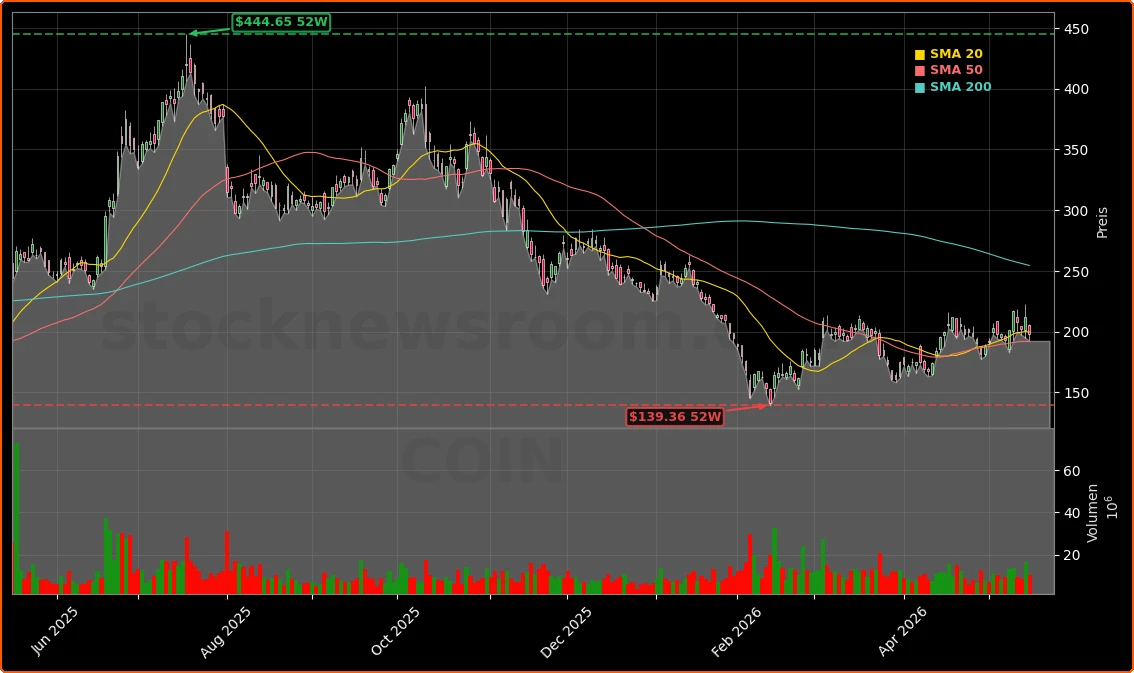
Coinbase shares surged on Thursday as traders positioned for a friendlier policy path, but today’s slide suggests short-term players are trimming risk into the weekend. Bitcoin has slipped below $80,000, pressuring transaction-sensitive names and reminding investors that, even with a Coinbase CLARITY Act roadmap forming, crypto equities still trade like high-beta derivatives of underlying token prices. With COIN now down around 12% year to date, sentiment remains constructive but fragile.
How does Coinbase stack up against peers?
Crypto-related stocks continue to trade as a tightly linked theme on the NASDAQ. Coinbase and listed bitcoin proxies have been moving in lockstep, with intraday swings of 5–6% increasingly viewed as routine noise rather than a thesis break. A broad risk-off tone in high-growth technology and chip names such as NVIDIA is amplifying the volatility. Unlike miners or single-asset vehicles, however, Coinbase is positioning itself as a diversified infrastructure and services play, more comparable to a fintech platform than a pure bitcoin tracker.
Institutional behavior underscores that distinction. A recent 13G/A filing shows Susquehanna affiliates now control more than 9.3 million Coinbase shares, about 4.2% of the float, signaling that large trading firms still see strategic value in COIN despite drawdowns. Elsewhere, trading house Jane Street has been paring back bitcoin ETF exposure while boosting positions in crypto-operating companies, including Coinbase, reflecting a gradual tilt from direct token vehicles toward regulated equity plays. That shift could accelerate if a Coinbase CLARITY Act regime further de-risks the business model in the eyes of pension funds and endowments.
What role does the USDC–Hyperliquid deal play?
Strategically, Coinbase is pushing beyond spot trading into stablecoin infrastructure and derivatives. Its new agreement with the Hyperliquid ecosystem installs USDC as the primary settlement asset across the platform’s markets and makes Coinbase the official treasury deployer. Under a framework known as AQAv2, Coinbase will manage USDC reserves, stake Hyperliquid’s native HYPE token and share the majority of reserve yield back to the protocol, effectively turning the exchange into a yield-routing layer between traditional capital and on-chain markets.
This is the first time Coinbase has taken such a formal treasury role on a major DeFi protocol, creating a template for future partnerships if regulators embrace a Coinbase CLARITY Act structure that blesses stablecoin and yield products. The market reaction has been swift: HYPE jumped about 20% to new local highs after the announcement, and Coinbase’s own stock participated in Thursday’s optimism before handing back gains today. For long-term shareholders, the deal speaks to a deliberate strategy of becoming a toll collector on stablecoin flows rather than relying solely on retail trading fees.
Why is Coinbase betting on AI and automation?
Behind the scenes, Coinbase is attempting an operating model reboot. The company is celebrating its 14th anniversary by articulating an ambitious goal: onboarding 1 billion people into an open financial system. To get there, management is cutting costs and redirecting capital toward infrastructure and automation. Earlier in May, Coinbase laid off roughly 14% of its workforce as part of what CEO Brian Armstrong described as a shift to an AI-first model, with internal systems and customer experiences increasingly driven by autonomous agents.
One example is the implementation of x402, an autonomous payment protocol that allows AI assistants to execute instant USDC transfers without manual user intervention. If regulators enshrine a Coinbase CLARITY Act framework that explicitly covers AI-driven financial agents and stablecoin rails, Coinbase could sit at the intersection of crypto, automation and mainstream payments. That thesis is attracting institutional interest: university endowments such as Dartmouth are expanding their exposure to regulated crypto ETFs, and major Wall Street firms are reallocating from pure bitcoin vehicles into equities tied to broader digital-asset infrastructure.
Do fundamentals justify the volatility?
Financially, Coinbase still has work to do. Q1 2026 revenue came in at $1.41 billion, below the $1.48 billion analyst consensus, as total crypto market cap and trading volumes dropped more than 20% quarter over quarter. Transaction revenue fell 23% sequentially, and the company posted a net loss of $394.1 million, largely driven by a $482 million markdown of its investment portfolio during the correction. Those numbers highlight why the stock reacts sharply to every policy headline and bitcoin price tick: the top line is still tightly tethered to trading activity.
Even so, the institutional setup remains reasonably supportive. Consensus on Wall Street centers around a moderate buy stance, with an average price target near $230, implying upside from current levels if a Coinbase CLARITY Act regime and expanding stablecoin and derivatives businesses can stabilize earnings. Analysts at large banks like Goldman Sachs and Morgan Stanley have emphasized the option value embedded in Coinbase’s platform if the U.S. ultimately endorses a more comprehensive digital-asset structure. Compared with consumer-tech bellwethers such as Apple or high-growth innovators like Tesla, COIN carries far greater regulatory and market risk—but also uniquely levered exposure to a maturing crypto ecosystem.
Related Coverage: What’s next for Coinbase?
For a deeper look at how the USDC pivot is reshaping the business, readers can review our detailed analysis in “Coinbase Stablecoin +8.2% Surge as DeFi Deal Lands”. That piece explains how the Hyperliquid partnership could turn Coinbase into a more predictable DeFi tollbooth for institutional flows. Taken together with today’s focus on the Coinbase CLARITY Act backdrop, investors get a fuller picture of how regulatory shifts, stablecoin economics and AI automation are converging in the company’s long-term strategy.
In summary, Coinbase is navigating a rare combination of regulatory momentum, USDC deal-making and AI-driven restructuring, even as its share price whipsaws with every move in bitcoin and on Capitol Hill. For investors willing to tolerate volatility, the emerging Coinbase CLARITY Act landscape and new stablecoin revenue lines offer a compelling, if risky, way to gain exposure to the institutionalization of crypto. The next catalysts will come from the full Senate’s handling of the bill, bitcoin’s trajectory and whether Coinbase can translate its bold anniversary vision into steadier, more diversified cash flows.