

Can a deep quarterly loss really coexist with a double‑digit stock rebound as Coinbase Earnings reset the crypto narrative?

How are Coinbase Earnings reshaping the stock story?
Coinbase Global, Inc. reported a Q1 2026 net loss of about $394 million, reversing prior profitability as crypto prices cooled and trading activity slowed. Revenue came in well below bullish Wall Street expectations, with one data point showing roughly $1.41 billion in sales versus consensus closer to $1.5 billion. Another disclosure for the same period highlighted $755.8 million in revenue and an adjusted EBITDA decline from $929.9 million a year earlier to $303.3 million, underscoring how quickly operating leverage can cut both ways in crypto markets.
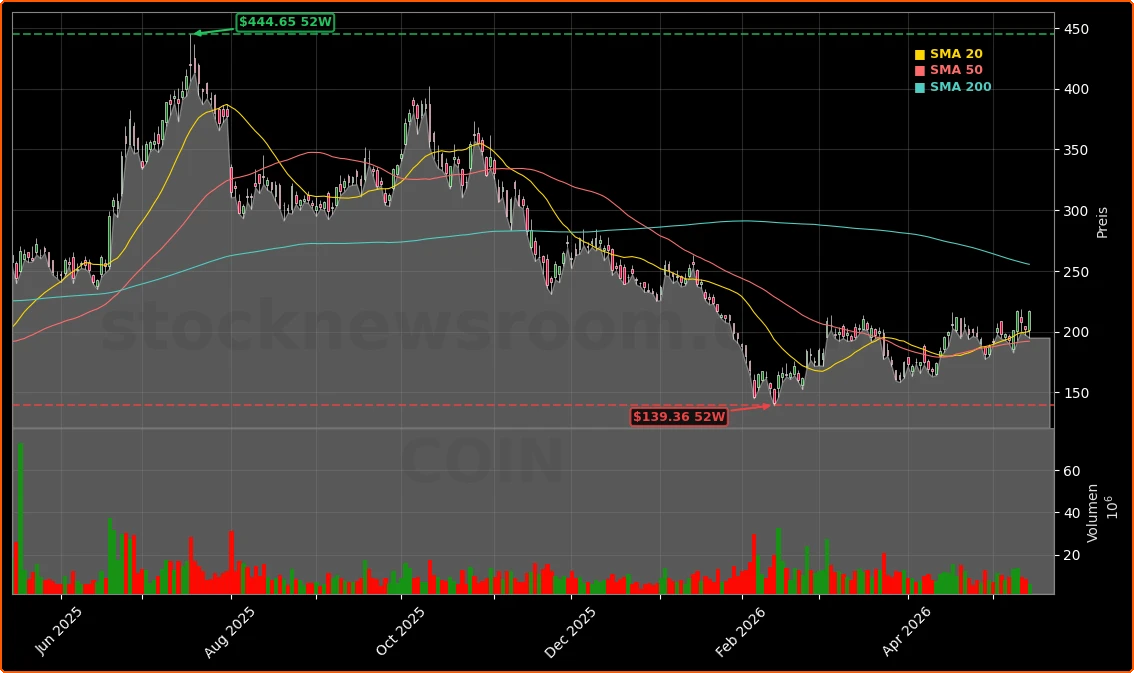
The earnings hit translated into a loss of about $1.49 per share, far off analyst models that had penciled in a modest profit. Shares initially fell around 6% after the Q1 2026 report, but have since clawed back those losses and more, with COIN now up 7.68% to $217.29 compared with yesterday’s $201.80 close in intraday trading on Wall Street. For NASDAQ‑focused investors, the message from recent Coinbase Earnings is that volatility cuts across both the income statement and the share price—but sentiment is far from broken.
Why are analysts still lifting targets on Coinbase Global?
Despite the weak quarter, some research desks remain constructive. Benchmark, a U.S. equity research firm, has reiterated its bullish stance on COIN and recently raised its price target from $260 to $270. Its analysts argue that Coinbase is transitioning from a cyclical trading venue to a foundational platform for the emerging on‑chain economy, spanning stablecoins, derivatives, tokenization and DeFi applications.
Benchmark’s thesis emphasizes that Coinbase is developing into an “everything exchange,” less dependent on short‑term retail trading spikes and more geared to recurring infrastructure revenues. Around a dozen business lines are already generating an annualized revenue base in the neighborhood of $100 million each, with the crypto‑derivatives unit hitting a record contribution in the last reported quarter. This stands in contrast to more cautious firms like Mizuho, which maintains a neutral rating and a $200 price target, warning that much of the upside may already be reflected in the stock and pointing to retail‑market share pressure from rivals such as Robinhood.
For U.S. portfolio managers comparing COIN with large‑cap growth names like NVIDIA or Apple, that dispersion in analyst views highlights the core debate: is Coinbase a high‑beta macro trade on Bitcoin cycles, or a structural beneficiary of the institutionalization of digital assets?
What do Coinbase Earnings say about market share and user trust?
Beneath the headline loss, the latest Coinbase Earnings also reveal strengthening competitive positioning. Coinbase’s global spot‑trading market share climbed to about 8.6%, a new high, even as industry volumes shrank. The platform has now logged its twelfth straight quarter of net inflows, with client assets on the platform rising to roughly $294 billion. That persistence of inflows suggests trust in Coinbase’s brand and custody standards remains intact despite the drawdown and sector scandals of past years.
Stablecoins are becoming an increasingly important pillar. Coinbase now processes around half of all USDC activity, cementing its role at the center of dollar‑linked liquidity flows in crypto. The firm is also leaning into third‑party DeFi ecosystems: via a recent deal with Native Markets and Hyperliquid, Coinbase will acquire USDH brand assets and act as USDC treasury deployer on the Hyperliquid perpetuals network. Under the upgraded AQAv2 framework, the vast majority of reserve yield on USDC balances is slated to be shared back with the protocol, signaling that Coinbase is willing to participate in revenue‑sharing models rather than simply extract fees.
On the technology side, Coinbase’s own Layer‑2 network, Base, has seen stablecoin transaction volume grow roughly tenfold year over year. That type of scaling, while not yet fully reflected in headline revenue, reinforces the infrastructure narrative that bullish analysts are betting on.
How do macro and regulation shape the outlook for Coinbase?
Macro policy remains a double‑edged sword. Research from Grayscale notes that a “higher‑for‑longer” interest‑rate regime creates headwinds for non‑yielding assets like Bitcoin, but simultaneously boosts revenue for stablecoin issuers and accelerates the tokenization of fixed‑income products. For Coinbase, that mix means spot‑trading volumes could stay choppy, even as custody, staking, tokenization and stablecoin‑related income grow more central to the investment case.
Regulation may be an even bigger swing factor. The U.S. Senate is currently weighing the Clarity Act, a wide‑ranging bill on crypto market structure. Coinbase’s CEO Brian Armstrong and Chief Legal Officer Paul Grewal frame the legislation as an opportunity to formalize an alliance between banks and crypto platforms, removing legal uncertainty that has limited cooperation. Armstrong stresses that U.S. banks and Coinbase have effectively been partners for more than a decade, and that clear rules could unlock far larger institutional flows into tokenized assets, DeFi and stablecoins.
That institutional bid is already visible. One recent example: BlackRock moved about $172 million in Bitcoin and Ethereum to Coinbase amid ETF redemptions, highlighting the exchange’s role as a preferred venue for large transfers. Meanwhile, single‑stock ETFs such as GraniteShares’ leveraged products tied to MicroStrategy and Coinbase tap into the growing appetite for crypto‑linked volatility trades, adding yet another layer of demand around COIN.
How does Coinbase compare with U.S. rivals?
Even with the latest Coinbase Earnings miss, the company remains one of the most direct listed plays on the crypto economy for U.S. investors, alongside other ecosystem names like Tesla via its Bitcoin exposure or fintechs integrated with digital assets. While trading‑first platforms such as Robinhood are nibbling at Coinbase’s retail share, Coinbase continues to pull ahead in institutional flows, derivatives, and stablecoin infrastructure. That differentiation matters for long‑only investors benchmarking COIN not only against crypto peers, but also against NASDAQ growth leaders and the broader S&P 500.
Related Coverage: For a deeper dive into how the market initially reacted, including the immediate share‑price drop and management’s response, readers can explore “Coinbase Earnings -2.5% Plunge After Weak Quarter Shock”, which analyzes whether the miss and strategic pivot are a temporary stumble or a longer‑term warning sign for the exchange’s future.
In sum, the latest Coinbase Earnings underline the short‑term pain of a trading‑driven model, but also showcase steadily rising market share, deepening institutional links and growing strength in stablecoins and DeFi infrastructure. For U.S. investors, COIN is evolving from a pure speculative vehicle into a levered bet on the architecture of the on‑chain financial system. The next quarters will reveal whether execution matches the bullish infrastructure thesis, but for now Coinbase remains a central, if volatile, building block in crypto‑focused portfolios.