
Is Coinbase’s bold stablecoin pivot turning a volatile crypto exchange into a steady DeFi tollbooth for institutional money?

Why is Wall Street rotating into Coinbase now?
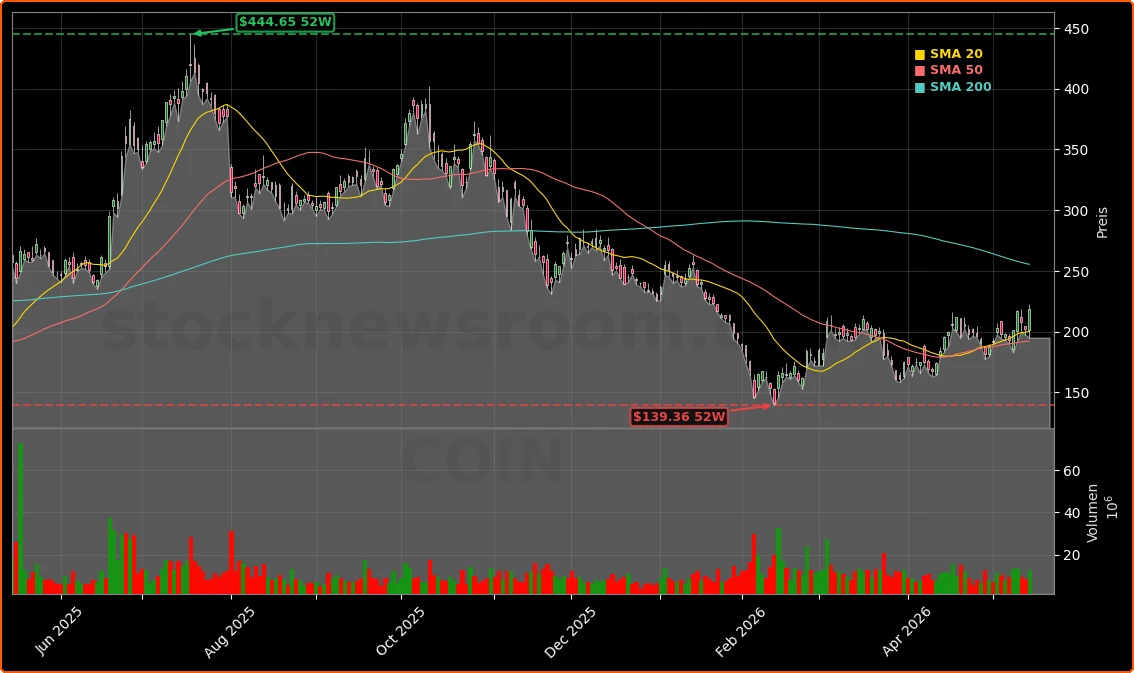
After a disappointing Q1, in which Coinbase Global, Inc. reported a loss of $1.49 per share versus expectations for a $0.27 profit, many investors expected COIN to stay under pressure. Softer crypto prices and lower retail trading volumes weighed on transaction revenue, reinforcing the view that Coinbase remains highly cyclical. Yet COIN is up about 8% today to $218.42 as institutional traders focus less on the backward‑looking quarter and more on structural growth drivers around stablecoins, tokenization and regulation.
The near‑term trigger is the Senate Banking Committee’s markup of the Digital Asset Market Clarity Act, often shortened to the CLARITY Act. The bill aims to clarify SEC versus CFTC jurisdiction and define digital commodity status, which would give U.S. exchanges like Coinbase a much cleaner rule book. Coinbase CEO Brian Armstrong framed the vote as a “big opportunity” to make the U.S. financial system faster and more accessible and argued that banks and Coinbase have effectively been partners for 14 years, now seeking to work together openly.
At the same time, single‑stock products such as GraniteShares’ leveraged and inverse ETFs tied to Coinbase highlight how central COIN has become to volatility strategies on the NASDAQ. For sophisticated traders, the stock is increasingly a proxy not only on Bitcoin but on the broader digital‑asset rails the company is building.
How does the Coinbase Stablecoin deal reshape DeFi?
The most tangible step in that direction is the new Coinbase Stablecoin push inside the Hyperliquid ecosystem. Coinbase will become the official USDC treasury deployer on Hyperliquid, effectively absorbing the USDH brand assets from Native Markets and replacing USDH as the primary quote asset across the decentralized perpetuals network. USDC, already roughly a $5 billion presence on Hyperliquid, will now sit at the center of an upgraded framework called AQAv2.
Under AQAv2, Coinbase has agreed to share the vast majority of reserve yield generated from Hyperliquid’s USDC balances back with the protocol. That mirrors and extends the “Aligned Quote Asset” model pioneered by USDH, in which stablecoin reserves tied to U.S. Treasuries and cash equivalents fund trading incentives, HYPE token buybacks and an Assistance Fund for ecosystem growth. Instead of fighting that model with a competing token, Coinbase is effectively adopting and scaling it, turning the Coinbase Stablecoin stack into a revenue‑sharing backbone for DeFi liquidity.
Circle will handle minting, redemption and cross‑chain infrastructure for USDC while also staking HYPE to align with the protocol. Coinbase has increased its own staked HYPE position as part of the arrangement, giving it deeper governance and economic exposure. With higher interest rates boosting yields on short‑term Treasuries, this structure could turn idle balances into an important, relatively stable income stream for Coinbase, even when spot trading slows.
What does this mean for institutional demand?
For U.S. and global institutions, the Coinbase Stablecoin strategy lines up with broader trends. Tokenized Treasury funds from heavyweights like BlackRock and Janus Henderson are starting to offer instant stablecoin redemptions through new credit facilities, shrinking settlement times from days to near‑zero and making blockchain rails practical for large allocators. Research from Grayscale has highlighted that a higher‑for‑longer rate environment pressures non‑yielding assets but directly benefits stablecoin issuers and tokenized fixed income platforms by lifting reserve income.
Corporate treasuries and asset managers appear to be leaning into this thesis. While U.S. spot Bitcoin ETFs have seen pockets of outflows, corporations accumulated tens of thousands of BTC in April, signaling that institutional capital is positioning for regulatory clarity and scalable on‑chain yield rather than short‑term price moves. For many of these players, a U.S.‑regulated venue with deep stablecoin infrastructure is the preferred entry point. That puts Coinbase in a different competitive set from pure trading apps like Robinhood or highly speculative miners, and more in line with infrastructure names that can monetize flows, custody and settlement.
On Wall Street, the launch of the GraniteShares 2x Long COIN Daily ETF and its inverse counterpart underlines how traders now view Coinbase as a core volatility instrument, similar in spirit to levered products on crypto‑exposed stocks like Tesla or MicroStrategy. An investor note on the long COIN ETF this week emphasized confidence in the structural story despite short‑term noise, encouraging investors not to “give in to the bears.”
How does Coinbase compare with other tech and payment names?
The pivot toward recurring, yield‑based revenues from the Coinbase Stablecoin ecosystem invites comparisons with payment networks and platforms rather than with speculative altcoins. Traditional fintechs such as PayPal and Block are also integrating stablecoins into their offerings, and JPMorgan has selectively increased positions in some crypto‑linked names while cutting others, including Coinbase, in recent quarters.
For diversified tech investors holding giants like NVIDIA and Apple alongside COIN, the key question is correlation and portfolio role. Coinbase will likely remain more volatile than mega‑cap tech and the S&P 500, particularly around regulatory headlines and crypto price swings. However, if stablecoin and tokenization revenues continue to scale, Coinbase could evolve into a hybrid between an exchange, a custody bank and a high‑margin software platform – a mix that is not easily replicated elsewhere on NASDAQ.
Relative to pure‑play meme or single‑asset products – such as Dogecoin‑focused ETFs that have seen heavy NAV drawdowns when sentiment turned – Coinbase offers broader exposure to infrastructure and regulation rather than just coin price direction. That may appeal to institutional allocators looking to balance upside from digital assets with business models that can generate cash flow in multiple market regimes.
Related Coverage
Investors looking for a deeper dive into how a weak quarter can coexist with a sharp move higher in the stock may want to read the analysis in Coinbase Earnings +7.7% Surge After Deep Quarterly Loss Shock. That piece explores how sentiment around regulation and long‑term ecosystem building can offset near‑term earnings disappointments.
In summary, the Coinbase Stablecoin expansion on Hyperliquid and the momentum behind the CLARITY Act are reshaping how investors value COIN, shifting the focus from pure trading volumes to recurring yield and regulatory positioning. For U.S. portfolios, Coinbase is increasingly a strategic bet on compliant stablecoin and tokenization infrastructure rather than a simple proxy on crypto prices. The next few quarters will show whether management can translate these structural tailwinds into steadier earnings, but for now Coinbase remains one of Wall Street’s highest‑conviction ways to play the institutionalization of digital finance.