Are Oklo Earnings and its multibillion-dollar cash war chest enough to justify the latest slide in this high-flying nuclear stock?

Do Oklo Earnings justify the latest stock pullback?
The newest Oklo Earnings report showed a Q1 2026 loss of $0.19 per share, roughly in line with Wall Street forecasts that centered around an $0.18–$0.20 per-share loss range. The result was significantly wider than the $0.07 loss a year ago, reflecting higher R&D and corporate spending as the company ramps its nuclear build-out. Net loss came in at $33.1 million, driven by a $51.2 million operating loss partially offset by $21.3 million in interest and dividend income from its investment portfolio.
Despite the red ink, Oklo’s balance sheet is the key story for U.S. investors. The company ended the quarter with about $2.5 billion in liquidity, including $1.6 billion in cash and equivalents and $0.9 billion in marketable securities, boosted by a $1.2 billion at-the-market equity raise completed during the period. Management reiterated guidance for 2026 cash used in operating activities of $80–$100 million and capital spending of $350–$450 million, signaling that the current cash position should comfortably fund several years of development without needing immediate additional equity.
How is Oklo deploying its capital across projects?
With no commercial revenue yet, the real substance behind Oklo Earnings lies in project milestones. The company is pushing forward across three pillars: power plants, advanced fuel and isotopes. On the power side, Oklo has begun initial work on its first Aurora powerhouse at the Idaho National Laboratory (INL), targeting commissioning in 2028. The company submitted its Preliminary Documented Safety Analysis for Aurora-INL to the Department of Energy and secured Nuclear Regulatory Commission (NRC) approval for its principal design criteria topical report, a critical step in de-risking the licensing path.
Oklo is also pursuing larger campuses aimed at data center and industrial customers. For its Aurora-Ohio project, the company filed PJM interconnection applications for a 1.2 gigawatt nuclear campus tied to a long-term power agreement with Meta Platforms. In Alaska, the Aurora-Eielson project advanced after Defense Logistics Agency Energy issued a notice of intent to award for a 5 megawatt electric, 60 megawatt thermal cogeneration facility at Eielson Air Force Base, where site characterization is now underway.
On the fuel front, Oklo reported early construction completion and final design for its Aurora Fuel Fabrication Facility at INL, with the next step being award of a full construction contract. A separate Tennessee Advanced Fuel Center is also moving toward NRC application filing and site preparation. Management emphasized a diversified fuel sourcing strategy that includes a long-term partnership with Centrus, access to government-sourced plutonium and recycling of surplus materials to support accelerated deployment.
What role do AI and partners like NVIDIA play?
Beyond hard assets, Wall Street’s enthusiasm around Oklo increasingly ties into AI-driven electricity demand. The company has built a customer pipeline across data centers, industrials, energy and government customers, mirroring themes seen at large-cap names like NVIDIA and Tesla where power availability is becoming a strategic bottleneck for AI and EV growth. Oklo’s collaborations are designed to place its microreactors at the center of that shift.
Oklo recently expanded its AI and simulation efforts through partnerships with Los Alamos National Laboratory and Idaho National Laboratory. These efforts leverage the Prometheus AI platform for reactor and fuel design, including the Pluto reactor concept using plutonium-bearing fuels, with the goal of compressing design cycles and enabling more rapid iteration than legacy nuclear programs. At the same time, a notable partnership with NVIDIA focuses on using advanced computing and AI to optimize reactor modeling and operations, directly tying Oklo’s strategy into the broader AI infrastructure narrative that has powered mega-cap tech and semiconductor stocks.
On the isotope side, Oklo completed construction of its Groves Isotope Facility in just 229 days and is preparing for reactor criticality targeted around July 4, 2026. The adjacent Idaho radiochemistry lab has received its NRC material handling permit, and Oklo expects its first commercial isotope contract to support initial revenue as soon as 2026—potentially the company’s first step out of the pre-revenue category that currently defines the Oklo Earnings story.
How are analysts and traders positioning around Oklo Earnings?
Options markets recently implied about an 11% potential move in either direction around the Q1 print, underscoring how volatile early-stage nuclear names can be on Wall Street. In the equity research community, views remain mixed but generally constructive. JPMorgan initiated coverage with a Neutral rating and an $83 price target, citing Oklo’s strong liquidity and exposure to structural electricity demand growth, while also warning about execution and permitting risk. Other firms, including Tigress Financial Partners and Texas Capital Securities, have adopted more bullish stances with higher targets, framing Oklo as a long-duration growth story within the small modular reactor space.
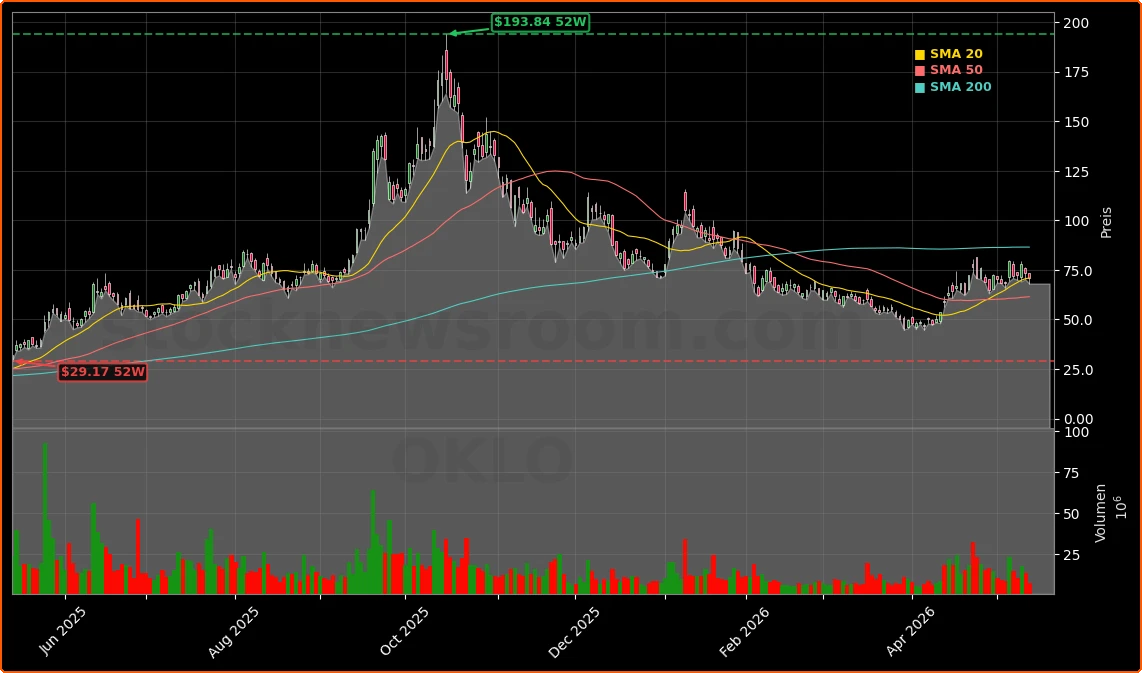
At the same time, short-term sentiment has been pressured by insider sale disclosures tied to Rule 10b5-1 plans and by profit-taking after the stock’s sharp run earlier in the year. With shares now down roughly 5% year to date and more than 60% below their all-time high near $200, valuations have come off frothy levels but still embed high expectations that Oklo will hit its 2028 reactor start-up goal and scale into multi-gigawatt campuses serving hyperscalers like Meta, alongside potential customers such as Apple and other S&P 500 technology giants that need reliable carbon-free power.
Related Coverage
For Oklo, the story has increasingly moved from strategy to execution.— Jacob DeWitte, CEO of Oklo Inc.
For a deeper dive into how Oklo is tying its nuclear microreactor roadmap to AI infrastructure demand, see this analysis of the Oklo NVIDIA partnership and its impact on AI power strategy, which explores whether the company can evolve from a speculative bet into a core pillar of data center energy supply.