

Can blockbuster Shopify Earnings and 34% revenue growth outweigh a sharp share-price slide and fresh analyst target cuts?

How did Shopify’s Q1 numbers surprise Wall Street?
Shopify Inc. turned in another high‑growth quarter to start 2026. First‑quarter revenue climbed roughly 34% year over year to about $3.17 billion, topping consensus estimates of around $3.09 billion by nearly 3%. In constant currency, revenue advanced about 32%, underscoring that demand strength was broad‑based and not just a FX tailwind. GMV surged to roughly $101 billion, up about 35% from a year earlier, helped by a balanced mix of higher spending from existing merchants and new merchant additions.
These Shopify Earnings extend a multi‑quarter streak of outperformance that already included Q4 2025 revenue of about $3.67 billion, up more than 30% year over year and ahead of expectations. Management is also backing growth with capital returns, having approved a $2 billion share repurchase program effective in February 2026. For investors tracking high‑growth software on the NASDAQ alongside names like NVIDIA and Apple, Shopify continues to post the kind of top‑line expansion that justifies its status as a premium ecommerce and software platform.
Why is the stock down despite solid Shopify Earnings?
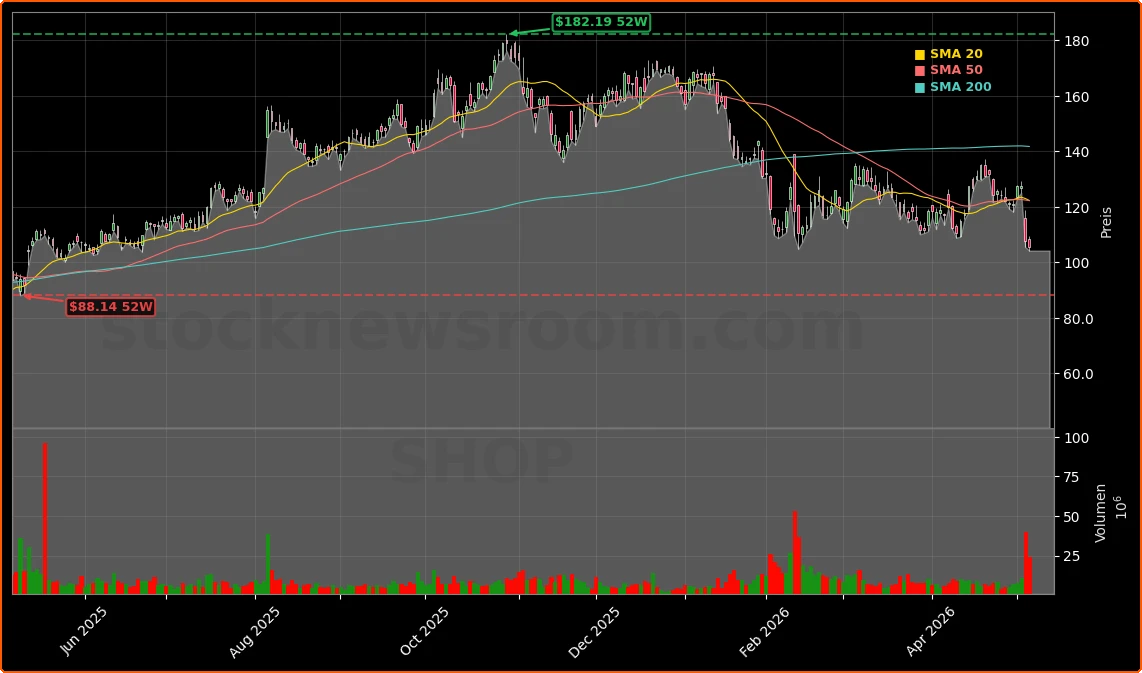
Even with the beat, the market reaction has been harsh. Shopify (SHOP) is down more than 30% year to date, sliding from December 2025 highs near $163 to about $105.44 on Wednesday, with after‑hours trading essentially flat at $105.43. That decline accelerated when investors looked past headline Shopify Earnings and focused on guidance and valuation. For Q2, management projected revenue growth in the high‑20% range, slightly above consensus of around 28% but implying a modest deceleration from Q1’s constant‑currency pace.
On its own, high‑20s percentage growth would be enviable for most software and internet stocks in the S&P 500 and NASDAQ 100. The challenge is that Shopify still trades at a steep earnings multiple: trailing P/E sits in the triple digits, and forward P/E projections remain well over 100. With net income having dropped in Q4 2025 amid mark‑to‑market hits on equity investments and rising loss provisions in its lending arm, investors are less willing to underwrite perfection. The result is a tug‑of‑war between powerful operational results and a market that is rapidly repricing high multiple growth assets.
How are analysts reacting to Shopify Earnings?
Wall Street remains broadly positive on Shopify Inc., but several firms have trimmed their expectations. At DA Davidson, analyst Gil Luria reiterated a Buy rating but slashed his price target from $195 to $140. Luria argues that the first‑quarter performance shows Shopify’s growth investments are working, pointing to continued momentum in GMV and a still‑healthy revenue trajectory. He views the recent sell‑off as a chance for investors to buy a quality name at a discount.
Wells Fargo followed a similar pattern. Analyst Ken Gawrelski maintained an Overweight stance while cutting his target from $166 to $144, acknowledging the reset in valuation while still seeing upside from current levels. At Citizens, analyst Andrew Boone kept a Market Outperform rating but nudged his target down from $160 to $150. Across the Street, many firms continue to highlight Shopify’s durable 30%‑plus revenue growth and rising free cash flow as reasons to stay constructive, even as they dial back aggressive price targets to reflect higher rates and a more selective risk backdrop for growth stocks.
What should U.S. investors watch next?
For American portfolios already exposed to ecommerce via Tesla’s online sales model or digital advertising heavyweights like Apple, Shopify offers a different angle: a scaled infrastructure play on global online retail. The company’s merchant solutions revenue, including payments and capital, continues to expand rapidly alongside GMV, while AI‑driven tools such as intelligent agents and catalog automation are designed to deepen its moat. Shopify now controls a significant share of U.S. ecommerce volume, positioning it as a structural winner if online penetration keeps climbing.
Still, risk factors matter. Transaction and loan losses have risen in tandem with the growth of Shopify Capital’s roughly $1.7 billion loan portfolio, and any consumer slowdown could pressure both GMV and credit performance. Macro headwinds—from higher tariffs to cautious discretionary spending—are already weighing on parts of the retail sector. For now, though, consensus expectations still call for low‑30s percentage revenue growth over the next year and mid‑teens free‑cash‑flow margins. If those assumptions hold, current levels near $105 may look attractive in hindsight relative to many other richly valued NASDAQ software names.
Related Coverage
Investors looking for a deeper dive into the latest Shopify Earnings and the GMV milestone can read Maik Kemper’s detailed analysis in “Shopify Earnings Record as GMV Tops $100B but Outlook Warns”. That piece explores whether record results and the $100 billion GMV mark are enough to offset a softer outlook that has put parts of Wall Street on alert.
In the end, the latest Shopify Earnings reinforce the company’s status as a high‑growth ecommerce infrastructure leader, even as its share price reflects a harsher environment for expensive growth stocks. For long‑term U.S. investors able to tolerate volatility, the combination of double‑digit revenue growth, expanding free cash flow and a more reasonable entry point could be compelling. The next quarterly update will show whether Shopify can maintain its growth tempo and begin to rebuild investor confidence from today’s lower base.