Can record Shopify Earnings and a $100 billion GMV milestone outweigh a softer outlook that suddenly has Wall Street on edge?

How did Shopify Earnings stack up against forecasts?
Shopify Inc. (SHOP) reported adjusted earnings of $0.36 per share for Q1 2026, beating consensus estimates of around $0.33 and rising 44% from $0.25 a year ago. Revenue climbed 34% year over year to $3.17 billion, ahead of expectations near $3.08 billion. The beat was driven by broad-based strength in both subscription and merchant solutions as well as accelerating adoption of Shopify’s payments and financing tools.
Despite the headline beat, some key profitability metrics underwhelmed. Operating income rose 88% to $382 million, but that fell short of analyst expectations near $420 million, and net income excluding equity investments reached about $360 million, below Wall Street hopes of roughly $419 million. On a GAAP basis, Shopify still reported a net loss of $581 million, largely due to non-cash losses on equity and other investments that run through its income statement.
Importantly for cash-focused investors, Shopify generated $476 million in free cash flow, maintaining a healthy 15% free cash flow margin, unchanged from the prior year. That combination of strong growth and double-digit cash margins remains a central bullish argument around the latest Shopify Earnings report, even as near-term sentiment wobbles.
Did Shopify’s growth engine hit a new gear?
By one key metric, Shopify’s scale has entered a new league. Gross merchandise volume (GMV) – the value of all orders processed on the platform – jumped 35% to $100.7 billion in the quarter, breaking through the $100 billion mark for the first time in company history. That performance edged past market expectations near $99.6 billion and underscores Shopify’s expanding role in global commerce, from small merchants to large brands.
Subscription solutions revenue rose 21% to $750 million, supported by rising monthly recurring revenue (MRR), which increased to $212 million from $182 million. Merchant solutions, which include payments, capital, and other transaction-based services, surged 39% to $2.42 billion. The faster growth in merchant solutions highlights how Shopify is monetizing more of the payment and logistics stack around its core software – a trend that often draws comparisons with players like Apple’s services ecosystem and NVIDIA’s software-enhanced hardware model.
Management emphasized that growth was broad-based across geographies, merchant sizes, and sales channels, including online, in-store point-of-sale, and business-to-business commerce. That diversification may help Shopify navigate macroeconomic bumps, but it also demands ongoing investment, particularly in payments risk management, where transaction and loan losses rose to $116 million from $75 million.
What does the outlook say about Shopify Earnings momentum?
Investors appear most unsettled by what comes next. For Q2 2026, Shopify guided for revenue to grow at a high-twenties percentage rate year over year, with gross profit dollars increasing at a mid-twenties rate. That marks a step down from the 34% revenue growth just delivered and signals a more moderate trajectory than some high-multiple growth investors had priced in.
Operating expenses are expected to land at 35% to 36% of revenue, indicating that Shopify will continue to invest aggressively in sales, marketing, and product development rather than squeezing margins in the near term. Stock-based compensation is projected at about $145 million for the June quarter, reinforcing that dilution remains a factor for equity holders.
President Harley Finkelstein said the company has entered the “AI era” with two decades of commerce data as an edge, while CFO Jeff Hoffmeister highlighted the ability to reinvest in merchant-facing AI tools and internal capabilities to “build and ship faster.” Those comments echo recent moves by Shopify to partner with leading AI platforms and to add features such as agentic shopping assistants, areas where it could eventually intersect with ecosystems built by Tesla (for in-car commerce) and other next-generation interfaces.
How is Wall Street reacting to Shopify Earnings?
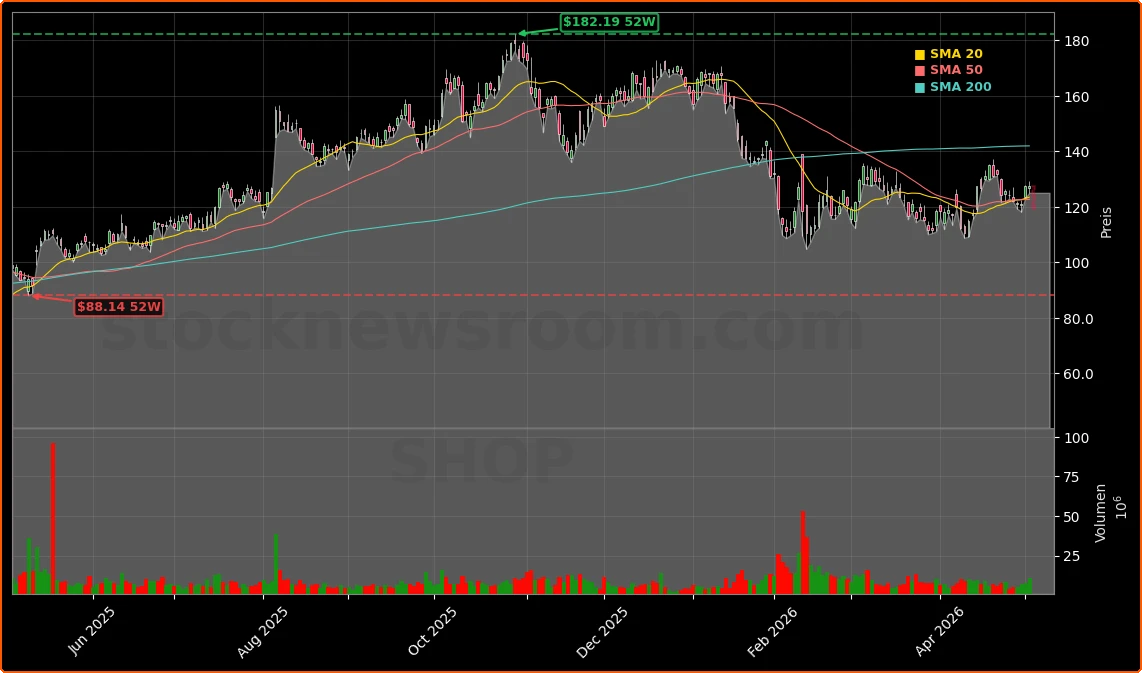
Despite the beat on adjusted EPS and revenue, Shopify stock is under pressure. The shares closed at $127.55 on Monday and are trading around $119.30 in pre-market action, down roughly 6.5%. Year to date, the stock had already fallen about 21% through Monday’s close, even after a strong 2025 performance, as investors reassessed software valuations and weighed the risk that generative AI platforms could reshape e-commerce software demand.
Analyst sentiment remains broadly constructive but more cautious on valuation. Citigroup analyst Tyler Radke maintains a Buy rating but recently trimmed his price target from $172 to $163. Wells Fargo’s Ken Gawrelski is still Overweight, though he cut his target from $191 to $166. Piper Sandler’s James Callahan initiated coverage with an Overweight and a $165 target, while Truist Securities’ Terry Tillman upgraded Shopify from Hold to Buy in February, raising his target from $110 to $150. RBC Capital’s Paul Treiber continues to rate the stock Outperform but cut his target from $200 to $170.
For U.S. investors benchmarking against the NASDAQ and S&P 500, Shopify remains a volatile but influential e-commerce name whose moves can ripple through related software and retail-tech stocks. Concerns about slowing growth and intensifying AI competition from players like Apple and other platform giants are now being weighed against Shopify’s still-impressive combination of scale, growth, and free cash flow.
Shopify has entered the AI era with a clear edge: strong, durable growth and two decades of commerce intelligence.— Harley Finkelstein, President of Shopify Inc.
In summary, the latest Shopify Earnings report confirms that the core business is firing on many cylinders, but it also exposes just how high expectations have become. The next few quarters will need to validate the company’s AI-driven strategy and its ability to sustain high-twenties growth for the stock to regain leadership status in growth-oriented portfolios.