
Can the Palantir AI Strategy turn explosive growth into a sustained stock rerating, or will rich valuations keep investors on edge?

Is Palantir’s stock lagging the AI boom?
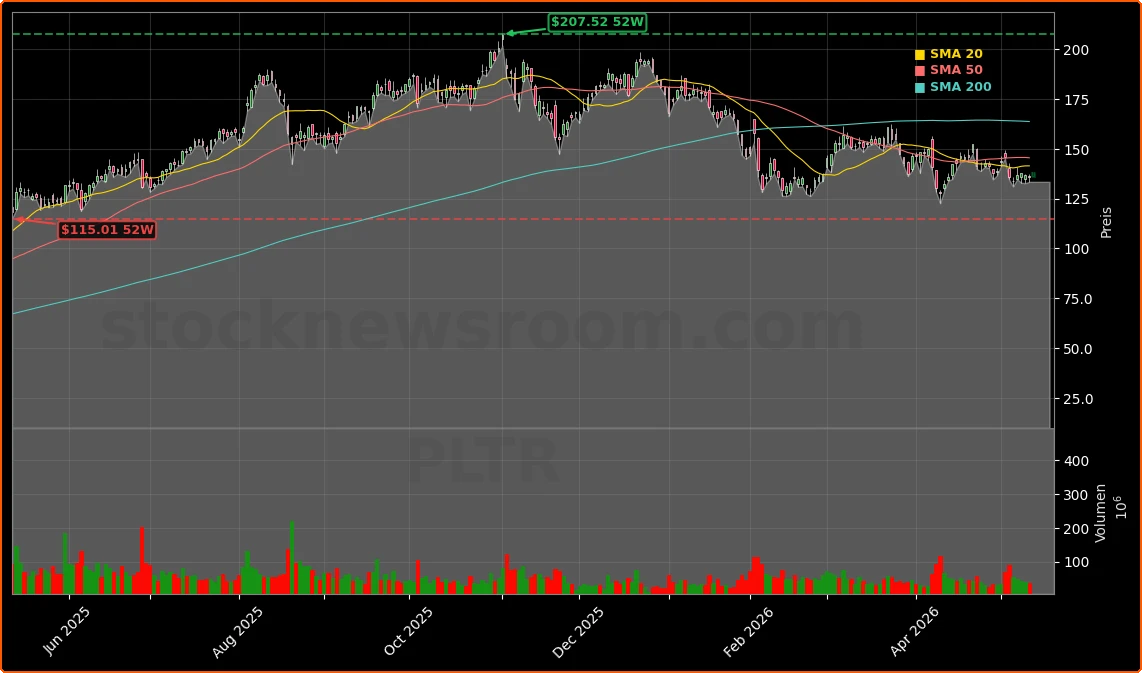
Despite the hype around artificial intelligence, Palantir Technologies Inc. has underperformed the broader market in 2026. Over the past 12 months, the stock has gained about 15.6%, while the S&P 500 returned more than 30%. Year to date, Palantir is down roughly 22.5% versus an 8% gain for the index, even as AI leaders like NVIDIA and cloud giants Amazon and Alphabet posted much stronger returns. At Tuesday’s $136.00 close and $138.32 after-hours quote, PLTR trades meaningfully below its 200-day moving average near $164, signaling investors are still digesting both its rapid growth and elevated valuation.
Yet the underlying business momentum is hard to ignore. Q1 2026 revenue jumped 85% year over year, with U.S. commercial revenue up an eye-catching 133% and U.S. government revenue growing 84%. U.S. revenue overall more than doubled, up 104%. That puts Palantir firmly among the fastest-growing large-cap software names on NASDAQ, even if the share price has moved sideways since November.
How does the Palantir AI Strategy drive growth?
The core of the Palantir AI Strategy is a three‑product stack: Gotham for defense and intelligence customers, Foundry for commercial enterprises, and the Artificial Intelligence Platform (AIP), which has become the primary engine of growth in the U.S. commercial segment. AIP allows clients to deploy AI agents on top of their operational data, aiming to turn complex workflows into automated decisions across manufacturing, logistics, finance, and national security.
Management emphasizes “forward-deployed engineers” who work on-site with customers, an operational model now being echoed by enterprise software heavyweight SAP. SAP is deepening its partnership with Palantir and integrating advanced models from Anthropic’s Claude directly into its Business AI Platform. That collaboration effectively embeds elements of the Palantir AI Strategy into SAP’s global customer base, creating a potential distribution catalyst for AIP-powered solutions across large corporations that already standardize on SAP infrastructure.
Financially, earnings are now starting to catch up with the story. Reported EPS rose from $0.13 in Q1 2025 to $0.33 in Q1 2026, while free cash flow guidance for the year stands at $4.2–$4.4 billion. Palantir’s “Rule of 40” score — revenue growth plus operating margin — hit an exceptional 145%, a level only a handful of AI software peers can match.
Is valuation the main risk for Palantir Technologies Inc.?
Even after the 2026 selloff, PLTR still trades on a rich multiple. Forward P/E is around 93, down from roughly 150 on a trailing basis, but still pricing in a long runway of high growth. The market has effectively already assumed Palantir will hit the top end of its 2026 revenue guidance range of $7.182–$7.198 billion and repeat strong expansion into 2027. Any disappointment could trigger a derating, particularly with a beta of about 1.5 amplifying market swings.
Stock-based compensation remains a pressure point for institutional investors. In FY 2025, Palantir paid roughly $684 million in SBC against $1.625 billion in GAAP net income, diluting some of the headline profitability. In addition, termination-for-convenience clauses and long sales cycles make that 133% U.S. commercial growth rate one of the most volatile lines in the income statement. Options markets currently cluster one‑week expectations between $132 and $138, with traders pricing a roughly three‑in‑four probability of a down close in the near term.
Analyst sentiment is cautiously constructive. Across 32 analysts tracked on Wall Street, the consensus target sits near $153, implying around 12% upside from Tuesday’s close. The mix skews bullish, with a majority in the Buy or Overweight camp and only a small minority recommending Sell. Large houses such as Morgan Stanley, Goldman Sachs, and Citigroup have highlighted Palantir as a key AI software exposure, but they also consistently flag valuation and execution risk, especially if U.S. government budgets tighten.
What would validate the Palantir AI Strategy on Wall Street?
From here, the Palantir AI Strategy must be validated quarter by quarter. Investors will focus on three metrics in the upcoming Q2 report: sustainability of triple‑digit U.S. commercial growth, maintenance of a high Rule of 40 score, and the resilience of U.S. government revenue once federal budget cycles reset. A breakout above the 200‑day moving average around $163.93 on a beat‑and‑raise Q2 print would likely be viewed as a bullish re‑rating signal, suggesting the market is willing to expand the multiple again for a proven AI compounder.
The bearish scenario would be a sharp slowdown, particularly if U.S. commercial growth dips below 100% year over year. That would undercut the acceleration narrative at the heart of the Palantir AI Strategy and could push the forward multiple down toward more conventional software valuations. For U.S. portfolios already heavy in high‑beta AI names like NVIDIA or high‑growth automakers such as Tesla, Palantir offers a different angle: software and data platforms directly embedded in mission‑critical government and industrial workflows.
Related Coverage: How do recent earnings fit in?
Investors looking for a deeper dive into Palantir’s most recent results can review detailed coverage of Palantir’s 85% revenue surge and valuation debate, which analyzes how the latest quarterly numbers stack up against the company’s rich earnings multiple. That article also discusses how the stock’s sharp reset this year has shifted the risk‑reward profile for long‑term AI investors and where consensus expectations may still be too optimistic or too cautious.
In summary, the Palantir AI Strategy is delivering exceptional operating performance, but the stock is still working through a period of multiple compression after years of outsized gains. For U.S. investors, the combination of SAP‑driven enterprise exposure, government contracts, and strong free cash flow makes Palantir a distinctive AI software play. The next few quarters will show whether growth can stay fast enough to justify a premium price, and whether Palantir can turn today’s skepticism into tomorrow’s upside.