

Can blockbuster Palantir Earnings and a fresh U.S. Army AI push really justify the stock’s lofty valuation from here?

How are Palantir Earnings reshaping the AI story?
The most recent Palantir Earnings report for Q1 2026 underscored just how aggressively the company is scaling inside the AI software stack. Revenue jumped 85% year over year to $1.633 billion, marking the 11th straight quarter of accelerating growth. Adjusted earnings per share rose from $0.12 to $0.33, driven by a 152% surge in adjusted operating income, signaling that Palantir is not just growing fast but gaining operating leverage.
On the back of those Palantir Earnings, management lifted full‑year 2026 revenue guidance to a range of $7.65 billion to $7.662 billion, well above its prior outlook of roughly $7.18 billion to $7.20 billion. Guidance for Q2 2026, at $1.797 billion to $1.801 billion, also came in well ahead of consensus, reinforcing the view that demand for its Artificial Intelligence Platform (AIP) remains robust across commercial and government clients.
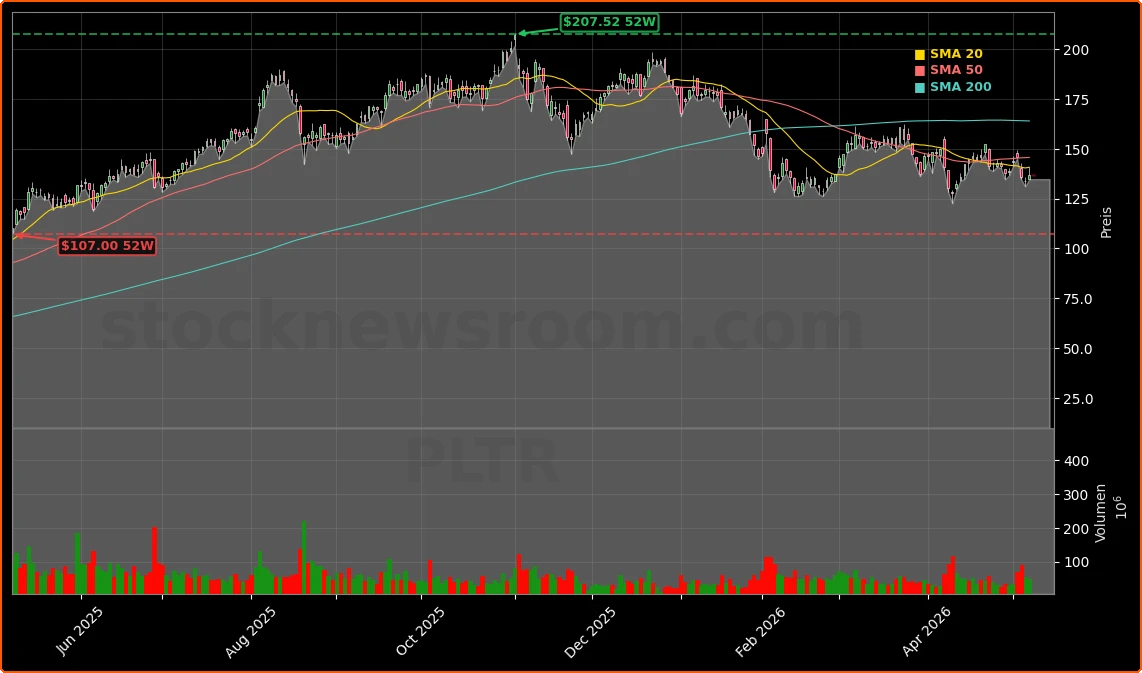
Yet despite the strength of the Palantir Earnings print, the stock initially sold off roughly 6% as investors focused on a book‑to‑bill ratio below 1.0 and the sheer level of expectations embedded in the share price. With PLTR now trading about 36% below its 52‑week high and still valued richly versus slower‑growing software peers, the market is wrestling with how long the current growth cadence can last.
Is Palantir Technologies Inc. delivering sustainable AI growth?
Beneath the headline Palantir Earnings numbers, several operational metrics highlight why some analysts see the company as one of the most important AI infrastructure plays on the market. U.S. commercial revenue surged 133% to $595 million in the quarter, with remaining deal value up 112% to $4.92 billion. Net revenue retention reached an eye‑catching 150%, meaning existing customers are expanding their spend aggressively as they roll out more AI‑driven use cases.
Government revenue also accelerated, rising 76% year over year to $858 million, including 84% growth in U.S. government sales. International government and commercial units contributed additional double‑digit gains, though management still treats international commercial as a secondary focus. Customer counts moved higher across the board, with U.S. commercial customers up 42% year over year and total customers rising 31%.
For U.S. investors comparing Palantir’s trajectory to mega‑cap AI leaders like NVIDIA or platform names such as Apple and Tesla, the key distinction is that Palantir sits higher in the software stack. Its ontology and orchestration layers are designed to connect large language models and other AI tools to real‑world operations in a governed, auditable way. Bulls argue that this makes Palantir an AI‑native disruptor, not just a wrapper around third‑party models, and that it could support premium growth and margins for years if adoption continues at current levels.
What does the U.S. Army hackathon mean for Palantir?
While Palantir Earnings have dominated headlines, today’s price move also reflects renewed optimism around the company’s entrenched role in U.S. defense. The firm announced it will join the U.S. Army’s “Right to Integrate” hackathon sprint, an interoperability initiative designed to ensure that offensive and defensive weapon systems and back‑office platforms can share data seamlessly across the force.
For Palantir Technologies Inc., the hackathon is an opportunity to showcase the same integration and ontology capabilities that impressed investors in the latest quarter, but applied directly to mission‑critical defense applications. Government revenue has historically been a key pillar of Palantir’s story, and a visible win with the Army could help reaccelerate government deal flow relative to its blistering commercial business.
The event also lands at a time when defense‑tech has become a recognized sub‑theme within AI investing, alongside chipmakers like NVIDIA and cloud hyperscalers. Palantir already carries significant weight in sector ETFs, including almost 9% of the iShares Expanded Tech‑Software Sector ETF. A stronger perceived pipeline with the Department of Defense could reinforce its role as a core AI‑defense holding in institutional portfolios.
How are Wall Street analysts reacting to Palantir Earnings?
Opinions on Palantir’s valuation remain sharply divided despite the blowout Palantir Earnings. On the bullish side, Rosenblatt Securities analyst John McPeake raised his price target from $200 to $225 after the Q1 report, maintaining a Buy rating and highlighting Palantir’s ontology as a key competitive moat for enterprise AI. Wedbush went even further with a $230 target, while Citigroup also boosted its target to $225 and kept a Buy stance.
Other firms are more cautious. DA Davidson trimmed its target from $180 to $165 with a Neutral rating, and RBC Capital has stuck to a bearish $90 target and Underperform rating. Across Wall Street, the stock now carries a consensus Buy rating with an average price target around $174, implying upside from today’s $137 handle but also reflecting substantial dispersion between bulls and bears.
Options markets are similarly active. PLTR options volume has spiked, with heavy trading in calls around the $140–$145 strikes and short‑dated expirations, suggesting traders are positioning for continued volatility following the earnings‑driven repricing. For investors used to steadier mega‑caps like Apple, Palantir remains a higher‑beta way to play the AI software wave.
Related Coverage
Investors looking for a deeper dive into how expectations built up ahead of the latest report may want to read “Palantir Earnings +70% Surge: High-Stakes AI Boom Test”, which analyzes whether Palantir’s growth can keep pace with Wall Street’s aggressive AI narrative. That piece explores how prior quarters set the stage for today’s debate over valuation, momentum, and the durability of Palantir’s competitive edge.
In summary, the latest Palantir Earnings, raised outlook and U.S. Army interoperability push underline how central Palantir Technologies Inc. has become to both enterprise AI and modern defense infrastructure. For U.S. investors, the stock offers rare exposure to hyper‑growth AI software at scale, but with the volatility and execution risk that come with a premium multiple. The next few quarters of Palantir Earnings will be critical in proving whether this momentum can justify the bullish price targets and keep the shares climbing from today’s still‑elevated base.