
Can Robinhood’s IPO push and prediction markets turn a trading app into a full-scale Wall Street disruptor?

What’s Driving Robinhood’s Record Traffic?
Robinhood Markets, Inc. experienced unprecedented platform load on Friday, June 12, during the historic SpaceX IPO — the largest in history at over $2 trillion valuation. Systems briefly hiccuped before stabilizing, a sign of scale rather than fragility. As one of only five retail brokers granted direct IPO allocation (alongside Fidelity, Schwab, SoFi, and E*TRADE), Robinhood enabled its 27.7 million funded customers to participate in real time. Pre-market trading surged 3.5% on Friday, and the momentum carried into Monday’s session. This traffic spike wasn’t incidental — it validated Robinhood’s infrastructure investment and its strategic bet on democratizing access to high-growth private companies before they go public. With NVIDIA, Tesla, and Apple all having spent years in private markets before public debuts, the demand for earlier access is intensifying.
How Does Robinhood IPO Expansion Change the Game?
Regulatory approval for Robinhood’s securities division to operate as a registered IPO underwriter marks a definitive inflection point. This Robinhood IPO Expansion moves the firm beyond distribution into fee-rich syndicate participation — a domain long dominated by Goldman Sachs, Morgan Stanley, and J.P. Morgan. Unlike legacy banks, Robinhood’s model integrates retail order flow directly into the book-building process. Bernstein analysts note the underwriting unit could contribute $120–$180 million in annual revenue by 2027, assuming just 3–5 mid-cap IPOs per quarter. The timing was no accident: approval landed just days before SpaceX’s debut, allowing Robinhood to co-lead — not just distribute — the deal. This isn’t incremental; it’s structural. As CEO Vlad Tenev stated, ‘Make everyone an owner’ isn’t a slogan — it’s a capital markets architecture project.
Why Is the World Cup a Catalyst for Revenue?
The 2026 FIFA World Cup isn’t just a cultural event — it’s Robinhood’s largest real-world test of its prediction markets platform. Partnering with Rothera (a CFTC-regulated exchange co-owned with Susquehanna International Group), Robinhood now routes match outcome, tournament winner, and total goals contracts natively — bypassing third-party platforms like Kalshi. Bernstein estimates the tournament could generate $5–$10 billion in consumer volume and drive 650,000 incremental funded prediction accounts. Prediction markets are already running at a $415 million annualized revenue rate and are projected to hit $586 million by year-end — roughly 17% of Robinhood’s transaction-based revenues. That growth trajectory rivals early-stage fintech verticals and strengthens HOOD’s case as a diversified financial technology platform, not just a brokerage.
What Do Insiders and Analysts Say?
Insider activity reveals a split but constructive picture: Director Meyer Malka’s fund acquired $15.1 million in HOOD shares on June 3, while Chief Legal Officer Daniel Gallagher sold $836,771 under a pre-arranged 10b5-1 plan. Neither action contradicts the broader strategy — Malka’s buy signals board-level confidence in the Robinhood IPO Expansion roadmap, while Gallagher’s sale fits a long-standing plan amid a 22% year-to-date gain. On the analyst front, RBC Capital Markets upgraded HOOD to ‘Outperform’ with a $112 price target, citing ‘underappreciated revenue optionality in underwriting and prediction markets.’ Citigroup reiterated its ‘Buy’ rating, noting ‘HOOD’s path to $2 billion in annual revenue is now materially de-risked.’ The stock’s Growth score sits in the 92nd percentile (Benzinga Edge), far outpacing its Momentum score at the 45th percentile — a classic sign of fundamentals accelerating ahead of price.
How Does This Fit Into the Broader Market?
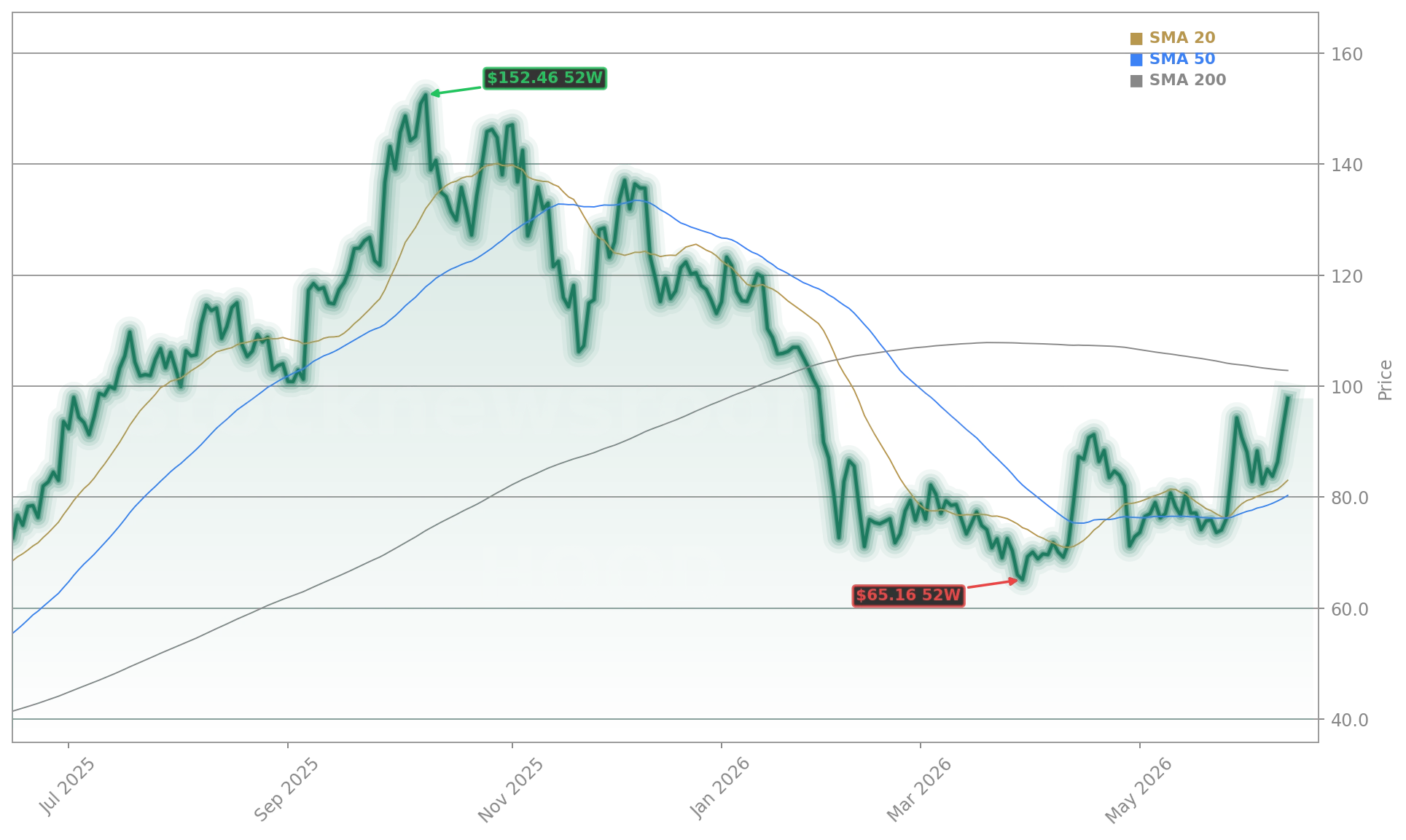
HOOD’s rally comes as the NASDAQ Composite gains 1.2% and the S&P 500 climbs 0.8% — a backdrop of broad tech strength and easing geopolitical concerns. Its performance stands in contrast to MicroStrategy (MSTR), which dropped 8.2% last week amid insider sales and Bitcoin volatility. While MSTR remains tethered to crypto speculation, Robinhood Markets, Inc. is diversifying into regulated, scalable, and recurring revenue lines — IPO underwriting, prediction markets, and margin lending. With a 52-week high of $102.40, HOOD is trading just 4.5% below that peak — suggesting further upside remains if Q2 2026 execution meets expectations. The stock’s valuation remains reasonable relative to its growth vector, especially compared to peers like SoFi Technologies, which trades at 5.2x forward sales versus HOOD’s 3.7x.
Robinhood Markets, Inc. is executing a bold, multi-pronged Robinhood IPO Expansion that transcends brokerage. The SpaceX traffic validated demand. The underwriting license unlocked revenue. The World Cup proved scalability. For U.S. investors, HOOD is no longer just a trading app — it’s a growth platform at the center of retail capital formation. The next quarterly earnings will show whether transaction-based revenue and prediction markets growth accelerate as projected. For long-term portfolios, HOOD’s expanding role in the equity ownership ecosystem makes it a compelling strategic holding.
Make everyone an owner.— Vlad Tenev, CEO of Robinhood Markets, Inc.
Related coverage: Robinhood IPO Underwriting Sends HOOD Up 5.5% on Approval details how the firm’s new underwriting license is reshaping Wall Street’s IPO hierarchy. Meanwhile, MicroStrategy Insider Sale: MSTR Drops 8.2% on Warning highlights how divergent strategies — crypto-centric speculation versus diversified financial infrastructure — are playing out across the fintech space.