
Can the Robinhood PDT Rule shake-up turn small accounts into a lasting growth engine for HOOD?

What Does the Robinhood PDT Rule Elimination Mean for Retail Traders?
For the first time since 1999, U.S. retail traders with accounts under $25,000 can now execute unlimited day trades without restriction. The old rule — which flagged accounts making four or more day trades in five business days — has been replaced by a dynamic, security-specific intraday margin framework that assesses risk per trade rather than applying a blanket wealth test. Robinhood Markets, Inc. responded instantly, wiping all historical PDT flags and announcing ‘No more $25K minimum, no more flags’ on X. With 27.4 million funded customers — many holding sub-$10,000 balances — the company is uniquely positioned to convert newly liberated activity into transaction revenue, margin interest, and Gold subscription growth.
How Does HOOD Compare to Webull and Interactive Brokers?
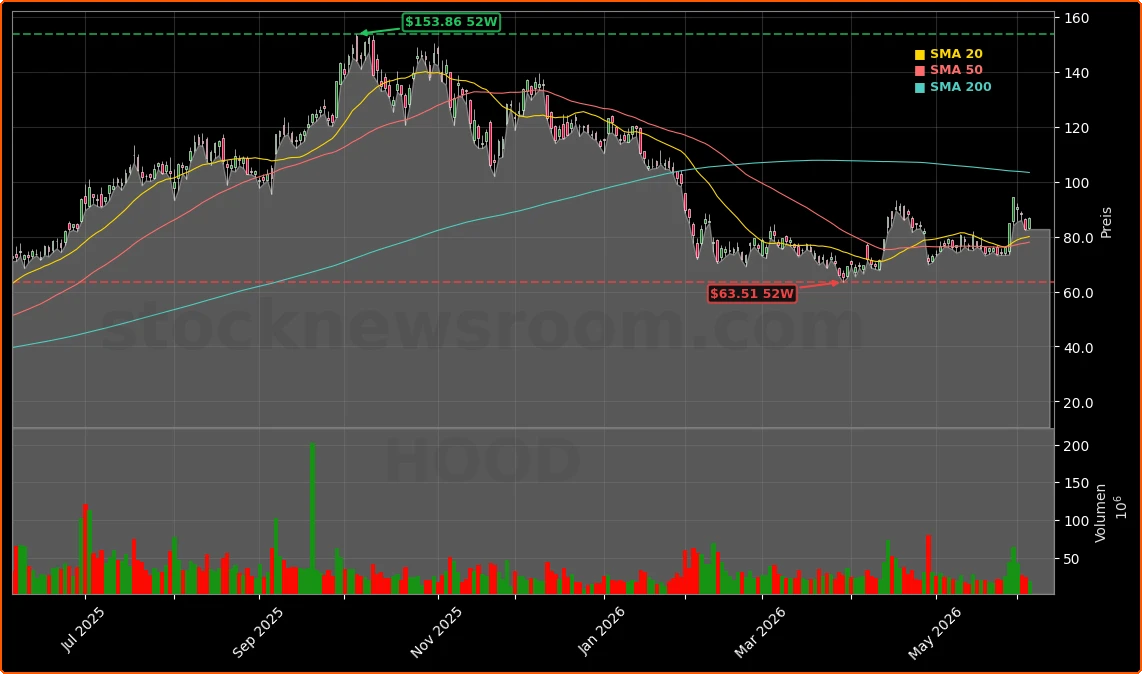
While Webull Corp. (BULL) and Interactive Brokers Group (IBKR) also stand to benefit, their exposure differs sharply. Webull, with an average account size under $5,000, expects at least a 20% lift in transaction volume and is targeting account consolidation among active small-balance traders. Interactive Brokers, by contrast, serves a wealthier, more institutional base — its 3.24% intraday drop on June 4 reflects muted near-term upside. Robinhood Markets, Inc. sits in the sweet spot: high retail density, aggressive product rollout, and a $17 billion margin book primed for expansion. Its $86.99 share price — up 5.00% on the day — outperformed both peers as investors priced in structural volume tailwinds.
Is the Q1 2026 Miss a Red Flag or a Smoke Screen?
Robinhood Markets, Inc. reported Q1 2026 revenue of $1.067 billion — 6.07% below consensus — driven by a 47% YoY collapse in crypto revenue to $134 million. Yet beneath the noise, the core business accelerated: equities revenue rose 46%, event contracts surged 320%, and net interest revenue climbed 24% to $359 million. Gold subscribers hit a record 4.3 million (+36% YoY), and the U.S. Treasury selected Robinhood as sole initial trustee for Trump Accounts. Analysts at RBC Capital Markets reiterated their ‘Outperform’ rating, citing ‘margin book resilience and Gold monetization as durable drivers beyond crypto cycles.’ The 43x trailing P/E remains elevated, but the 2.29 beta reflects genuine optionality in the new retail trading regime.
Why Did Ribbit Capital’s Malka Buy 249,000 Shares?
On May 28, 2026, Meyer ‘Micky’ Malka — Robinhood Markets, Inc. board member and Ribbit Capital founder — purchased 249,000 Class A shares at an average $80.39, the only meaningful open-market insider buy amid routine 10b5-1 selling by CEO Vlad Tenev and other executives. Crucially, two days prior, a Ribbit-affiliated entity established a FLEX put collar ($100/$75/$45) expiring December 2027 — signaling conviction with prudent risk management. This wasn’t a blind bet: it was a fintech specialist stepping in at $80.39, well below the $153.86 52-week high and amid a 26.8% YTD drawdown. As Citigroup noted in its June 3 update, ‘Malka’s action validates the valuation floor — especially as the Robinhood PDT Rule removal unlocks a multi-year volume inflection.’
What’s Next for Robinhood’s Margin and IPO Access Strategy?
Eliminating the $25,000 PDT threshold removes an arbitrary wealth barrier that has penalized smaller accounts for decades.— Anthony Denier, CEO of Webull Corp.
Robinhood Markets, Inc. is already capitalizing on broader market momentum: it’s among the select platforms — alongside Charles Schwab and Fidelity — offering retail investors direct access to the $75 billion SpaceX IPO at $135 per share on June 12. With up to 30% of the offering reserved for retail, Robinhood’s role as a gateway for mass-market participation reinforces its strategic positioning. The company also refreshed its $1.5 billion share repurchase program in March, buying back $250 million in Q1 at ~$81. With the Robinhood PDT Rule now obsolete, the path forward is clear: accelerate margin book growth, deepen Gold engagement, and leverage its infrastructure to capture new waves of retail capital — from SpaceX to NVIDIA, Tesla, and Apple options traders alike.