Can SoFi’s record-breaking quarter overcome Wall Street’s doubts about its tech platform and lending-heavy growth story?

Why did Wall Street sell SoFi on strong results?
The Q1 2026 SoFi Earnings report checked most of the major boxes. Adjusted net revenue jumped 41% year over year to a record $1.1 billion, beating the roughly $1.05 billion consensus. GAAP net income reached about $167 million, or $0.12 per share, doubling from $0.06 a year earlier and landing in line with expectations. Adjusted EBITDA surged 62% to $340 million, implying a robust 31% margin and marking the 18th consecutive quarter where SoFi cleared a Rule‑of‑40 style hurdle with a combined revenue growth plus margin figure above 40%.
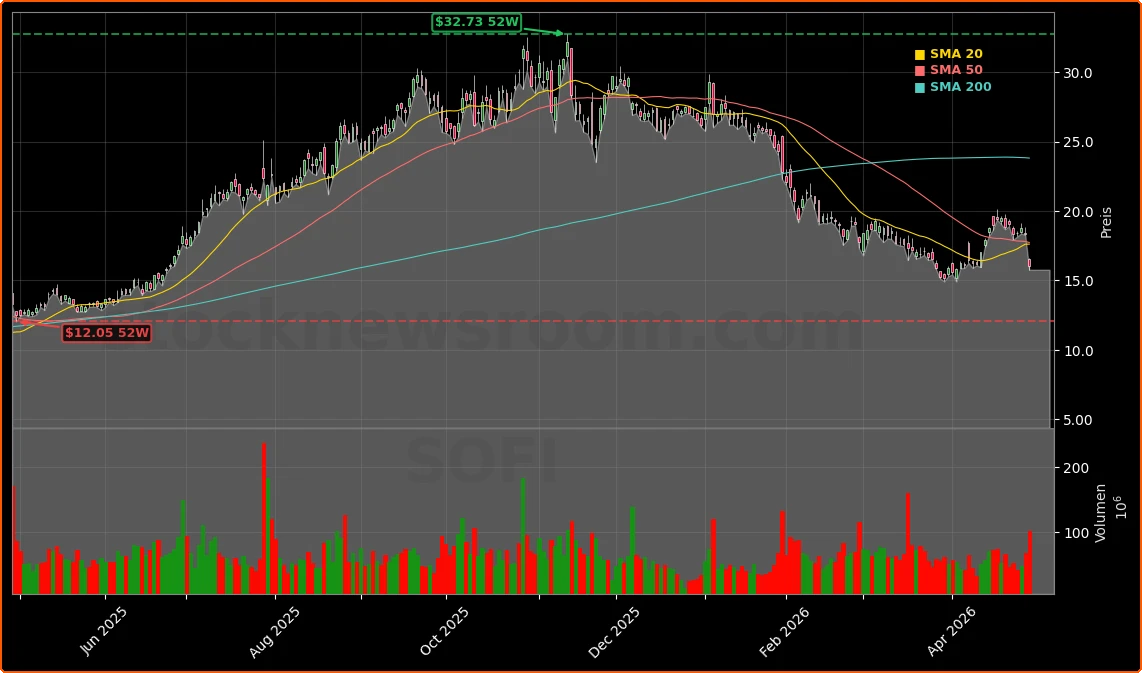
Despite that, SOFI is trading sharply lower around $16, down from Tuesday’s $18.47 close and roughly 30% below where it started 2026. The key reason is mix and messaging. Revenue from SoFi’s high‑margin technology platform segment, which includes its Galileo banking‑as‑a‑service unit, dropped 27% to $75 million after the full exit of a major client, widely known to be Chime. At the same time, fee-based revenue of $387 million missed expectations, and management chose not to raise its full‑year outlook even after delivering a top‑line beat.
That combination has revived the debate over whether SoFi is simply a fast‑growing lender or a scalable fintech platform comparable to names like NVIDIA or Apple in their early platform‑building days in their own sectors. On Wednesday’s tape, investors are voting for the more cautious interpretation.
How strong is SoFi’s core lending engine?
Beneath the surface volatility, the Q1 numbers showed that SoFi’s core franchise continues to gain scale. Total loan originations hit a record $12.2 billion, up 68% from a year ago, with personal loans up 51%, student loans up 119%, and home‑loan originations more than doubling thanks to share gains in purchase mortgages. Net interest income rose 39% to $693 million as deposits reached roughly $40.2 billion and now fund more than 90% of liabilities, giving SoFi a structurally cheaper funding base than many regional banks.
Member growth remained a highlight: SoFi added 1.1 million new members in the quarter, bringing total members to 14.7 million, up 35% year over year. Total products climbed 39% to over 22 million, with 43% of new products coming from existing members, signaling rising cross‑sell intensity. For long‑term holders building diversified portfolios alongside positions in names like Tesla or other NASDAQ growth stocks, this level of engagement is central to the SoFi bull case.
Management reaffirmed its 2026 targets of at least 30% annual member growth and about $4.655 billion in adjusted net revenue, with adjusted EPS guided to roughly $0.60. The decision to maintain, rather than raise, guidance was framed against a changed interest‑rate backdrop: SoFi had initially assumed two Fed cuts in 2026 and now expects none, yet still believes it can hit its original full‑year outlook.
What are the risks inside SoFi Earnings?
The main worries embedded in the latest SoFi Earnings report are credit quality and the durability of fee‑based, tech‑platform revenue. The overall net charge‑off ratio improved to 2.07% from 2.37% a year earlier as the loan book scaled, but student‑loan charge‑offs ticked higher and personal‑loan charge‑offs inched up on a sequential basis. Net interest margin compressed by about 63 basis points, a data point bears cite as evidence that SoFi is leaning harder into higher‑risk lending to sustain growth in a softening consumer environment.
On the technology side, management emphasized that excluding the departed large client, the platform would have grown about 12% year over year, and it pointed to new banking‑as‑a‑service wins and upcoming big‑bank API launches, including capabilities that bridge fiat and crypto. Still, the stark 27% headline decline undercuts the narrative that SoFi’s future earnings power will increasingly be driven by capital‑light software and infrastructure rather than balance‑sheet lending.
Adding to the overhang is an activist short‑seller report from Muddy Waters, which accused SoFi of using aggressive accounting and off‑balance‑sheet structures to mask credit risk. SoFi has rejected those claims and highlighted more than $1 billion of cash revenue in the quarter to clarify how its fair‑value accounting translates into realized economics, but the episode keeps scrutiny high at a time when consumer credit has not yet been tested by a deep downturn.
How are institutions and analysts positioned?
Institutional ownership in SoFi continues to build even as the stock struggles. BlackRock recently disclosed a 5.1% passive stake of nearly 65 million shares, while firms such as Vivid Wealth Management and Evergreen Capital Management have added to their positions. Other investors, including Kercheville Advisors and Rakuten Securities, have trimmed holdings, reflecting a divided institutional view on risk‑reward. Options activity heading into this week’s SoFi Earnings event skewed heavily bullish, with call volume outpacing puts and a sizable short interest near 13% of float, setting up the potential for sharp moves in either direction.
On the Street, consensus remains a “Hold,” with average price targets in the mid‑$20s from houses such as MarketBeat‑tracked analysts, implying upside from current levels but less enthusiasm than high‑growth tech leaders. Some specialists, like William Blair’s Andrew Jeffrey, remain constructive on the long‑term story while warning that the stock could stay under pressure near term due to the tech‑platform slowdown, modestly worsening charge‑offs, and the decision not to lift guidance. For investors benchmarking against broad indices like the S&P 500 or NASDAQ Composite, that setup makes sizing and timing in SOFI particularly critical.
Related Coverage
For a deeper dive into how short‑seller scrutiny intersects with today’s SoFi Earnings, readers can explore SoFi Short Seller Report Warning: How Muddy Waters Hit Back at Q4 Boom. That analysis examines whether Muddy Waters’ allegations pose a structural threat to SoFi’s growth story or simply create another buying opportunity for long‑term bulls watching the stock’s repeated sell‑on‑strength pattern.
We had an excellent first quarter, delivering another period of durable growth and strong returns fueled by our relentless focus on innovation and brand building.— Anthony Noto, CEO of SoFi Technologies, Inc.
In sum, the latest SoFi Earnings print confirms that SoFi’s digital bank is scaling quickly and profitably, even as its technology platform hits a speed bump. For U.S. investors, the stock now trades at a steeper discount to consensus targets, but with elevated sensitivity to credit trends and execution on new tech‑platform deals. The next few quarters of loan performance and Galileo wins will show whether Wednesday’s drop becomes a long‑term entry point or just another stop along a volatile path.