Can Spotify’s new Spotify Fitness push with Peloton turn a simple music app into a high-margin global wellness platform?

How big is the new Spotify Fitness push?
The new Spotify Fitness category opens immediate distribution for Peloton’s instructor-led classes across most of the 184 markets where Spotify Technology S.A. operates. Premium subscribers gain access to more than 1,400 Peloton sessions spanning Strength, Pilates, Barre, Yoga, Stretching, Meditation, Floor Cardio and outdoor run/walk formats, with content in English, Spanish and German and more material to be added regularly. In parallel, both free and paid users can tap curated workout playlists and programs from well-known fitness creators such as Yoga with Kassandra, Chloe Ting, Sweaty Studio, Cailin K’eli Yoga and others.
Spotify has long been a workout companion: users have created roughly 150 million fitness-focused playlists, and nearly 70% of Premium members report exercising at least monthly. The company is now formalizing that behavior into an integrated product layer with guided workouts, downloadable classes for offline use and creator monetization tools. Management frames the initiative as part of a broader ambition to become a “daily wellness companion” that helps users build momentum, recover and reset, rather than simply a background music app.
What does this mean for Spotify and Peloton?
For Spotify, the Peloton deal strengthens a strategic pivot beyond music and traditional podcasts into higher-engagement verticals such as audiobooks and now fitness. Guided workouts can keep users on platform for longer sessions and create more moments to upsell Premium, serve targeted advertising or monetize fitness creators through tools similar to those already used in podcasting. The Spotify Fitness category also leverages the platform’s scale of 751 million total users and 290 million subscribers to test new subscription bundles or wellness-related sponsorships over time.
Peloton, in turn, gains international reach well beyond its installed base of connected fitness hardware. The company is leaning on its brand, instructor roster and AI-enhanced content while reducing dependence on at-home bikes and treadmills. Management describes the Spotify collaboration as a “significant leap” in global exposure that aligns with its push toward a more diversified, content-first business model and entry into previously untapped international markets. The partnership lands as Peloton shares have been volatile and remain far below their 2021 peak, making distribution-focused deals key to rebuilding growth.
How does Spotify Fitness change the competitive landscape?
The expansion of Spotify Fitness intensifies competition with Apple, whose Apple Music and Apple Fitness+ products are tightly integrated into the Apple One subscription bundle. Unlike Apple Fitness+, which sits behind a dedicated paywall, Spotify is seeding much of its workout and wellness content into the core app, available to both ad-supported and Premium users. That approach could attract cost-conscious consumers who want structured workouts without adding another standalone subscription, while still leaving room for premium tiers or add-ons later.
Beyond Apple, Spotify also competes for time and attention with digital fitness platforms such as Peloton’s own app ecosystem, while indirectly jostling with broader consumer-tech names like NVIDIA and Tesla for space in growth-focused portfolios. For investors following the NASDAQ and S&P 500, the fitness initiative reinforces a pattern seen across leading platforms: use existing distribution to layer on higher-margin, behaviorally sticky services. If engagement metrics improve, Spotify Fitness could support the bullish margin-expansion case laid out by several recent analyst upgrades.
How is Wall Street valuing Spotify’s strategy shift?
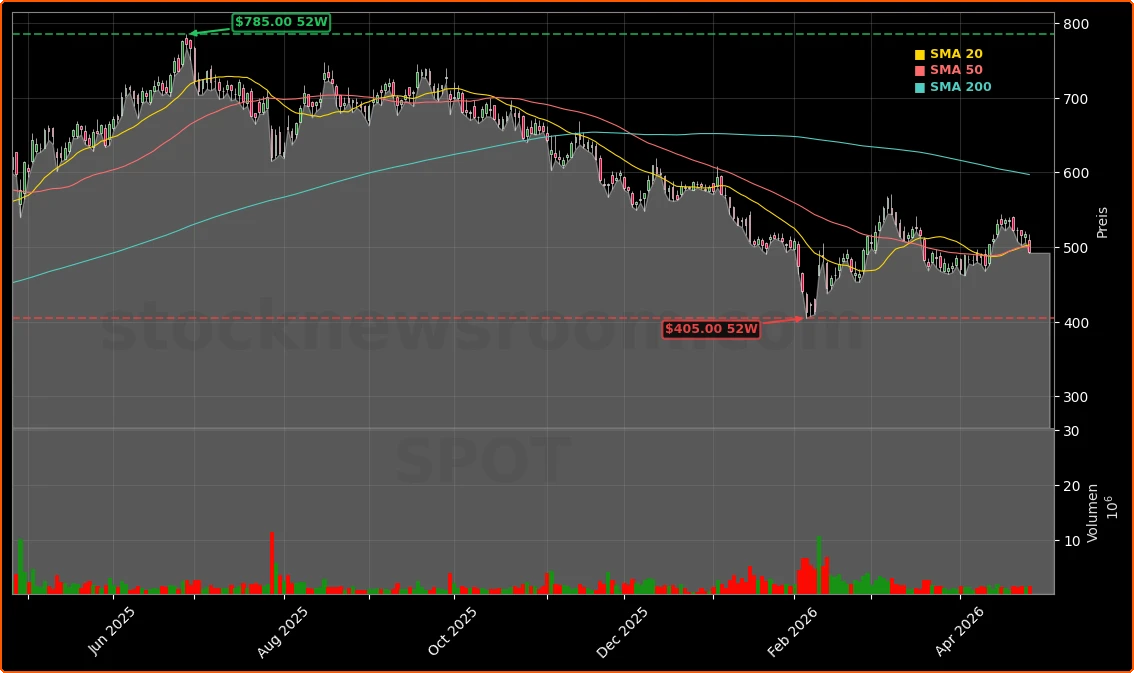
On Wall Street, the stock has pulled back from last year’s highs but remains a closely watched growth name. SPOT trades today around $493, down roughly 4.75% from the prior close of $519.49, and about a third below peak levels reached in mid-2025. Some analysts see that as an entry point ahead of Q1 2026 results, pointing to strong user growth, improving free cash flow and the potential for gross margins to move into the mid-30s over the coming years as advertising, podcasts and new verticals like Spotify Fitness scale.
Others are more cautious after the rally of the last 18 months. IndeRes, for example, recently downgraded Spotify from “Buy” to “Accumulate” while maintaining a $595 price target, arguing that much of the near-term upside had already been priced in despite continued confidence in user and profitability trends. At the same time, ChartMill’s aggregation of 47 analyst forecasts shows an average target around the mid-$600s, implying double-digit upside if Spotify executes on pricing, margin expansion and engagement initiatives such as fitness.
Fund managers such as Baron Capital continue to frame Spotify as a long-term winner in music streaming, with the potential to reach more than 1 billion subscribers by 2030. Their thesis hinges on steady price increases, ongoing label negotiations, and monetization of high-margin tools like the artist marketplace and targeted ads. The success of Spotify Fitness will likely feed directly into that narrative by lifting time spent in-app—an important driver for both ad impressions and subscription stickiness.
Today, we are expanding Spotify to become a true daily wellness companion.— Roman Wasenmüller, VP Global Head of Podcasts at Spotify
Regulatory and competitive risks remain. Texas recently opened a probe into music-streaming promotion practices, injecting uncertainty around how platforms prioritize content and accept payments for placement. Meanwhile, pricing power is being tested as Spotify raises Premium rates in multiple markets. Yet so far, management reports strong engagement and relatively low churn even after past hikes, suggesting some room to maneuver while layering on new services like fitness and audiobooks.