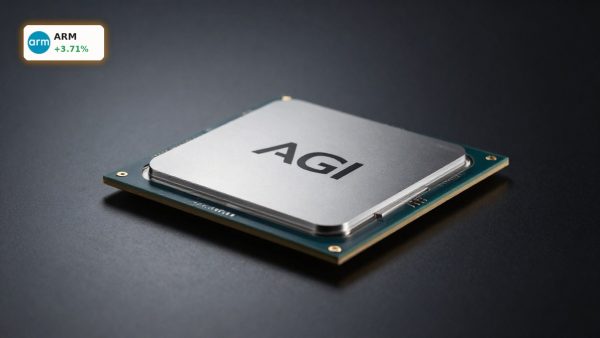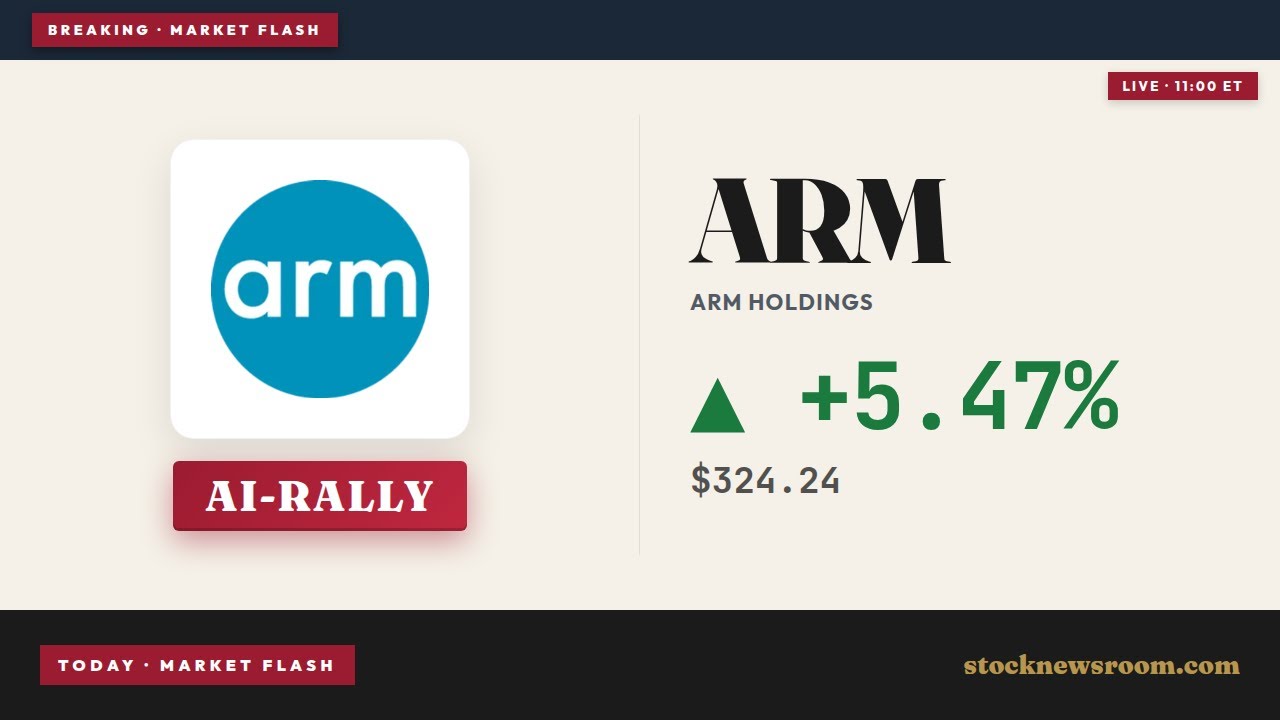

Can Arm’s AI-fueled story outrun a brutal after-hours drop, or is the market finally questioning the valuation?

What Does the Arm Holdings Forecast Mean for S&P 500 Tech?
Arm Holdings Forecast revisions are now driving real portfolio recalibration across U.S. equity funds. Bank of America’s $335 target — issued Thursday, June 11, 2026 — isn’t just about valuation. It signals a structural shift: CPUs are no longer just compute engines but AI co-pilots embedded in every data center, edge device, and autonomous system. That reframes Arm’s role from IP licensor to AI infrastructure orchestrator — a pivot that directly pressures traditional x86 incumbents. While NVIDIA dominates GPU-accelerated training, Arm’s agentic AI CPU roadmap — now backed by Oracle, ByteDance, and Meta — targets inference, orchestration, and real-time decision layers where latency and energy efficiency matter most. This dynamic is why the S&P 500’s tech sector, up 14.2% YTD, is increasingly bifurcated between ‘accelerator-first’ and ‘infrastructure-first’ winners — and Arm sits squarely in the latter.
How Do Mizuho and BofA Differ on Arm Holdings Forecast?
Mizuho takes a more aggressive stance, lifting its price target to $500 and maintaining an Outperform rating — a $175 increase from $425 — citing $15 billion in projected agentic AI infrastructure CPU revenue by fiscal 2031. Its analysis emphasizes Arm’s record Q4 FY2026 results: $1.49 billion in revenue and $0.60 non-GAAP EPS, with AGI CPU order backlog doubling to over $2 billion for FY2027–2028. BofA, by contrast, maintains Neutral while upgrading the target — a nuanced signal that near-term volatility (28% off highs, 115% annualized volatility) remains a headwind, even as TAM expansion is undeniable. Both banks agree on one driver: the emergence of ‘energetic AI’ — systems that continuously learn, adapt, and act — is expanding CPU demand far beyond legacy compute models.
Is Arm Holdings Forecast Justified Amid Macro Risks?
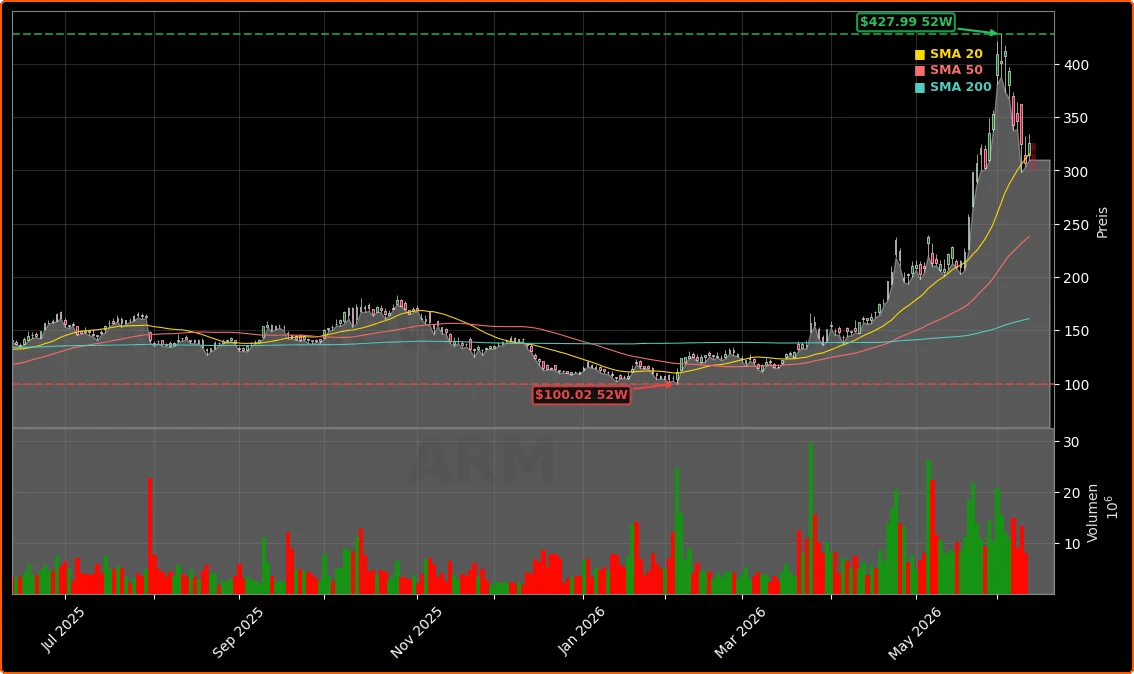
Yes — but with caveats. U.S. inflation hit 4.2% in May, the highest in three years, and Federal Reserve policy uncertainty is pressuring growth stocks. Arm’s 25% pullback over five trading days reflects that macro sensitivity. Yet its technical posture remains strong: trading well above its 50-day moving average ($206), with the Relative Strength Index at 53.9 — neutral, not oversold. Analysts stress that Arm’s licensing model insulates it from supply chain swings that hit chipmakers like Intel (INTC), which surged 11.1% Thursday after its own BofA upgrade. Still, regulatory risk lingers — an ongoing FTC investigation into Arm’s licensing practices and SoftBank’s financial strain add complexity. For U.S. investors, that means Arm Holdings Forecast upside is real, but execution risk remains elevated.
Arm Holdings Forecast vs. Peer Semiconductor Valuations
Arm’s trailing P/E of 399 looks extreme — until compared to peers. NVIDIA trades at 62x forward earnings; Apple at 33x. Arm’s valuation reflects optionality, not current earnings. Its $10 billion IP revenue target by 2031 — alongside $15 billion in AGI CPU revenue — implies a $25 billion annual revenue base and $9+ EPS, a trajectory that could re-rate the stock meaningfully. Meanwhile, KLA Corp (KLAC) surged 8.8% Thursday after Barclays raised its target to $2,250, underscoring how AI-driven capacity expansion is lifting the entire semiconductor equipment and design stack. Arm’s forecast isn’t isolated — it’s the linchpin in a broader AI infrastructure buildout now accelerating across the NASDAQ.
Related Coverage: Arm’s recent 6.2% plunge is being re-examined as a valuation reset rather than a trend break — Arm Holdings Plunge -6.2%: AI Favorite Faces Valuation Reset. Meanwhile, Marvell’s S&P 500 inclusion highlights how AI infrastructure stocks are gaining institutional traction — Marvell S&P 500 Inclusion +3.9% as AI Momentum Builds.
Arm Holdings Forecast revisions are converging on a powerful consensus: AI’s next phase demands smarter, more efficient CPUs — and Arm is architecting that layer. For U.S. investors, this isn’t just about one stock — it’s about positioning for the infrastructure backbone of generative and agentic AI. The next quarterly earnings will test whether execution matches the forecast. For long-term portfolios, Arm remains a high-conviction AI infrastructure play — provided volatility tolerance aligns with the opportunity.