
Is a $1 billion Bitcoin buy the clearest sign yet that smart money sees a major shift ahead?

Is Robinhood’s Global Push a Catalyst for Retail Flow?
Robinhood has officially launched crypto trading in Canada — offering 50 digital assets — and secured a licensing framework in Singapore, signaling a deliberate, regulatory-compliant expansion beyond U.S. borders. Unlike its 2021–2022 growth spurt, this phase emphasizes agentic AI trading tools, enabling real-time micro-execution and portfolio integration for retail investors. That matters for Wall Street: Robinhood’s user base overlaps significantly with NASDAQ-traded tech investors, and its infrastructure upgrades now allow seamless correlation analysis between Bitcoin (BTC/USD) and equities like NVIDIA and Tesla. With crypto markets operating 24/7 and U.S. equity hours increasingly decoupled from price action, Robinhood’s timing aligns with institutional demand for non-correlated alpha — a key driver in the current Bitcoin Market Analysis.
Who Bought $1 Billion of Bitcoin — and Why Now?
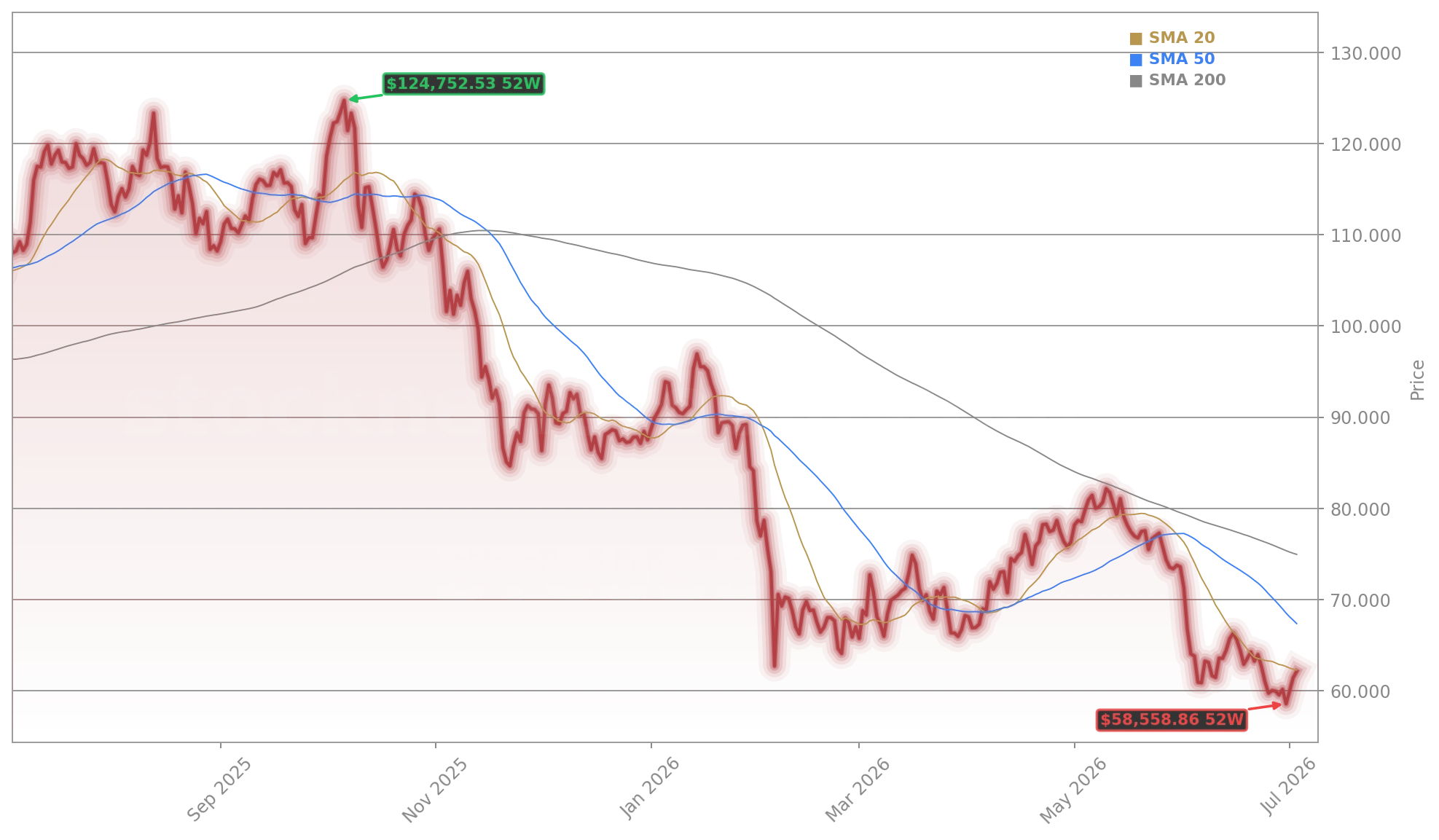
A single institutional firm acquired nearly $1 billion worth of Bitcoin in late June — confirmed by on-chain analytics and corroborated by Bloomberg — targeting accumulation below $56,000. That price level has held as a floor since February 2026, even amid weak labor data and elevated 10-year Treasury yields. Citigroup analysts note this purchase reflects a strategic rebalancing toward non-sovereign, hard-capped assets amid persistent inflation uncertainty and rising global fiscal deficits. Importantly, the buyer did not use leveraged derivatives — a contrast to the 2021–2022 cycle — suggesting longer-duration conviction. That shift supports the thesis that Bitcoin is evolving from a speculative instrument to a reserve-tier holding, particularly for hedge funds and family offices diversifying away from overvalued U.S. Treasuries.
Bitcoin Market Analysis: Is the Macro Backdrop Turning Favorable?
Yes — and the pivot is accelerating. Bitcoin’s rebound coincides with cooling inflation prints, softer nonfarm payrolls, and growing market expectations for Fed rate cuts beginning in September 2026. As money flows into risk assets, Bitcoin (BTC/USD) is outperforming NFTs and altcoins — underscoring its role as the ‘blue chip’ of digital assets. RBC Capital Markets recently upgraded Bitcoin’s medium-term outlook, citing falling mining difficulty (down 20% from peak) and improved network security margins. Crucially, the CoinMarketCap Fear & Greed Index remains at 23 — historically a contrarian buy signal — while Ethereum’s recovery to $1,700 signals broader ecosystem stabilization. This Bitcoin Market Analysis highlights a critical inflection: macro tailwinds are now syncing with on-chain fundamentals.
How Is AI Reshaping Bitcoin’s Utility — and Valuation?
AI isn’t just boosting chip stocks — it’s redefining Bitcoin’s infrastructure role. Investor Katie Hahn emphasized that agentic commerce requires instant, low-cost micropayments — a use case where Bitcoin’s Lightning Network and emerging zero-knowledge proof integrations excel. Fully homomorphic encryption and verifiable identity layers are now being tested on Bitcoin sidechains to secure AI model training data — a convergence that’s attracting capital from both crypto-native VCs and traditional tech strategists. This shift matters for U.S. investors: as Apple and other S&P 500 firms explore on-chain identity and payments, Bitcoin’s utility layer strengthens beyond store-of-value narratives. The result? A more resilient valuation floor — and higher sensitivity to AI infrastructure capex trends.
What’s Next for Bitcoin (BTC/USD) — and U.S. Portfolio Strategy?
Short-term, resistance looms near $70,000–$72,000 — a zone where past rallies have stalled or reversed. But the $56,000 floor now appears durable, per Morgan Stanley’s technical team, which cites 90-day on-chain accumulation patterns and declining exchange reserves. With institutional inflows accelerating and macro conditions favoring risk assets, Bitcoin (BTC/USD) could retest its 2025 highs before year-end — especially if the Fed cuts rates in Q3. For U.S. investors, this Bitcoin Market Analysis suggests allocating 1–3% to digital assets not as speculation, but as structural diversification — particularly in portfolios already long NVIDIA and other AI enablers. The next catalyst? The SEC’s final decision on spot Bitcoin ETF rule changes, expected by August 15, 2026.
Related coverage: For deeper insight into the $1 billion institutional buy and AI-driven adoption tailwinds, see Bitcoin Market Analysis: $1B Buy, AI Boom, Macro Shift. That analysis also explores how Bitcoin’s resilience compares to broader digital asset trends — a vital context for investors assessing risk across the NASDAQ and S&P 500.
All the regulatory things are little speed bumps along the road. Bitcoin is a new model for society to have a global economy that is much more frictionless and open, transparent, keeps perfect records on the blockchain.— Tim Draper
Bitcoin (BTC/USD) is no longer just a crypto story — it’s a macro, AI, and institutional liquidity story with direct implications for U.S. equity and fixed-income portfolios. The current Bitcoin Market Analysis underscores a structural shift toward adoption, not just speculation. For investors, the path forward is clear: treat Bitcoin as a strategic hedge, not a lottery ticket. The next quarterly review will confirm whether institutional flows sustain — and whether $62,000 becomes a launchpad, not a ceiling.