
Is Coinbase building the next payments backbone for AI agents and institutions through its stablecoin push?

What triggered COIN’s strongest weekly rally since early 2026?
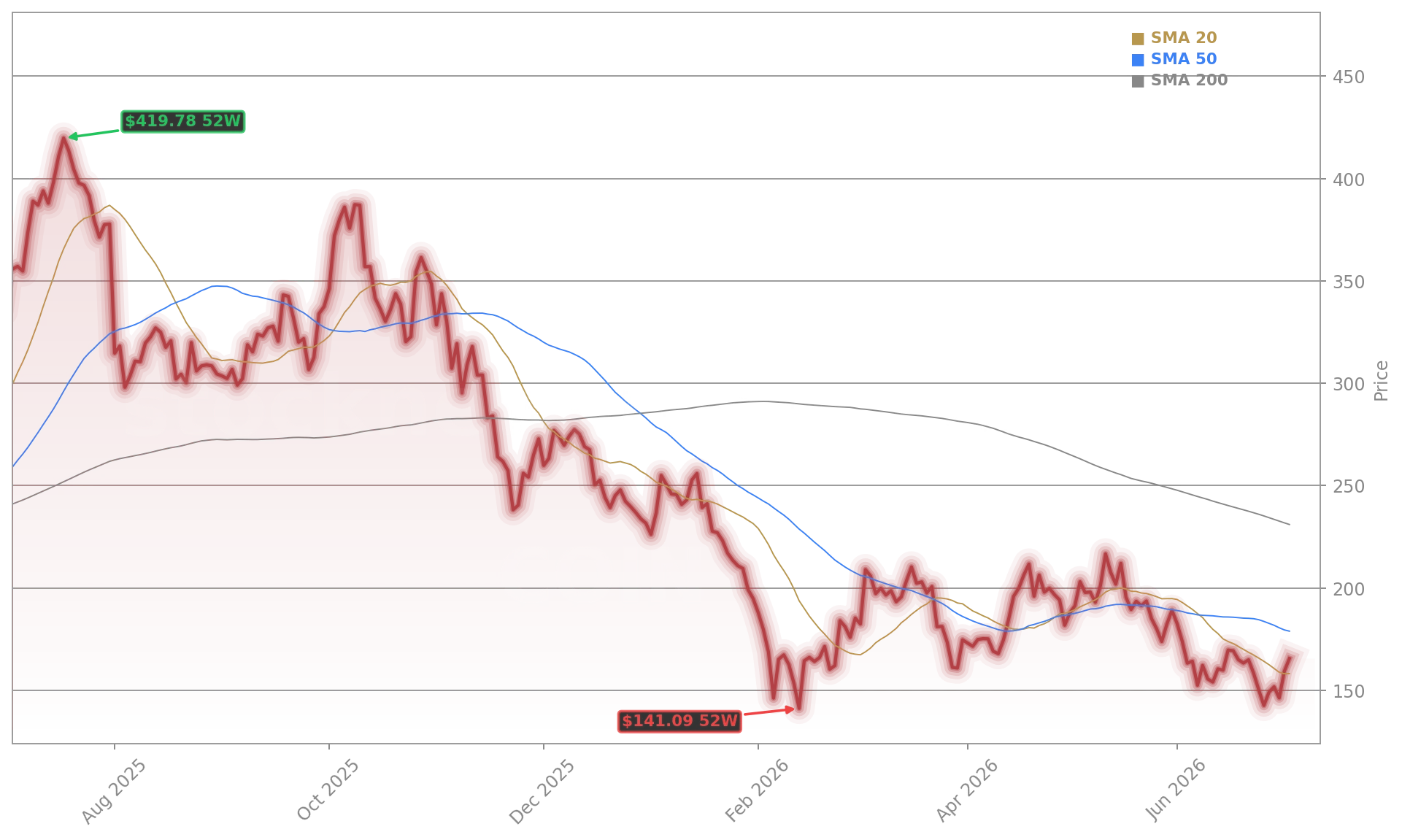
This week, Coinbase Global, Inc. delivered its most powerful performance in months — surging +18.9% from Monday’s open of $139.23 to Friday’s close of $165.48. The stock carved a wide weekly range, hitting a high of $173.09 and dipping only to $139.18 — underscoring both volatility and robust underlying demand. Three outlier days drove the momentum: Wednesday’s +8.9% surge coincided precisely with the Wall Street Journal’s exclusive report on Open USD’s consortium launch; Thursday’s +3.9% advance reflected broad crypto market strength and confirmation of Base chain integration; and Friday’s +4.6% lift followed a wave of positive sentiment around AI agent infrastructure and Bitcoin’s rebound above $60,000. Crucially, the rally occurred despite Bitcoin’s earlier ‘crypto winter’ weakness — highlighting that this was not a leveraged beta move, but a fundamental re-rating tied to Coinbase Stablecoin adoption and infrastructure leadership.
How did the Coinbase Stablecoin reshape the investment case?
The launch of Open USD — a dollar-pegged stablecoin backed by BlackRock, Google, Visa, Stripe, Mastercard, and over 140 other firms — was the week’s defining catalyst. Unlike legacy stablecoins, Open USD is designed for seamless interoperability across Base, Solana, and other chains, and is explicitly built to power the emerging ‘agentic economy’. As CEO Brian Armstrong explained in a widely circulated interview, Coinbase has now deployed the full stack: Coinbase for Agents, Coinbase Advisor (an SEC-registered AI investment advisor), and X402 — an open Linux Foundation standard for AI-to-AI payments co-developed with Cloudflare and Google. This isn’t just a payments play; it’s infrastructure dominance. Morgan Stanley upgraded its rating to Overweight and raised its price target to $210, citing Open USD as ‘the first truly institutional-grade stablecoin with embedded compliance and cross-chain liquidity’. Meanwhile, RBC Capital Markets emphasized that stablecoin-related revenue — now including USDC custody, Base transaction fees, and Open USD settlement — is growing at a 42% quarterly run rate, positioning Coinbase Stablecoin as the fastest-growing segment within an increasingly diversified revenue model.
Why are analysts shifting focus from trading fees to AI infrastructure?
While spot trading volumes remain under pressure — down 37% year-over-year — analysts are increasingly valuing Coinbase Global, Inc. on structural moats, not cyclical metrics. Citigroup highlighted that 44% of Q1 2026 revenue now comes from subscriptions and services — up from 28% two years ago — with stablecoin payments, institutional custody, and Base chain fees forming the core growth engine. The firm noted that COIN’s 13 consecutive quarters of positive EBITDA ($303M in Q1) reflect durable operational discipline, even as margins compress in legacy trading. Further, Armstrong’s public confirmation that AI is accelerating internal development — enabling engineers to ship 10x more code — validated long-standing investor speculation about efficiency gains. Unlike Microsoft or Coinbase Stablecoin Strategy Drives COIN’s 11.4% Surge, which focuses on stablecoin monetization, this week’s narrative centered on AI as a force multiplier across compliance, risk, and product velocity — a theme echoed by Barrons in its Friday market wrap.
What happens next week — and why does Open USD matter beyond crypto?
Next week brings two critical catalysts: first, the U.S. Senate Banking Committee’s scheduled markup of the bipartisan Clarity Act — a bill that would provide clear federal regulatory authority for stablecoins and digital asset custody. Passage would directly benefit Coinbase’s Open USD rollout and accelerate institutional onboarding. Second, the scheduled release of the Federal Reserve’s semiannual Financial Stability Report, expected to include commentary on systemic risks posed by stablecoin growth — a potential headwind or tailwind depending on tone. Investors should also monitor Bitcoin’s ability to hold above $60,000, given the recent correlation between BTC strength and COIN’s AI infrastructure narrative. Open USD’s success hinges not just on adoption, but on regulatory clarity — and next week could deliver the first major legislative signal.
Coinbase Stablecoin Strategy Drives COIN’s 11.4% Surge details how stablecoin revenue is outpacing trading fees in growth velocity, while Cardano Hard Fork Nears as 22% Whale Buying Lifts ADA illustrates the broader market shift toward infrastructure upgrades and onchain utility — a trend in which Coinbase Global, Inc. is now a central architect. This week proved that Coinbase Stablecoin is no longer a side project — it’s the foundation of a new financial operating system. For investors, the takeaway is clear: COIN’s 18.9% rally reflects a decisive pivot from crypto exchange to AI-native financial infrastructure leader — and the Coinbase Stablecoin initiative is its most powerful, scalable, and defensible growth vector.
AI will actually make software more secure, not less. It favors defenders over attackers, since they can scan all code before production.— Brian Armstrong, CEO of Coinbase Global, Inc.
Fazit folgt.