
Can Coinbase Stablecoin ambitions turn Open USD into the next major bridge between Wall Street capital and onchain finance?

What drove Coinbase Global, Inc.’s 18.9% weekly surge?
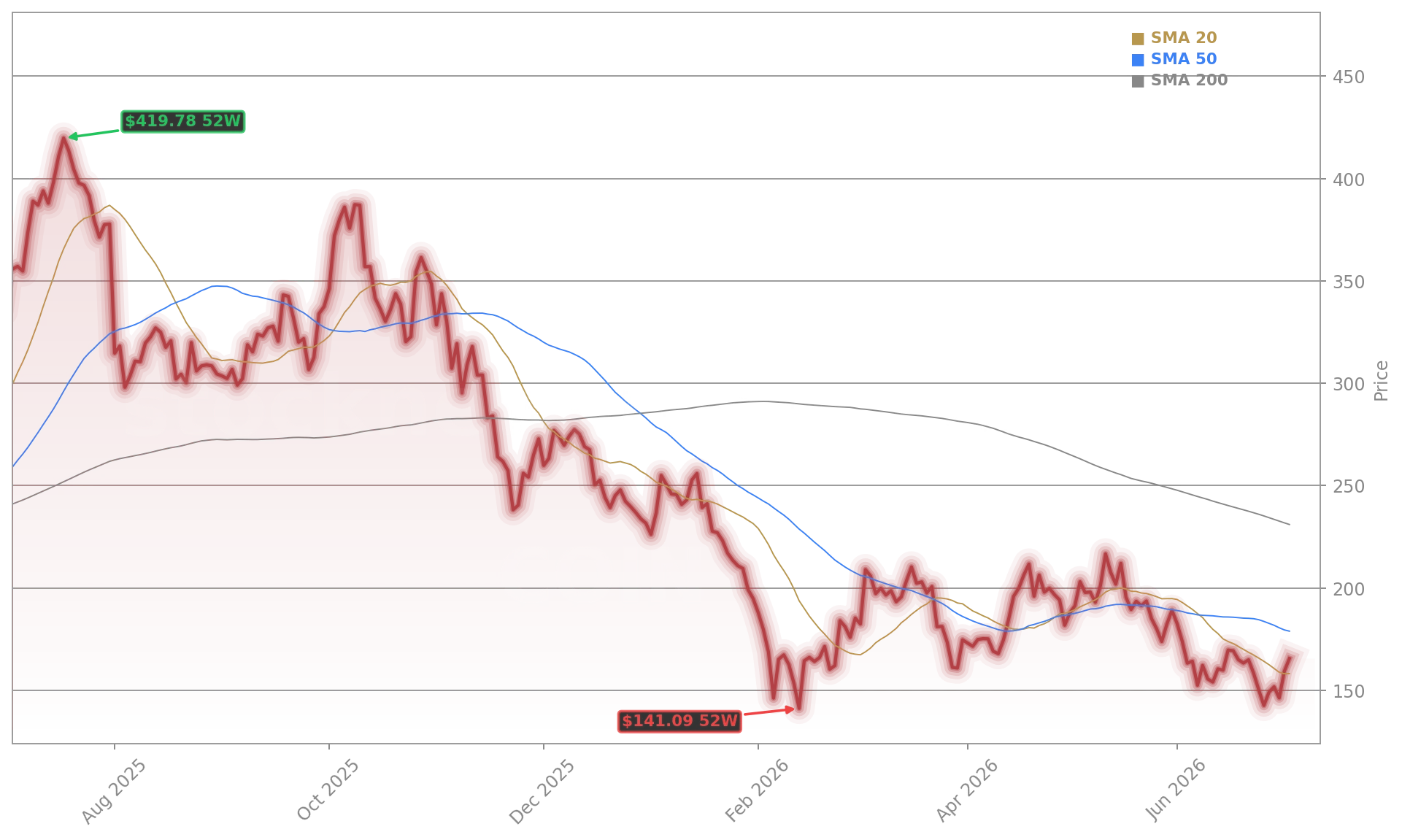
This week, Coinbase Global, Inc. delivered its most powerful performance since March — rising +18.9% from Monday’s open of $139.23 to Friday’s close of $165.48. The weekly high of $173.09 and low of $139.18 captured extreme intraday volatility, anchored by two genuine outlier days: Wednesday’s +8.9% surge and Thursday’s +3.9% follow-through. These gains were directly tied to Tuesday’s announcement of Open USD — a new, regulated, dollar-backed stablecoin co-developed with BlackRock, Google, Visa, and Stripe, and slated for launch later this year on Base, Solana, and other chains. The timing was pivotal: the Wall Street Journal confirmed the consortium’s formation just as Bitcoin rebounded above $60,000, lifting all crypto-linked equities. Analysts at Citigroup immediately upgraded their rating to Buy, citing Open USD as a “structural inflection point for stablecoin monetization,” while RBC Capital Markets raised its 12-month price target to $210, emphasizing that Coinbase Stablecoin infrastructure now underpins 19 billion USDC holdings and powers over 80% of Base’s onchain activity.
How did AI reshape Coinbase Global, Inc.’s product narrative?
AI was not a background theme — it was the engine. CEO Brian Armstrong’s widely cited X post — “AI will actually make software more secure, not less. It favors defenders over attackers, since they can scan all code before production” — framed the week’s technical credibility. But the real story unfolded in product: Coinbase for Agents, Coinbase Advisor (the first SEC-registered AI investment advisor), and the open-source X402 agentic payments protocol — co-developed with Cloudflare and Google — signaled a full-stack AI financial layer. Morgan Stanley analysts highlighted that “over 60% of new product features shipped in Q2 were AI-assisted,” and noted that internal engineering velocity has doubled year-over-year. This wasn’t theoretical — it was operational. As Armstrong explained in a New York event, “We’re hitting recursive self-improvement: customers give feedback in-app, AI turns it into pull requests, and engineers review 100 prioritized features per day.” That execution velocity explains why Coinbase Global, Inc. outperformed peers like Robinhood and Strategy — both of which reported mixed Q1 results — even as Bitcoin remained range-bound.
Why does the Coinbase Stablecoin ecosystem matter beyond payments?
The Coinbase Stablecoin initiative transcends transaction rails. With 12% of all global crypto assets now under Coinbase custody — and 19 billion USDC held on-platform — stablecoins are the liquidity bridge between legacy finance and the agentic economy. Open USD’s design, backed by BlackRock’s treasury expertise and Google’s infrastructure scale, positions it as a de facto settlement layer for institutional tokenized stocks, AI agent payroll, and cross-border payroll. Barclays underscored this in a note titled “Stablecoins as Strategic Moats,” writing: “Open USD isn’t competing with USDC — it’s extending the USDC ecosystem into regulated, multi-issuer, multi-chain settlement. That’s where 80% of the next $10T in onchain value flows.” Meanwhile, the Base blockchain — now hosting over 400 tokenized assets — is becoming the default infrastructure layer for firms like NVIDIA and Apple-adjacent developers building AI-native financial apps.
What’s next for Coinbase Global, Inc.?
Investors now pivot to three near-term catalysts. First, the Senate floor vote on the Clarity Act — expected within weeks — which would provide federal regulatory clarity for stablecoins and tokenized securities. Second, the July 15 launch of tokenized U.S. equities on Base for non-U.S. investors, a move that Goldman Sachs says could drive $2B+ in annual revenue by 2027. Third, the quantum-resistant cryptography upgrade rollout across Base and Coinbase custody — critical for institutional trust. Open questions remain: Will Open USD achieve parity with USDC in yield and liquidity by year-end? Can Coinbase sustain >20% quarterly growth in subscription revenue — now 44% of total net revenue — as trading volumes remain depressed? And how quickly can its AI agents scale beyond Coinbase’s own app into third-party financial workflows?
Coinbase Stablecoin Rally: Open USD and AI Lift COIN dives deep into the technical architecture and institutional partnerships fueling the stablecoin’s rapid adoption. Meanwhile, Cardano Hard Fork Nears as 22% Whale Buying Lifts ADA offers a contrasting view of infrastructure evolution — highlighting how consensus-layer upgrades like Van Rossem are reshaping the competitive landscape for tokenized assets and AI-native settlement. Both underscore a broader reality: infrastructure, not speculation, is now the primary battleground for digital finance.
AI will actually make software more secure, not less. It favors defenders over attackers, since they can scan all code before production.— Brian Armstrong, CEO of Coinbase Global, Inc.
Fazit folgt.