
If DocuSign beat estimates and raised guidance, why did investors still send the stock lower after hours?

What Did DocuSign Earnings Reveal?
DocuSign, Inc. reported fiscal Q1 2027 results that exceeded analyst expectations across key metrics. Non-GAAP earnings per share landed at $1.09—10.1% above the $0.99 consensus—while revenue hit $830.2 million, 0.66% above the $824.8 million forecast. Year-over-year growth stood at 8.7%, driven by accelerated adoption of its AI-native Intelligent Agreement Management (IAM) platform, now representing 12.6% of annual recurring revenue (ARR), up from 10.8% in Q4. Free cash flow surged 27% to $289.4 million, and operating cash flow rose to $321.7 million—underscoring the company’s capital efficiency. Still, GAAP net income per diluted share was $0.40, reflecting the weight of stock-based compensation and tax expenses.
How Does DocuSign Compare to Peers?
Within the enterprise SaaS landscape, DocuSign, Inc. sits at an inflection point—distinct from workflow-focused peers like Tesla’s enterprise software initiatives or legacy CLM vendors. While Adobe Sign and PandaDoc compete on ease-of-use, DocuSign’s IAM platform now integrates with Anthropic Claude, Google Gemini, and OpenAI ChatGPT via its Model Context Protocol—giving it a unique AI-native edge. Yet valuation remains a headwind: with a forward P/E of 29.8 (per Zacks Investment Research), DocuSign trades at a premium to the broader software sector, though well below hyper-growth peers like NVIDIA. Morgan Stanley recently reiterated its ‘Equal Weight’ rating on DocuSign, citing solid execution but limited near-term multiple expansion potential.
Why Did DOCU Stock Drop After DocuSign Earnings?
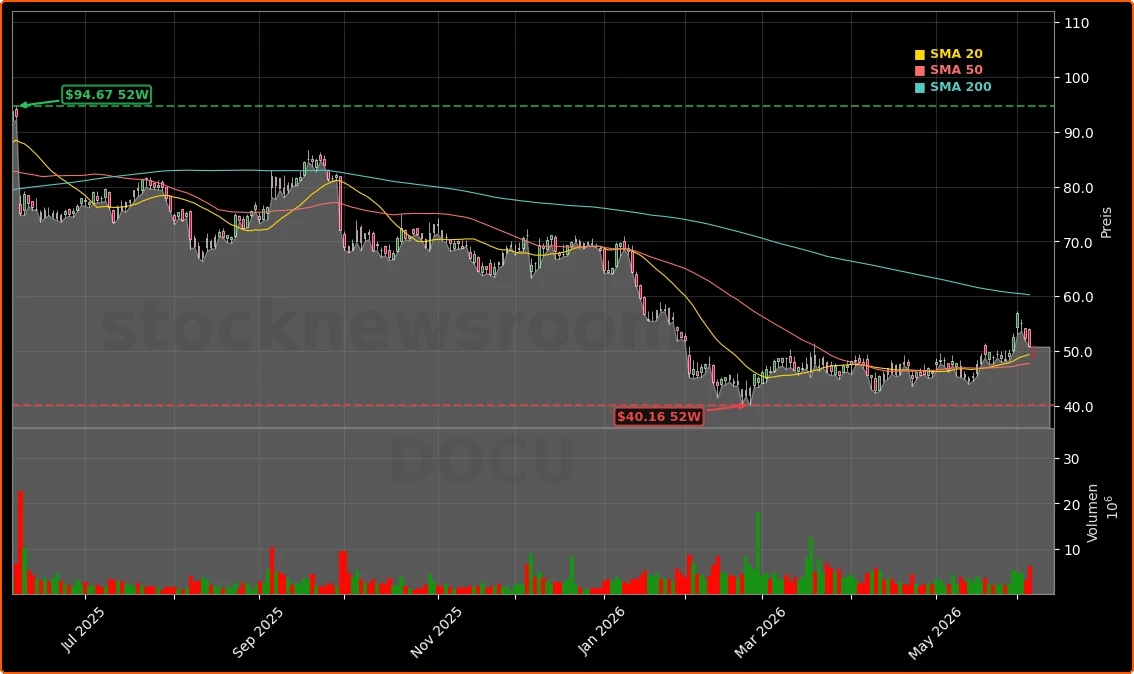
Despite the strong DocuSign Earnings report, shares fell 4.73% after-hours to $48.53—dragged by concerns over margin compression and rising R&D spend. Non-GAAP gross margin dipped to 81.5% from 82.3% YoY, and sales & marketing as a percentage of revenue held steady at 29.8%, suggesting customer acquisition costs remain elevated. The $317.5 million in share repurchases—nearly double last year’s $183.4 million—also raised questions about capital allocation priorities versus product investment. Citigroup analysts noted in a June 4 follow-up that “DocuSign’s AI roadmap is compelling, but monetization clarity beyond IAM’s current 13% ARR share is still evolving.” That hesitation resonated across Wall Street, especially as the NASDAQ faces renewed scrutiny over AI-related valuations.
What’s Next for DocuSign, Inc.?
In Q1, we saw continued growing demand for Docusign’s AI-native IAM platform with 40,000 customers investing in our rapidly expanding roadmap.— Allan Thygesen, CEO of DocuSign, Inc.
DocuSign, Inc. raised its full-year revenue guidance to $3.49–$3.502 billion—up $6 million at the midpoint—while forecasting Q2 revenue of $865–$869 million, in line with consensus. CEO Allan Thygesen emphasized that 40,000 customers are now actively investing in IAM’s expanding roadmap, including new Iris assistant agents for contract review and automated compliance triggers. With new integrations into Microsoft Copilot, Salesforce, and Coupa—and partnerships with Thomson Reuters’ CoCounsel and Harvey—the company is building a defensible ecosystem. RBC Capital Markets upgraded DocuSign to ‘Outperform’ on June 4, citing “increasing stickiness in high-velocity agreement workflows,” and raised its price target to $58. The next catalyst? Q2 results due in early September—and whether IAM adoption crosses the 20% ARR threshold.