
Did DocuSign’s earnings beat really matter if cautious guidance was enough to send the stock sharply lower?

Did DocuSign Earnings Justify the Sell-Off?
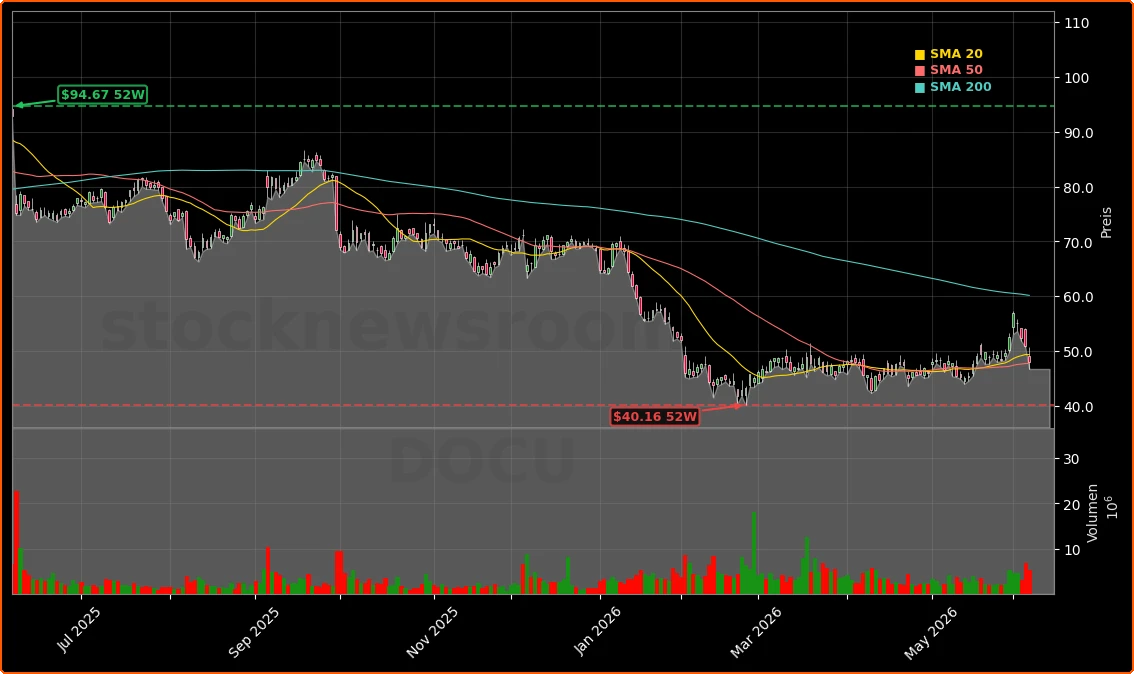
DocuSign Inc. reported fiscal Q1 2027 results that exceeded analyst consensus across key metrics: revenue of $830.2 million (+9% YoY) beat estimates of $824.8 million, while adjusted EPS of $1.09 topped the $1.00 forecast. Free cash flow surged to $289.4 million — well above the $217.5 million expected — and operating margin expanded to 32%, up from 29.5% a year earlier. The company also executed its largest-ever quarterly share repurchase: $318 million. Yet the stock fell sharply, closing Thursday at $48.58 and dropping another 4.83% in pre-market Friday trading. The disconnect reflects shifting investor priorities: in today’s NASDAQ environment, beating estimates is table stakes — what matters is whether the beat signals durable, accelerating growth in the next phase of the business.
What’s Driving DocuSign Earnings Confidence?
The core driver behind DocuSign’s improved profitability and revenue growth remains its transition toward AI-powered agreement management. The Intelligent Agreement Management (IAM) platform now accounts for 12.6% of annual recurring revenue — up from 10.8% last quarter — and is on track to reach 18% by fiscal year-end. With 40,000 customers actively investing in the IAM roadmap and enterprise adoption accelerating (notably at Experian and HSBC), management sees IAM as the foundation for long-term expansion beyond e-signature. Partnerships with Anthropic and OpenAI further cement its AI integration strategy. Still, as Morgan Stanley’s Josh Baer noted in his equal-weight rating and $69 price target, ‘financial inflection is limited and economics remain too opaque to prove a durable path back to double-digit growth.’
Why Did Guidance Disappoint Wall Street?
DocuSign Earnings momentum stalled at the guidance stage. Q2 revenue is forecast at $865–$869 million — essentially in line with the $866.1 million consensus — while full-year revenue guidance was only modestly raised to $3.49–$3.502 billion from $3.484–$3.496 billion. More critically, non-GAAP gross margin guidance of 81.5–82% landed below the 81.8% consensus midpoint, citing ongoing cloud migration investments. Wells Fargo responded by cutting its price target to $55 from $60, maintaining its Equal Weight rating. BTIG reiterated Buy but lowered its target to $60 from $70. Citigroup upgraded its outlook to Neutral and lifted its price target to $54 from $50 — yet underscored ‘noise in the absence of quarterly ARR disclosures,’ highlighting transparency concerns that continue to weigh on sentiment.
How Does DocuSign Compare to Broader Tech and AI Peers?
Against peers like Tesla and NVIDIA, where AI infrastructure and software monetization are accelerating rapidly, DocuSign’s progress appears measured. While IAM adoption is real, it lacks the explosive revenue visibility seen in cloud-AI plays. The S&P 500’s tech sector has rallied 12% year-to-date on AI optimism — yet DocuSign has lagged, down nearly 30% from its January high near $70. Analyst consensus remains a Hold, with an average price target of $58.58. That implies roughly 21% upside from current levels — but only if IAM adoption accelerates meaningfully in Q2 and Q3. For investors comparing DocuSign Inc. to broader digital workflow leaders, the question isn’t whether the platform works — it’s whether it can scale faster than rivals like Adobe and Salesforce, both of which are investing heavily in embedded AI contract intelligence.
What’s Next for DocuSign Earnings and the Stock?
With $1.0 billion in cash and zero debt, DocuSign Inc. has ample flexibility to invest in IAM, repurchase shares, or pursue strategic M&A. But near-term catalysts hinge on two metrics Wall Street now demands: quarterly ARR growth and IAM’s contribution to new logo acquisition. The company’s decision to retire billings as a disclosed metric — while emphasizing ARR — has created short-term opacity. As Briefing.com noted, this is the first quarter without billings guidance, and investors are still adapting. Next up: the Q2 earnings report in early September, where IAM’s share of ARR and dollar net retention — now at 102% and rising — will be closely watched. Until then, DocuSign Earnings remain a story of strong execution overshadowed by cautious expectations.
While DocuSign displayed solid first-quarter execution, the debate is unchanged. Financial inflection is limited and economics remain too opaque to prove a durable path back to double-digit growth.— Josh Baer, Morgan Stanley
Related Coverage: If DocuSign beat estimates and raised guidance, why did investors still send the stock lower after hours? DocuSign Earnings Drop 4.7% After Hours Despite Q1 Beat explores the AI adoption paradox and competitive pressures facing the company.