Can the latest DoorDash Earnings surprise and a double‑digit after-hours jump turn DASH into a new on-demand market leader?

How did DoorDash Earnings move the stock price?
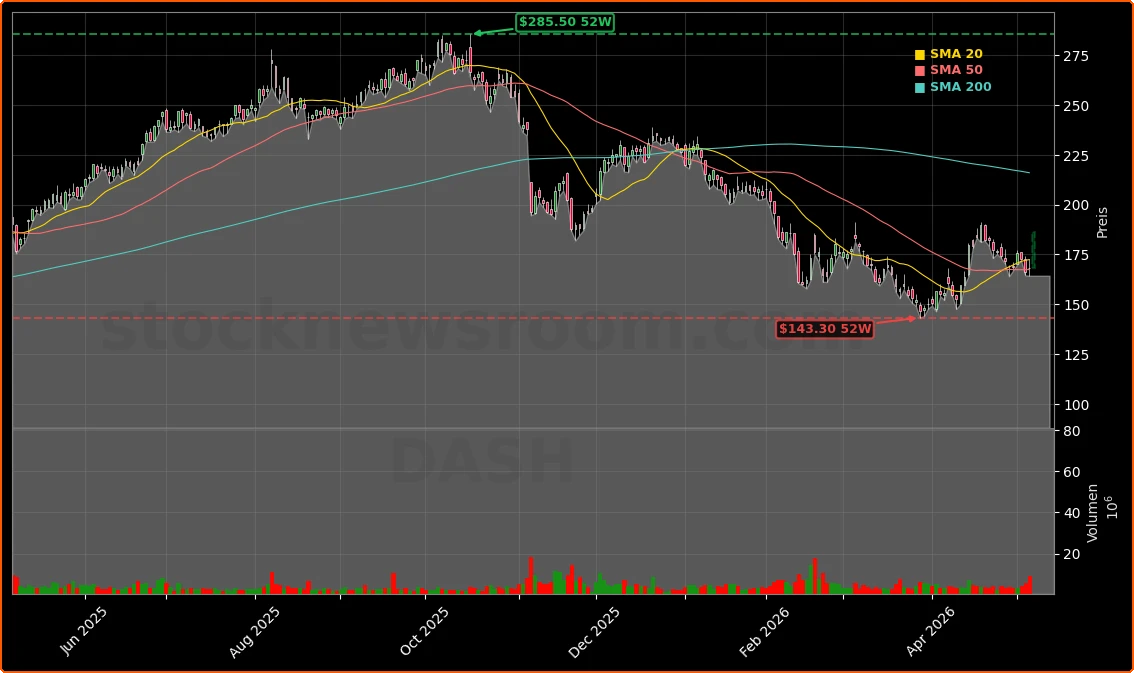
DoorDash, Inc. (DASH) traded actively as investors digested the latest DoorDash Earnings update. The shares closed at $167.97 on Wednesday, up 1.10% from the previous close of $167.13. In post-close electronic trading, the stock jumped to about $186.21, a gain of roughly 10.9%, reflecting strong investor response to the company’s numbers and guidance.
The move places DoorDash among the better-performing U.S. internet and app-based delivery names this week, even as broader NASDAQ and S&P 500 components remain sensitive to interest rates and growth expectations. While the company is not yet part of the major indices’ mega-cap club populated by Apple and NVIDIA, the latest reaction shows that DASH is increasingly treated as a key bellwether for on-demand consumer services.
For traders, the price action after the DoorDash Earnings release suggests short-term sentiment has turned more constructive, with the market rewarding both top-line resilience and tighter operating discipline.
What do the latest DoorDash Earnings show?
Management reported that first-quarter revenue reached about $2.14 billion, slightly above consensus estimates of roughly $2.13 billion. That modest beat on sales was complemented by stronger profitability: adjusted EBITDA came in above analyst expectations, even though it landed below the upper end of DoorDash’s own prior guidance range. Overall, the DoorDash Earnings profile painted a picture of a company still in investment mode but increasingly capable of scaling profitably.
On the demand side, total orders were described as only slightly below Wall Street’s forecasts, while the company’s Q2 outlook for Gross Order Value (GOV) of $32.4–$33.4 billion fell broadly in line with expectations. That guidance reassured investors that consumer appetite for delivered meals, groceries, and convenience items remains healthy despite macro uncertainty and elevated inflation in certain categories.
In combination, these data points explain why the stock surged in extended trading: investors got a revenue beat, better-than-expected adjusted EBITDA, and a GOV guidance band that did not indicate a slowdown.
Why is DoorDash spending $100 million on gas support?
A major storyline tied to the recent DoorDash Earnings call was the company’s decision to devote roughly $100 million in the first half of 2026 to gas-related benefits for its delivery drivers, known as Dashers. The company expects to recognize about $50 million of these costs in Q1 and another $50 million in Q2. This spending is a response to elevated fuel prices following geopolitical tensions, including the conflict involving Iran, the U.S., and Israel that pushed energy costs higher.
DoorDash introduced temporary “relief payments” of up to $15 per week, scaled by driving distance, as well as a 10% cashback offer on gas purchases made with its Crimson debit card. While the direct relief payments ended in April, the cashback program is scheduled to run through June 30. Management indicated that if the program is extended, additional offsets would be identified elsewhere in the budget.
To accommodate the $100 million burden, DoorDash is delaying part of its planned investments—particularly in technology upgrades—into the second half of the year. The company still expects to spend several hundred million dollars in 2026 to enhance its tech infrastructure but is shifting some of that spend to preserve margins in the near term.
How is AI changing operations at DoorDash?
Beyond the headline DoorDash Earnings metrics, CEO Tony Xu highlighted the growing role of artificial intelligence in the company’s operations. He noted that well over half, and potentially close to two-thirds, of DoorDash’s code is now written by AI tools, helping accelerate software development and product rollout. Crucially, Xu emphasized that these gains have not yet translated into broad workforce reductions, setting DoorDash apart from other tech players that openly link AI adoption to layoffs.
The immediate strategic focus is twofold: unifying all teams on a single tech stack and ensuring that employees across functions—not just engineers—become “AI-capable.” That suggests DoorDash is positioning itself similarly to larger technology peers such as Tesla in autonomy and ML, while still operating within the on-demand logistics niche.
For investors, AI-driven productivity could support margin expansion over time, especially as the company balances higher driver incentives with efficiency savings in engineering and operations.
How does DoorDash stack up against U.S. rivals?
In the broader American gig-economy landscape, DoorDash competes with ride-hailing and delivery platforms including Uber, Lyft, and Instacart. Like DoorDash, these companies have introduced a mix of fuel discounts, cash-back incentives, and subsidies to help drivers cope with higher gas prices. Many drivers acknowledge that such perks help but do not fully offset their increased operating costs, meaning pricing, order selection, and driving patterns remain in flux.
From a Wall Street perspective, DoorDash’s willingness to support drivers while still beating on adjusted EBITDA puts it in a relatively strong position versus some peers that struggle to balance incentives with profitability. Investors comparing the latest DoorDash Earnings to disclosures from other gig-economy names may view DASH as a more disciplined operator, particularly as it leans into AI and infrastructure upgrades to enhance long-term competitiveness.
Analyst commentary from major U.S. investment banks such as Goldman Sachs, Morgan Stanley, Citigroup, and RBC Capital is likely to focus on whether the current GOV trajectory and AI efficiencies can offset cyclical risks in consumer demand, especially if fuel costs remain elevated.
We’re being more productive, we’re shipping more code, but the ultimate question I have is, are we actually delivering better outcomes for customers?— Tony Xu, CEO of DoorDash
Overall, the DoorDash Earnings release confirms that the company can absorb substantial, temporary cost headwinds while still delivering upside on key financial metrics. For U.S. growth investors, the combination of solid revenue momentum, improving profitability, and a clear AI strategy keeps DASH squarely on the watchlist ahead of the next quarterly update.