

Can Lowe’s Earnings and its dividend powerhouse status offset a shaky housing market and a -1.9% share price move?

How do Lowe’s Earnings shape today’s share price?
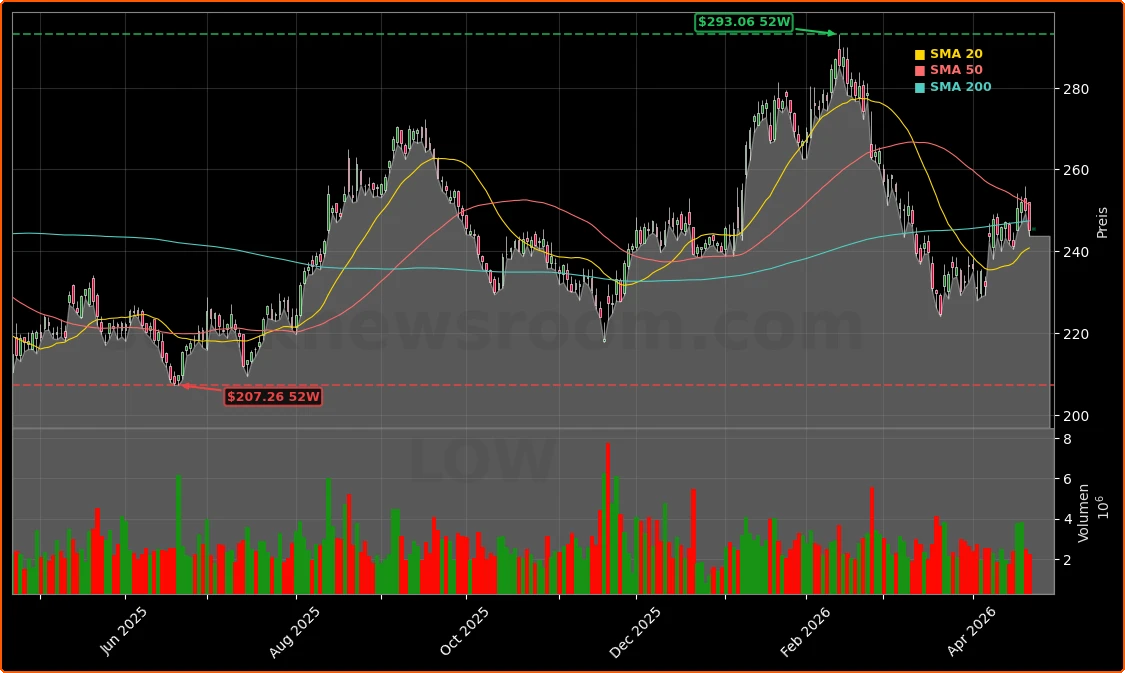
Lowe’s Companies, Inc. opened the session near $245, roughly flat versus its recent move above $250 but still below many analyst price targets that cluster just under $290. The current quote leaves the stock trading at a discount to those targets, implying upside if the company can keep delivering on its profit and capital‑return story. The latest Lowe’s Earnings report, which delivered earnings per share ahead of Street estimates on revenue of about $20.6 billion, reassured investors that management can defend margins despite softer unit volumes and a sluggish housing market.
On a trailing basis, the company continues to throw off substantial free cash that supports both a rising dividend and aggressive share repurchases. That combination has kept Lowe’s in the conversation with income‑oriented investors, even as yields on cash and Treasuries remain comparatively attractive. With a market cap firmly in large‑cap territory, Lowe’s remains a meaningful weight in many S&P 500 and consumer discretionary portfolios.
What are institutions signaling about Lowe’s Companies, Inc.?
Recent regulatory filings show that large asset managers are leaning into the Lowe’s story. Mirae Asset Global Investments lifted its position in Lowe’s Companies, Inc. by roughly 17% in the latest reported quarter, taking its stake to more than 100,000 shares valued at over $26 million. Merit Financial Group also boosted its holding by low double digits, while other long‑only firms such as Wellington Management and Victory Capital have been adding exposure. In aggregate, hedge funds and institutions now control more than 70% of the float, signaling broad professional conviction.
Analyst coverage mirrors that confidence. Market research shows a consensus rating in the “Moderate Buy” range, with multiple Wall Street firms reiterating positive stances after the most recent Lowe’s Earnings release. The average 12‑month price target sits close to $289, suggesting double‑digit percentage upside from current levels if management executes on guidance. While specific banks like Goldman Sachs or Morgan Stanley have not radically changed their views in recent weeks, the overall tone remains constructive rather than defensive.
How does Lowe’s stack up against Home Depot and peers?
Against core rival Home Depot, Lowe’s still plays catch‑up on professional contractor penetration, but the gap has been narrowing. Home Depot has been investing heavily in its Pro ecosystem, logistics, and digital capabilities to drive the next leg of growth, and Lowe’s has responded with its own targeted initiatives, particularly around simplifying the store base, enhancing merchandising, and sharpening its focus on higher‑ticket project business. For U.S. investors, that duopoly dynamic matters: both chains remain key proxies for home‑improvement demand and discretionary housing‑linked spending.
Paint specialist Sherwin‑Williams, appliance producer Whirlpool, and other building‑products names provide additional context. These companies are leaning on pricing power and replacement‑cycle demand to stabilize results, similar to how Lowe’s has relied more on big‑ticket projects and Pro customers to offset weaker small‑ticket DIY categories. For diversified portfolios holding sector heavyweights such as Apple or NVIDIA on the tech side, a position in LOW can offer a different economic driver tied to remodeling, household formation, and long‑term housing stock maintenance.
What do Lowe’s Earnings say about housing and the consumer?
The most recent Lowe’s Earnings commentary pointed to modestly improving comparable‑store trends after a period of negative comps, suggesting that big projects are still being done even as smaller, discretionary purchases are deferred. Management highlighted stabilization in categories like appliances and building materials, which tend to correlate with housing transactions and major renovations rather than pandemic‑era nesting behavior. That lines up with macro data showing a cooling but not collapsing U.S. housing market.
For Wall Street, the key question is whether this stabilization can persist if mortgage rates remain elevated into 2027. A prolonged high‑rate environment could cap new housing turnover, but it also tends to support repair‑and‑remodel activity as owners stay put and upgrade existing homes. In that scenario, Lowe’s and competitors like Home Depot and Sherwin‑Williams may remain relative winners versus more cyclical building‑products players.
What’s the risk‑reward for U.S. investors now?
With Lowe’s trading roughly in the mid‑$240s and the S&P 500 still digesting geopolitical and interest‑rate uncertainty, the stock offers a blend of income, buyback‑driven EPS growth, and moderate multiple expansion potential. The dividend yield, hovering just under 2%, looks modest against high‑yield credit but is backed by decades of consecutive hikes that place Lowe’s firmly in Dividend King territory. Continuous repurchases shrink the share count, magnifying per‑share earnings even if top‑line growth remains in the low single digits.
The main risks revolve around a deeper housing downturn, a sharp pullback in consumer spending, or missteps in competing for professional contractors. Execution on merchandising and supply chain remains critical, especially with competition from online players and specialty retailers. That said, the latest Lowe’s Earnings results and the visible support from institutional buyers give the stock a constructive setup within diversified U.S. equity portfolios that may already include high‑beta names such as Tesla or fast‑growing tech leaders like NVIDIA.