
Is Micron’s red-hot Micron AI Memory boom finally colliding with reality as the stock gives back part of its parabolic run?

Is Micron’s AI rally finally overheating?
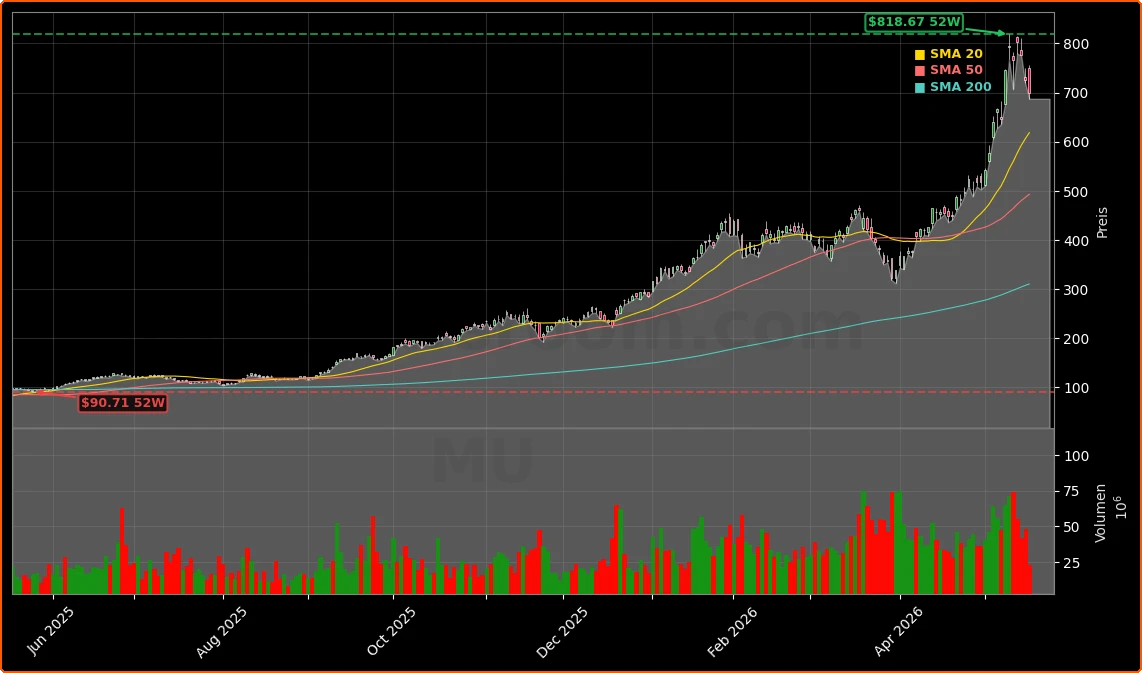
Micron has become one of the most explosive beneficiaries of the AI build‑out, with the stock up several hundred percent over the past year before the latest pullback. Even after today’s intraday decline to about $698, MU sits in rarefied air compared with its 52‑week low of $90.93, underscoring how aggressively investors have priced in the Micron AI Memory story. The move comes after a nearly 62% surge in under a month and a brief spike to an all‑time high of $818.67 last week, a pace that made a corrective phase increasingly likely.
The recent slide was amplified by sector‑wide weakness after headlines around uncertain AI chip deals between U.S. suppliers and Chinese buyers. Reports that Chinese hyperscalers such as Alibaba and ByteDance failed to secure government approval for new NVIDIA H200 purchases rattled the entire semiconductor complex, dragging memory names like Micron lower in sympathy. With MU already extended far above key moving averages, traders are now debating where a realistic downside floor might emerge, with some models highlighting support in the $680–$700 zone and deeper bear‑case scenarios pointing as low as the mid‑$200s in a severe downturn.
How strong is the Micron AI Memory demand story?
Beneath the price swings, Micron’s operating momentum is hard to ignore. Fiscal Q1 2026 revenue jumped to roughly $13.64 billion, up 56.6% year over year, while non‑GAAP EPS of $4.78 beat consensus by nearly a dollar. Guidance for Q2 points to $18.70 billion in sales and a 68% gross margin, driven largely by Micron AI Memory products such as HBM for GPUs and accelerators as well as high‑density DRAM for cloud and AI servers.
On the earnings call, CEO Sanjay Mehrotra stressed that the company cannot fully meet demand, noting Micron is only able to supply around 50% to two‑thirds of orders from several key customers. He also described the current gap between DRAM demand and supply, including HBM, as the most extreme the company has ever seen. That tightness is mirrored across the industry: consulting and market‑research firms expect memory shortages to persist through at least 2026, with some projections seeing DRAM and NAND revenue nearly tripling to more than $600 billion by mid‑decade on the back of AI workloads.
Unlike logic chips, memory capacity can in theory be expanded more quickly, and Micron along with peers like Samsung and SK Hynix is investing heavily in new fabs. Still, issues such as a potential Samsung labor strike and long HBM qualification cycles suggest that supply will not fully normalize overnight, supporting elevated pricing for Micron AI Memory components in the near term.
How do Micron, Nvidia and Sandisk stack up?
For U.S. investors, Micron now sits alongside NVIDIA and Sandisk as a core way to play AI infrastructure. GPUs from NVIDIA, custom accelerators from Broadcom, and CPUs from Intel all rely on high‑performance memory to avoid bottlenecks in both training and inference. As inference workloads migrate from the data center to edge devices like AI PCs, smartphones, and autos, the amount and speed of memory per device are rising, giving Micron leverage well beyond hyperscale cloud spending.
Micron’s diversified portfolio across DRAM, HBM, and NAND contrasts with Sandisk’s pure‑play NAND exposure. Some institutional strategies now treat the two as a relative‑value pair trade—overweighting Micron to express a view that HBM scarcity and AI server demand will stay tighter for longer than contract‑backed NAND pricing. Meanwhile, mega‑cap platform companies like Apple and Tesla are pushing on‑device AI, which also favors higher DRAM and flash content in their hardware ecosystems.
Valuation highlights the trade‑off. Micron’s forward P/E has compressed toward the high‑single‑digit to low‑teens range even after its rally, a steep discount to NVIDIA’s multiple but consistent with Micron’s history as a cyclical, commodity‑driven business. Bulls argue that if the Micron AI Memory cycle proves structurally different—supported by years of AI inference growth—earnings could stay elevated longer than in past booms. Skeptics counter that once capacity catches up and pricing normalizes, Micron’s multiple could quickly slide back toward single digits.
What is Wall Street saying now?
Wall Street remains broadly constructive despite the latest pullback. Bank of America recently lifted its MU price target to $950 from $500 while keeping a “Buy” rating, explicitly tying the call to Micron’s HBM ramp and its central role in AI data centers. Aggregated analyst data show roughly three dozen Buy ratings and no Sells, with average 12‑month targets clustering around the mid‑$400s to low‑$500s.
Institutional flows echo that optimism but with some nuance. Filings show firms such as WealthPlan Investment Management, May Hill Capital, and Chase Investment Counsel adding to MU positions in recent quarters, while others like Blume Capital Management and GLOBALT Investments have trimmed stakes after the run‑up. Insider selling has picked up as well, reflecting both profit‑taking and equity‑compensation vesting after a 700%‑plus rally. For long‑term investors, the key question is whether today’s volatility marks the start of a typical memory downcycle or a pause in a longer Micron AI Memory supercycle.
Related Coverage
Investors looking for a deeper dive into cycle risk versus AI upside may also want to read Micron Forecast -6.6%: AI Memory Boom or Classic Crash Risk?. That analysis examines whether current shortages and price strength in Micron AI Memory can persist or if they are already sowing the seeds of the next downturn.
We are only able to meet about 50% to two-thirds of our demand from several key customers, and the gap between the demand and supply for all of DRAM, including HBM, is really the highest that we have ever seen.— Sanjay Mehrotra, CEO of Micron Technology
Micron’s latest selloff underscores how tightly the stock is tethered to expectations for sustained Micron AI Memory demand, especially in HBM and high‑end DRAM. For U.S. investors, MU remains a high‑beta way to express a view on the durability of the AI infrastructure build‑out across the NASDAQ and S&P 500. The next few quarters of earnings and capacity announcements will show whether today’s consolidation is a buying opportunity or the first leg of a more classic memory cycle reset.