
Can the bullish Micron Forecast survive AI memory shortages and wild price swings, or is this supercycle already peaking?

Is Micron Technology still leading the AI trade?
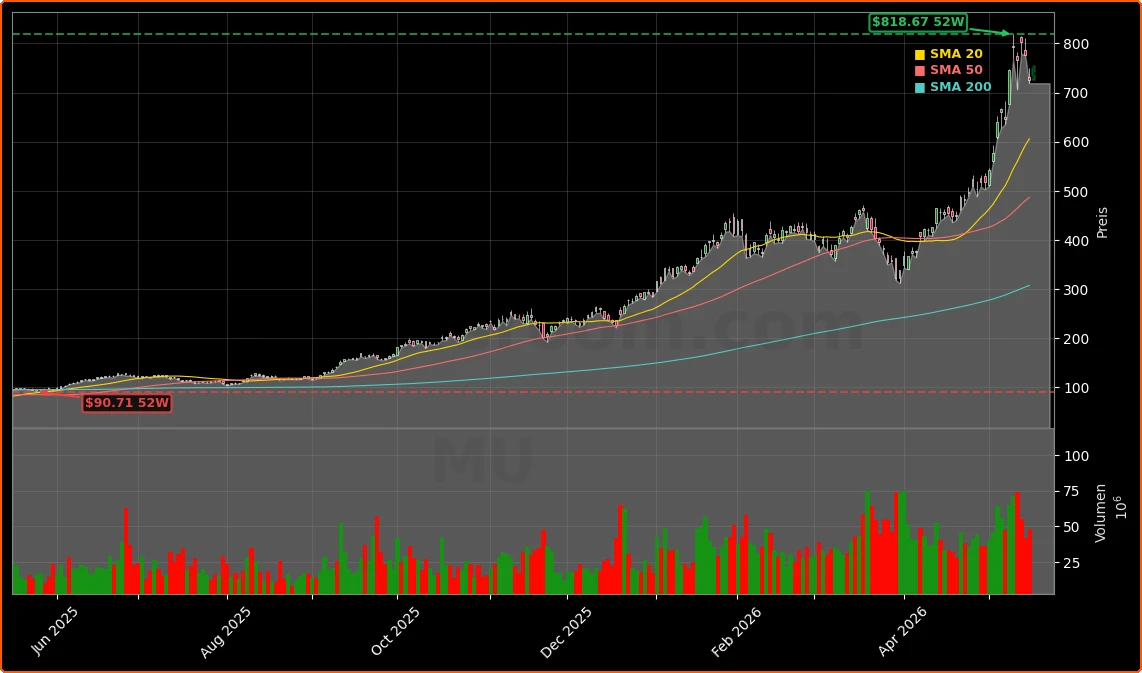
Micron shares have surged more than 60% in under a month before pulling back roughly 7% on May 15, landing close to $724 in intraday trading and modestly rebounding in early Monday action. The drop followed a broader semiconductor selloff tied to disappointment over the Trump–Xi summit in Beijing, where reports suggested no large AI chip deals were finalized and Chinese cloud giants like Alibaba and ByteDance failed to secure approvals for fresh orders from NVIDIA. That macro uncertainty hit AI‑linked names across the board, including Micron, AMD, Intel and Qualcomm.
Despite the volatility, the fundamental backdrop is unusually strong. Fiscal Q1 2026 revenue jumped to about $13.64 billion, up 56.6% year over year, with non‑GAAP EPS of $4.78 beating Wall Street estimates around $3.94. Guidance for Q2 2026 points to roughly $18.7 billion in revenue and a 68% gross margin, driven primarily by tight supply in DRAM and especially HBM for AI accelerators. CEO Sanjay Mehrotra told investors Micron is currently able to meet only about 50% to two‑thirds of demand from several major customers, calling the gap between memory demand and supply the largest the company has ever seen.
How does the Micron Forecast balance upside and cyclicality?
The Micron Forecast from major banks underscores just how wide the potential path has become. Bank of America recently raised its price target on Micron to $950 from $500 while maintaining a Buy rating, effectively endorsing the idea that this AI‑driven memory supercycle could take the stock toward the $1 trillion market‑cap club over the next several years. A separate long‑term scenario from 24/7 Wall St. outlines a bull case with Micron at about $1,025 to $1,054 by 2030, assuming roughly 20% annual bit shipment growth and sustained HBM share.
Consensus, however, is far less aggressive. Across Wall Street, the average 12‑month target still sits closer to the mid‑$500s, and some models highlight material downside risk if the cycle turns. Low‑end targets for a realistic downturn range from about $249 to $435, and technical models point to the 200‑day moving average near $294 as a potential floor if sentiment sours. With the 52‑week low at just $90.93 and the recent high at $818.67, Micron’s trading range illustrates both explosive upside and classic memory‑sector volatility.
What are valuation and institutional flows signaling?
On valuation, Micron looks inexpensive against its own history and versus AI peers. The forward P/E multiple is near 8, unusually low for a stock that has rallied several hundred percent in the last few years and is now delivering triple‑digit revenue growth. The trailing P/E near 34 reflects how quickly earnings are inflecting from a recent downturn, including a fiscal 2023 net loss of about $5.8 billion on $15.5 billion in sales. Historically, memory stocks have reverted to single‑digit earnings multiples once supply catches up, so some investors expect today’s mid‑teens to high‑single‑digit multiples to compress again after this cycle peaks.
Institutional positioning remains broadly constructive. WealthPlan Investment Management recently disclosed a new Micron stake of 4,509 shares valued around $1.29 million, while May Hill Capital also initiated a position worth roughly $534,000. Chase Investment Counsel boosted its holdings by more than 70%, underscoring confidence in Micron’s earnings trajectory and AI exposure. At the same time, firms like Blume Capital Management and GLOBALT Investments have trimmed positions, and a wave of insider selling — including transactions by directors and executives — has raised questions about where management believes the current cycle stands, even if some sales are tied to equity compensation after a 700%‑plus run.
How does Micron stack up against NVIDIA and other AI winners?
For AI‑focused portfolios, Micron plays a different role than GPU leader NVIDIA or electric‑vehicle bellwether Tesla. NVIDIA’s GPUs sit at the heart of AI training clusters and carry far more pricing power than commodity memory, which helps smooth its earnings over the cycle. Micron, by contrast, sells DRAM, NAND and HBM into a market where products are more interchangeable and pricing is acutely sensitive to supply‑demand balances. When demand is tight, Micron’s revenue and margins can explode higher; when capacity catches up, pricing can crater and earnings compress rapidly.
For some investors, that makes Micron a high‑beta levered bet on the AI build‑out, while names like Apple or NVIDIA function as “set‑it‑and‑forget‑it” AI exposure. Micron’s structural advantages — including U.S.‑based fabs drawing on domestic helium and grid power — are becoming more valuable as geopolitical and energy‑security considerations factor into where data‑center capacity gets built. But the memory business is still cyclical at its core, and the current Micron Forecast embeds both spectacular growth assumptions and the risk that supply expansions from Micron, Samsung and SK Hynix eventually overshoot.
Related Coverage
Investors looking for a deeper dive into the AI memory cycle can review the analysis in “Micron HBM Boom -3.4%: Is the AI Memory Supercycle Peaking?”. That piece explores whether the latest pullback marks a healthy pause or an early sign that the HBM‑fueled rally is running out of steam, and how supply responses from major DRAM players could shape Micron’s earnings path from here.
We are only able to meet about 50% to two-thirds of our demand from several key customers, and the gap between the demand and supply for all of DRAM, including HBM, is really the highest that we have ever seen.— Sanjay Mehrotra, CEO of Micron Technology, Inc.
The Micron Forecast today sits at the crossroads of a historic AI‑driven demand surge, unusually tight memory supply and a valuation that still looks modest versus growth. For U.S. investors, Micron offers outsized upside but demands careful risk management and attention to the cycle. The next few quarters of AI data‑center spending and pricing updates will determine whether Micron earns the lofty long‑term targets now emerging or if this Micron Forecast proves too optimistic for such a cyclical business.