Why are MicroStrategy executives preparing stock sales just after another major Bitcoin buy?

Why Did Leadership Sell Shares After Buying Bitcoin?
MicroStrategy Incorporated’s decision to acquire 1,550 Bitcoin for $101 million — lifting its treasury to 845,256 BTC valued at approximately $53 billion — was widely interpreted as a bullish signal. Yet the simultaneous filing of Form 144 notices by CEO Phong Le and CFO Andrew Kang has created dissonance. Neither filing indicates immediate execution — both allow sales within a 90-day window — but the timing has unsettled traders already wary of MSTR’s 11% net leverage and its outsized beta to Bitcoin. Unlike typical insider sales tied to diversification or estate planning, these filings follow restricted stock vesting events on June 4, 2026, and align with broader insider activity: Jarrod Patten sold over 15,000 shares between March and May, while Kang previously offloaded 9,886 shares. The juxtaposition — buying hard assets while monetizing equity — underscores the tension between macro conviction and personal liquidity needs.
How Does This Compare to Broader Crypto Equity Trends?
While MicroStrategy Incorporated remains the most leveraged Bitcoin proxy listed on NASDAQ, its recent volatility contrasts sharply with more diversified crypto-adjacent names. Coinbase, for example, reported its 13th consecutive quarter of positive adjusted EBITDA ($303.3 million) and executed a $500 million cost-savings initiative — signaling operational discipline absent at MSTR. Meanwhile, spot Bitcoin ETFs saw $2.6 billion in net outflows in Q2 2026, per Bloomberg data, even as corporate buyers like MicroStrategy Incorporated absorbed $2 billion in BTC. That divergence highlights a key risk: MSTR’s valuation is almost entirely tethered to Bitcoin price action and financing costs, whereas firms like Apple and NVIDIA benefit from structural AI and hardware tailwinds independent of crypto sentiment. RBC Capital Markets recently downgraded MSTR to ‘Underperform’, citing ‘unquantifiable margin-call risk’ despite Polymarket assigning only an 8% probability to such an event in 2026.
What’s the Real Message Behind the MicroStrategy Insider Sale?
This MicroStrategy Insider Sale isn’t isolated — it’s part of a pattern. Since March 2026, insiders have filed notices to sell over 50,000 Class A shares, mostly tied to vesting and option exercises. Yet the June 9 filings stand out not for size, but for proximity to the $100 million Bitcoin buy. Critics, including ARCA’s Chief Investment Officer Jeff Dorman, argue the move undermines Saylor’s ‘digital gold’ narrative. Bullish voices like Lawrence Lepard counter that the sales are immaterial relative to MSTR’s $53 billion BTC stack and reflect routine compensation mechanics — not loss of faith. Still, options data shows rising put volume, with large institutional accounts positioning for further downside. The disconnect between macro thesis and micro execution remains the core friction point for U.S. portfolio managers weighing MSTR against broader S&P 500 tech exposure.
Is MSTR Still a Viable Bitcoin Proxy for U.S. Investors?
I think it’s a $1,000 stock within a few years.— Lawrence Lepard
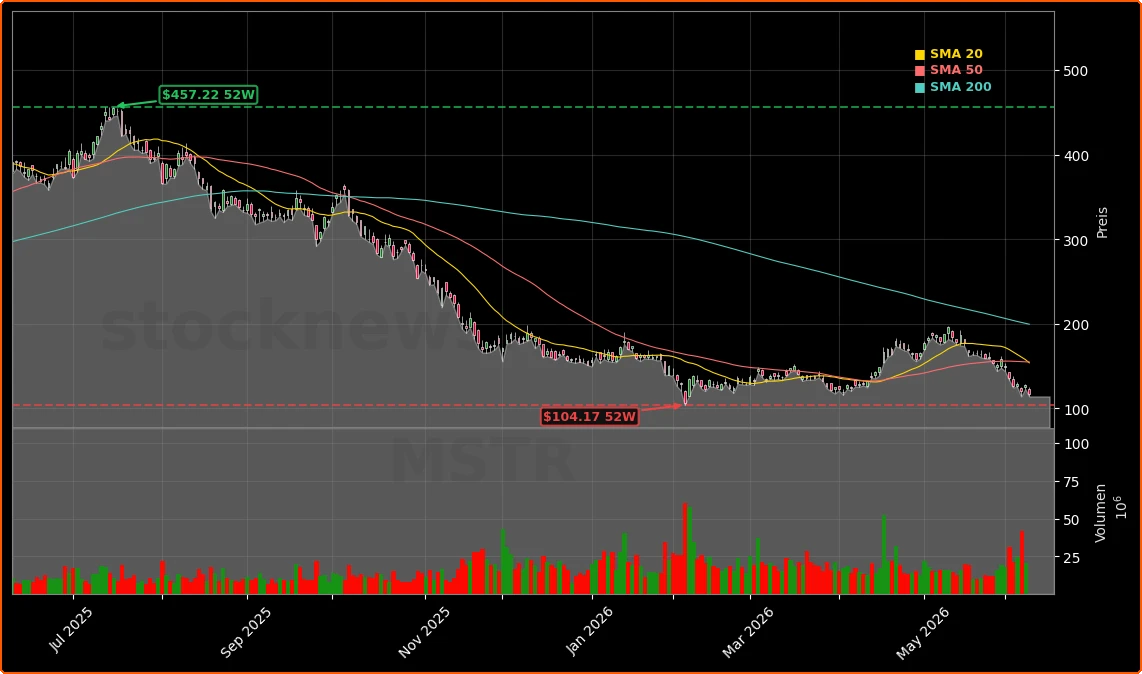
For U.S. investors seeking regulated Bitcoin exposure, MSTR competes directly with spot ETFs — but with dramatically higher risk-adjusted volatility. While ETFs offer liquidity and transparency, MSTR delivers leveraged, uncorrelated beta: it rose 6% on the $100 million BTC buy but plunged 35% in the prior month as Bitcoin fell 21%. Its 52-week high remains $382.96 — nearly 3.3x current levels — underscoring how far it has retreated. Yet institutional demand persists: BlackRock and Vanguard added $1.344 billion in MSTR shares in Q2, per TradingView. That duality — retail skepticism versus institutional accumulation — defines MSTR’s current crossroads. Unlike traditional tech names where earnings drive valuation, MSTR’s price hinges on three variables: Bitcoin price, USD interest rates, and confidence in Saylor’s capital stack. With the Federal Reserve holding rates steady and Bitcoin stabilizing near $63,500, the next catalyst may be S&P 500 inclusion speculation — a potential liquidity upgrade many analysts now rate as 40% probable by year-end.