Can Nike’s turnaround survive another Wall Street reset, or is the brand’s recovery story slipping further into the future?

Why Did RBC Cut Nike’s Target?
RBC Capital Markets, led by analyst Piral Dadhania, downgraded Nike, Inc. and reduced its price target to $50—$20 below its prior $70 outlook—citing persistent execution gaps under CEO Elliot Hill. The firm now expects Nike’s turnaround to materialize in 2027, not 2026, directly challenging the narrative that the FIFA World Cup would catalyze immediate growth. Revenue growth for fiscal 2026 is now projected at just 3%, well below the industry average of 6%. RBC also cut profitability forecasts by 9% for 2027 and 13% for 2028—leaving them 2% below consensus. That’s not just a slowdown; it’s a structural recalibration of investor expectations for one of the NASDAQ’s most iconic consumer brands.
What’s Holding Back Nike Forecast Momentum?
Despite beating Q3 revenue estimates at $11.28 billion, Nike’s year-over-year revenue was flat—and Nike Direct sales fell 4%. That’s a red flag for a company increasingly reliant on direct-to-consumer channels. Worse, product execution stumbles—including design flaws in World Cup jerseys (notably shoulder puckering) and late retailer deliveries—undermine Hill’s ‘back to sport’ strategy. Meanwhile, labor restructuring continues: 775 U.S. distribution center jobs cut in early 2026 followed 1,000 corporate layoffs last summer. These moves were meant to fuel agility—but markets now interpret them as signs of internal strain. Competitors like Lululemon and Deckers Outdoor (Hoka) are gaining share in running and premium apparel, while Apple and Tesla continue to set the pace for brand-led digital engagement—areas where Nike lags.
How Does Nike Compare to Peers?
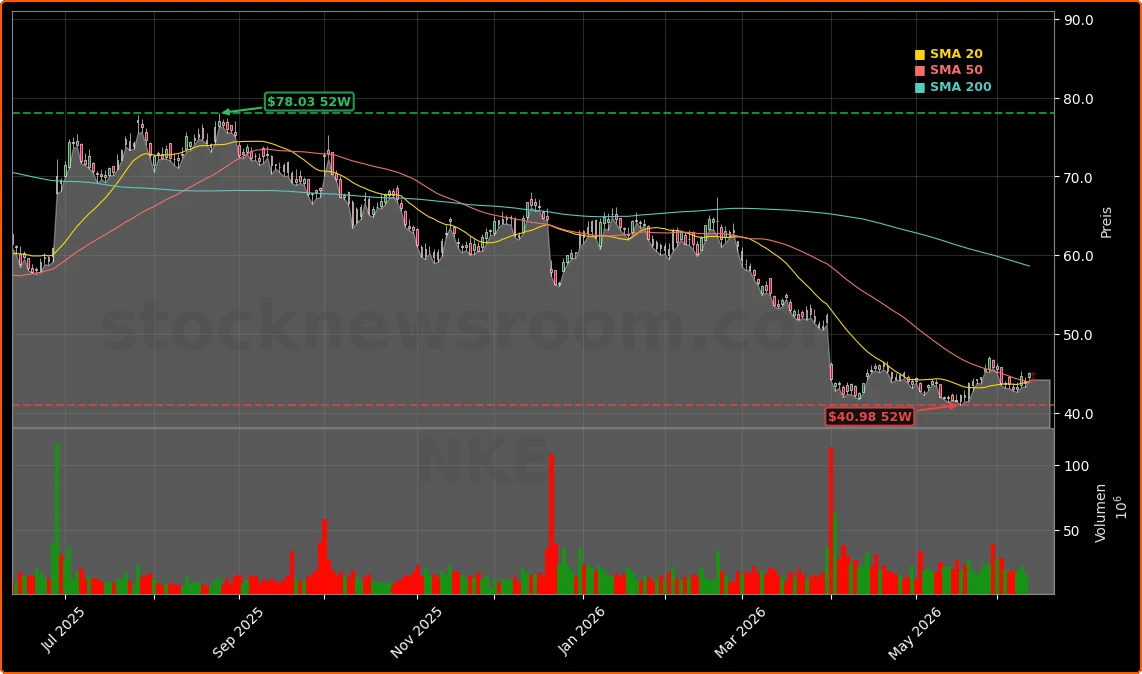
Nike, Inc. trades at a steep discount to peers on growth and momentum metrics. While Lululemon (LULU) trades at 28x forward earnings with 12% projected revenue growth, Nike trades at just 16x with flat growth. Deckers Outdoor (DECK) is up 22% year-to-date, while Nike is down 30.53% YTD—and 45% since Hill’s appointment. Even in the S&P 500 consumer discretionary index, Nike underperforms by over 500 basis points. Bloomberg’s recent commentary reinforces RBC’s concerns, noting ‘sand in the gears’ across Hill’s turnaround—particularly in North America and Greater China, where inventory misalignment and soft demand persist. The $30 billion productivity hit U.S. employers may face during the World Cup isn’t translating into Nike sales lift.
Is the Nike Forecast Still Investable?
The $43.78 after-hours price reflects deep skepticism—but also opportunity. With a 3.6% dividend yield and Benzinga’s valuation screener placing Nike in the 65th percentile for value, the stock appeals to income-focused investors willing to wait. Yet the Nike Forecast from RBC isn’t isolated: Citigroup recently reiterated ‘Neutral’ with a $48 target, while Morgan Stanley cut its 2027 EPS estimate by 7%. The core issue isn’t profitability—it’s growth visibility. Without meaningful product innovation or faster market share recapture in running and women’s premium apparel, Nike risks becoming a value trap. That said, the UEFA ball supplier talks (potentially replacing Adidas in 2027) and Hill’s sport-first pivot could still catalyze a re-rating—if execution improves in H2 2026.
What’s Next for Nike Forecast Timing?
Q2 2026 earnings—due in late September—will be the first true test of Hill’s reset. Investors will scrutinize North America gross margin recovery, Greater China inventory digestion, and digital sales inflection. Until then, the Nike Forecast remains anchored in caution—not collapse. The World Cup is underway, but Nike’s brand heat isn’t yet showing up in sell-through data or wholesale reorder rates. With shares trading near 11.5-year lows, the margin for error has narrowed. The next catalyst won’t be marketing—it will be measurable, sequential improvement in sport-specific footwear and apparel velocity.
Related Coverage: For deeper context on Nike’s earnings pressure and dividend sustainability, read Nike Earnings Warning: Flat Q3 Revenue And Dividend Strain. Meanwhile, global regulatory shifts are reshaping tech-consumer linkages—see how Alibaba Regulation Sparks Selloff as BABA Jumps 5% Late impacts cross-border apparel supply chains and digital commerce infrastructure.
The benefits of Hill’s turnaround strategy are now expected to materialize only in 2027, not 2026.— Piral Dadhania, RBC Capital Markets
Nike, Inc. remains a foundational brand—but its Nike Forecast is now firmly in the ‘wait-and-see’ zone for U.S. investors. The path to recovery hinges on execution, not announcements. The next quarterly earnings will show whether momentum is building—or fading.