Can Rheinmetall’s new Drone Shield pivot offset a sharp share price slide as investors rotate out of classic war trades?

Why is Rheinmetall under pressure today?
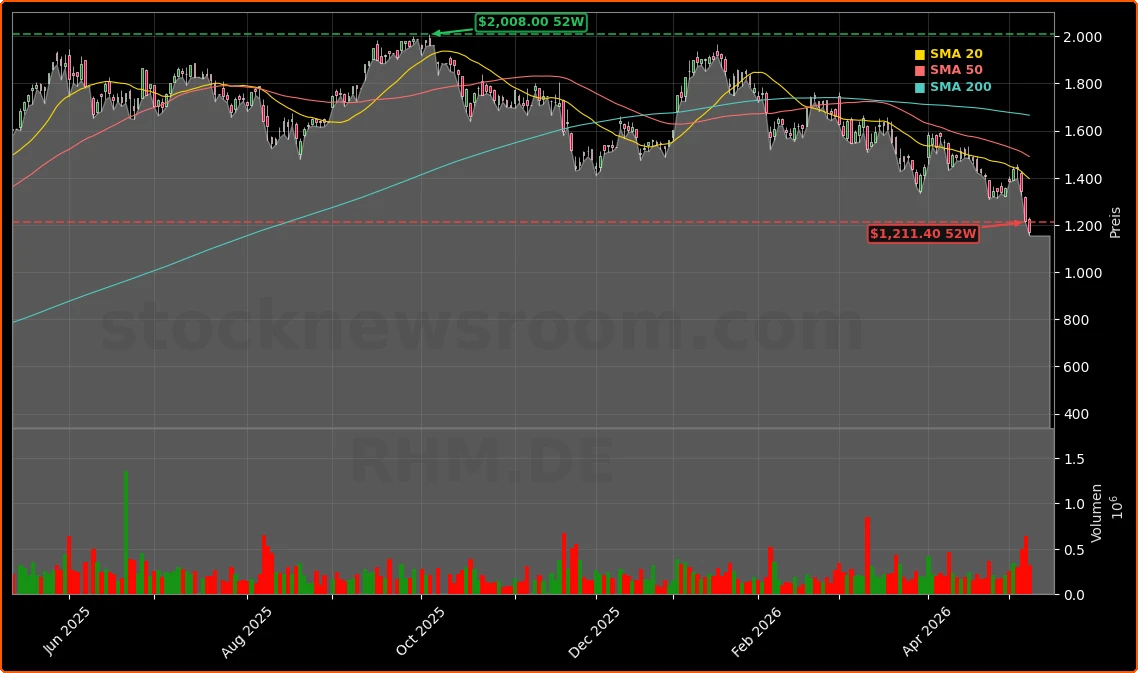
Rheinmetall (RHM.DE) traded weaker on Monday, changing hands around EUR 1,168.60 and extending a recent slide of more than 20% below its 50-day moving average. The stock is down roughly 4% on the day and has dropped about a quarter since the start of 2026, as European defense names fall out of favor amid renewed peace efforts in Ukraine and a broader rotation out of war-beneficiary trades.
Analysts highlight that the selling is less about a broken business model and more about recalibrated expectations. Bernstein Research warned that a durable cease-fire in Ukraine would remove a key driver for land-systems demand such as ammunition, armored vehicles and transport platforms, segments where Rheinmetall is heavily exposed. At the same time, Warburg Research upgraded the shares to “Buy,” arguing that the recent selloff looks overdone given the company’s strong order book and ongoing margin expansion.
Barclays also trimmed its stance, cutting its price target from EUR 2,125 to EUR 2,035 while maintaining an “Overweight” rating. That combination – lower target but still positive recommendation – typifies the mood on Wall Street and in Europe: investors still see structural upside in defense, but they are no longer willing to pay peak war-premium valuations.
What is the Rheinmetall Drone Shield with Deutsche Telekom?
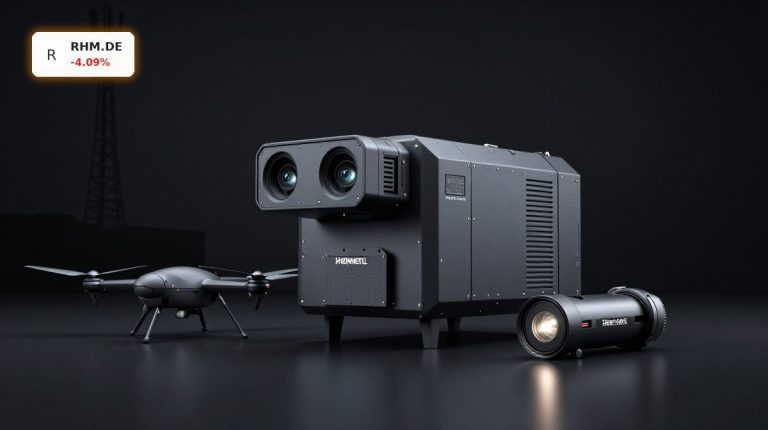
Against this backdrop, the Rheinmetall Drone Shield project with Deutsche Telekom stands out as a bid to reposition the group as a technology-driven security provider rather than just a tank and ammunition supplier. The two DAX constituents plan to develop a multi-layer protection system for cities and critical infrastructure in Germany, combining cyber capabilities, radio-frequency (RF) and cellular sensing, and physical interceptors.
The concept centers on detecting hostile or unauthorized drones as early as possible and then neutralizing them using jamming signals, interceptor drones, or in the future, laser-based effectors. Unlike traditional anti-aircraft guns, the system focuses on smaller, low-flying drones that can be used for espionage, sabotage or attacks on energy facilities, industrial sites, ports and transportation hubs.
Deutsche Telekom contributes expertise in mobile networks, secure connectivity, cloud and data analytics, turning parts of the cellular grid into a kind of radar. Passive RF sensors mounted on cell towers can pick up remote-control signals without emitting active search beams, reducing interference with normal communications. Rheinmetall supplies the sensor payloads, kinetic and non-kinetic effectors, and integrates the data for command-and-control. Management describes the threat as “highly digital,” arguing that only an integrated stack of sensors, effectors and hardened communications will be effective.
How does this fit Rheinmetall’s broader strategy?
The Rheinmetall Drone Shield initiative dovetails with a series of moves into naval platforms and advanced air defense. The company recently entered shipbuilding by acquiring the naval division of the Lürssen group and has now submitted a non-binding offer for German Naval Yards Kiel, setting up a potential bidding contest with Thyssenkrupp Marine Systems. A successful deal would position Rheinmetall more strongly for upcoming German frigate programs, including the F126 line, which has been discussed with an order-of-magnitude value in the low double-digit billions of euros.
On the technology side, Rheinmetall has showcased its own interceptor drone at industry fairs and is co-developing laser-based air-defense systems with MBDA, including tests aboard the German Navy frigate “Sachsen.” It is already cooperating with Hamburg’s police and port authority on drone detection and response solutions, underscoring the dual-use potential of the Rheinmetall Drone Shield for both military and civilian customers.
Financially, the company continues to grow. In Q1 2026, revenue rose about 7.7% year-on-year to roughly EUR 1.94 billion, though it missed consensus expectations near EUR 2.3 billion after some projects were shifted into later quarters. Operating margin, however, improved to 11.6%, with profit growing faster than sales. The order backlog stands at about EUR 25.8 billion, and including framework contracts, the pipeline reaches roughly EUR 73 billion. Management still guides for 40–45% revenue growth for the full year and an operating margin around 19%.
What does it mean for U.S. and tech-focused investors?
For U.S.-based investors used to drone and defense exposure via NVIDIA, Apple’s secure-device ecosystem, or aerospace primes like Lockheed Martin and Northrop Grumman, the Rheinmetall Drone Shield is another sign that drone defense is becoming a software-and-sensor problem as much as a hardware one. Rheinmetall’s collaboration with a telecom operator mirrors trends in the U.S., where defense contractors increasingly partner with cloud and carrier players instead of going it alone. The use of mobile networks as a detection layer rhymes with how U.S. firms deploy edge computing and AI at the network level to monitor low-altitude airspace.
From a portfolio-construction standpoint, the stock’s steep drawdown and solid backlog could appeal to investors looking for contrarian defense exposure outside the S&P 500. Volatility remains elevated as peace headlines, budget debates and ESG constraints shape flows into European arms makers. Yet if Rheinmetall executes on its growth targets and successfully commercializes its drone and laser offerings, the current derating may eventually give way to renewed interest, especially from global funds that already hold U.S. defense, cybersecurity and communications names such as Tesla’s satellite connectivity ventures or big cloud platforms.
The threat from drones is highly digital, which means effective defense must tightly connect sensors, effectors and secure communications networks.— Armin Papperger, CEO of Rheinmetall
In conclusion, the Rheinmetall Drone Shield highlights how the German group is leaning into digital defense just as its share price faces a harsh sentiment reset. For international investors, the combination of a depressed valuation, expanding margins and a strategic push into high-tech drone protection could be an attractive, if volatile, complement to U.S.-listed defense and security plays. The next few quarters will show whether the partnership with Deutsche Telekom and the naval expansion can turn today’s skepticism into a renewed growth story.