Can SpaceX still outrun global launch rivals as China closes the gap and investors punish execution risk?

Is SpaceX’s Launch Dominance Slipping?
China’s Long March 10B booster recovery — captured on video by Xinhua and CCTV — wasn’t just symbolic. Using a novel net-and-hook system aboard the Linghangzhe vessel, Beijing achieved what no other nation has: controlled, reusable orbital launch capability outside U.S. jurisdiction. While SpaceX has completed 614 Falcon 9 landings and 579 reuses, China’s breakthrough narrows the operational gap — especially as its state-backed SpaceSail deploys 200 satellites toward a rival to Starlink. Crucially, the Long March 10B’s 16-ton payload capacity still trails Falcon 9’s 25 tons and Starship’s 100+ ton target, but Elon Musk himself acknowledged in October 2025 that China’s methalox stainless-steel architecture ‘would enable it to beat Falcon 9.’ That admission, now backed by flight data, redefines the SpaceX Rocket Competition as a near-term execution race — not a long-term inevitability.
How Is Wall Street Pricing the Competition?
Raymond James analyst Brian Gesuale initiated coverage with a $800 price target — the highest on Wall Street — anchored in Starship’s potential to slash orbital launch costs by 99%. Yet Goldman Sachs issued a more conservative $205 target, citing ‘billion-dollar execution risk’ in Starship certification and Starlink Gen3 satellite deployment. Meanwhile, CFRA maintains a ‘Sell’ rating, arguing SpaceX’s $1.96 trillion market cap trades at 105x 2025 revenue — a multiple no space or AI infrastructure firm has ever sustained without near-term profitability. The bond market echoes this caution: SpaceX’s 2056 notes have fallen to 94.52 cents on the dollar, pushing yields higher — a signal that fixed-income investors demand more compensation for SpaceX’s capital intensity and regulatory uncertainty.
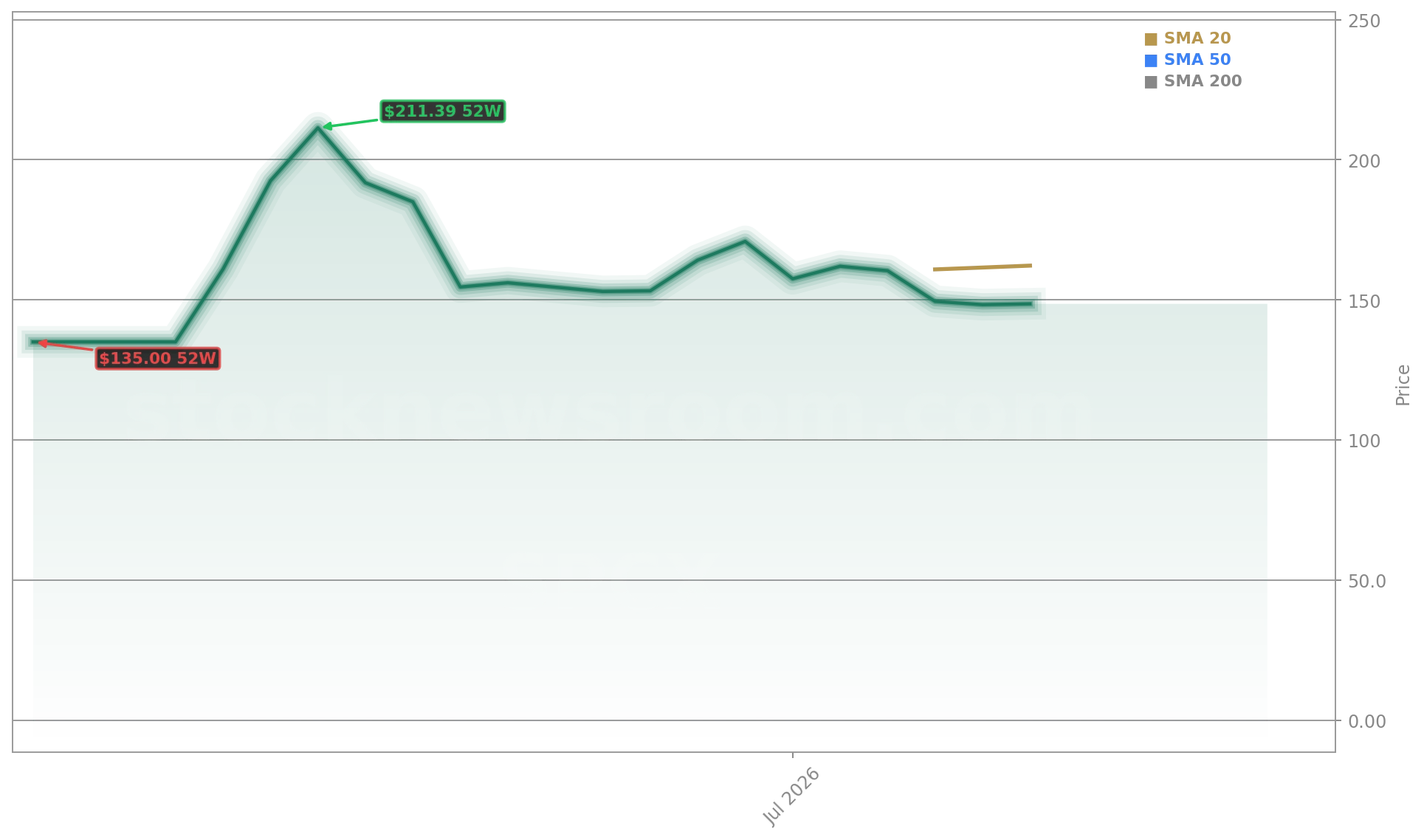
What’s Driving the $148.65 Price Action?
Three structural forces converged this week: (1) The July 7 Nasdaq-100 inclusion triggered $4.3 billion in passive index buying — immediately followed by institutional ‘sell-the-news’ activity; (2) Lock-up expirations loom in late July, unlocking ~20% of total shares; and (3) Grok 4.5’s aggressive $2/million input-token pricing failed to lift sentiment, as shares fell 1% on launch day. Notably, SpaceX’s AI compute deals with Google Cloud and Anthropic — while validating its infrastructure thesis — also expose it to hyperscaler budget discipline. As Bloomberg noted, ‘AI capital expenditure deceleration could drag on financials’ — a risk absent from Raymond James’ $800 model. The stock’s 25% drop from its $225.64 peak reflects this recalibration: investors now price SpaceX not as a monolithic ‘21st-century infrastructure layer,’ but as a portfolio of interdependent bets — Starship, Starlink, and SpaceXAI — each with distinct regulatory, technical, and competitive hurdles.
Where Does SpaceX Rocket Competition Go From Here?
I was clearly wrong about Anthropic. They are obviously currently the leader in AI. No company has released a model as good as Mythos/Fable and they will undoubtedly have Mythos 2 ready soon.— Elon Musk
With NVIDIA GPUs powering Grok 4.5 and Tesla co-developing autonomous launch systems, SpaceX’s ecosystem remains uniquely integrated. But China’s progress — and Blue Origin’s November 2025 New Glenn landing — means the SpaceX Rocket Competition is no longer a solo act. Oppenheimer sees Starlink threatening U.S. telecom incumbents in rural markets, while RBC Capital Markets warns that ‘Starship delays could compress EBITDA margins by 18% in 2027.’ The next catalyst? Q2 2026 earnings — SpaceX’s first quarterly report as a public company — due in late July. It will test whether $38.5 billion in projected 2026 revenue is credible amid falling bond prices and rising options put volume. For U.S. portfolios, the stakes are clear: a sector-weighted NASDAQ-100 now holds SpaceX at ~1%, making its volatility a direct input into tech-heavy index performance.