
Can the latest Applied Materials Earnings and bullish AI guidance justify the stock’s massive run, or is optimism peaking?

How did Applied Materials Earnings surprise Wall Street?
For its fiscal second quarter, Applied Materials, Inc. delivered new records on the top and bottom line. Revenue climbed 11% year over year to $7.91 billion, above consensus estimates around $7.65–$7.7 billion. Adjusted earnings per share came in at $2.86, beating expectations near $2.66–$2.68. On a GAAP basis, EPS surged to $3.51, helped in part by unrealized gains on strategic investments.
Profitability was a key highlight of the latest Applied Materials Earnings release. The non-GAAP gross margin improved to 50.0%, its highest level in more than 25 years, while the operating margin reached about 32.1%. In the core Semiconductor Systems segment, operating margin rose to an impressive 35.2%, underscoring strong pricing power and favorable mix toward leading-edge tools used in AI and high-performance computing.
Net income attributable to shareholders increased roughly 31% year over year to about $2.81 billion, reflecting both higher volumes and margin expansion. Management also raised the quarterly dividend by 15% to $0.53 per share and continued share repurchases, signaling confidence in long-term cash generation despite near-term investment headwinds.
What is driving the stronger guidance at Applied Materials?
The real catalyst in the Applied Materials Earnings report was the outlook for fiscal Q3. Management guided revenue to a range of $8.45–$9.45 billion, with a midpoint of $8.95 billion, well ahead of prior Street expectations around $8.1–$8.2 billion. Adjusted EPS is projected between $3.16 and $3.56, with a midpoint of $3.31, again comfortably above the roughly $2.88–$2.89 analysts had modeled.
CEO Gary Dickerson tied the stronger guidance directly to a global AI infrastructure build-out. Demand remains robust for high-bandwidth memory (HBM), advanced DRAM, and leading-edge logic chips used in accelerators designed by companies like NVIDIA. The company also sees growing opportunities in advanced packaging technologies, which are increasingly critical for AI accelerators and heterogeneous compute architectures.
Reflecting that momentum, Applied Materials now expects the semiconductor equipment market to grow more than 30% this calendar year, up from a prior forecast of above 20%. The company also signaled confidence that growth above 30% can continue into 2026, pointing to a multiyear investment cycle in AI data centers, high-performance computing, and next-generation memory.
How did the stock react compared with other AI leaders?
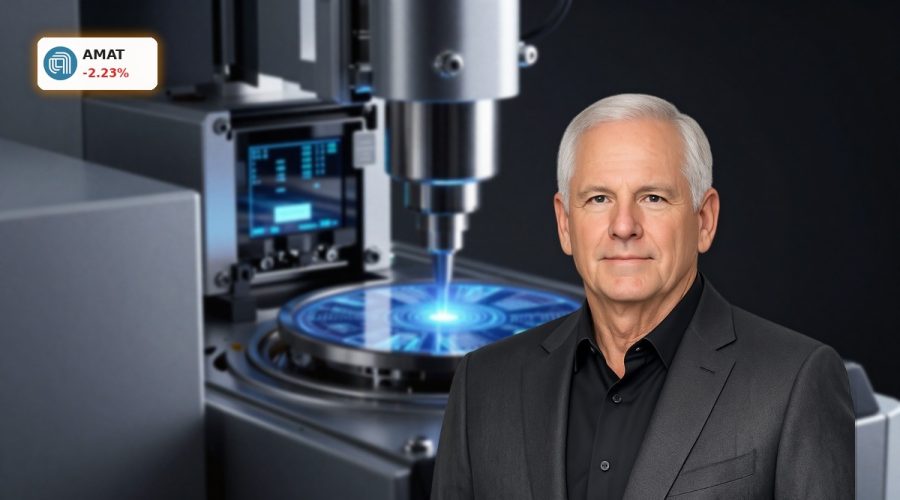
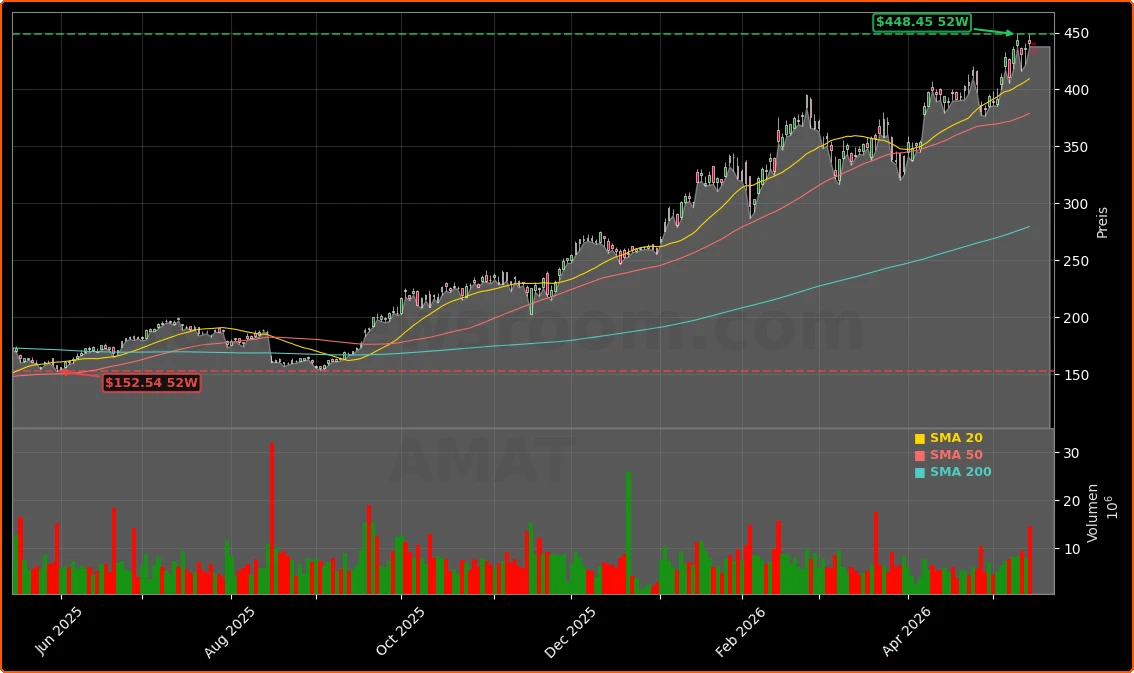
Despite the upbeat Applied Materials Earnings and raised outlook, the stock is under pressure in early Friday trading. AMAT closed Thursday at $440.56, up 0.90% on the day, but is quoted around $430.75 in pre-market trading, down about 2.2%, as a broader selloff hits chip names on both sides of the Atlantic.
The stock had already surged more than 70% year to date and over 150% versus a year ago, recently trading near its 52-week high around $448.45. That rapid ascent has pushed valuation metrics well above historical averages and sector peers, leaving the shares vulnerable to profit-taking even on strong news. Similar volatility has been visible this week in AI-related leaders like NVIDIA and other semiconductor names, as investors periodically question how long the AI boom can sustain current spending levels.
Still, several Wall Street firms remain constructive. Citigroup recently reiterated a Buy rating on AMAT and raised its price target to $520, citing improved earnings visibility and leverage to AI capital spending. Goldman Sachs also highlighted that the Q2 performance exceeded already elevated expectations and argued that the long-term AI equipment cycle remains underappreciated in many models.
Are there risks behind the strong Applied Materials Earnings?
Beneath the headline strength, the latest Applied Materials Earnings also revealed some pressure points. Free cash flow on a non-GAAP basis fell sharply, down about 80% year over year to roughly $210 million from more than $1 billion in the year-ago quarter. The drop was driven by elevated capital expenditures, particularly for the company’s roughly $5 billion EPIC Center, as well as deliberate increases in inventory and receivables intended to secure supply during the ongoing demand surge.
Geographic exposure also remains a double-edged sword. China accounted for about 27% of quarterly revenue, or roughly $2.09 billion, while Taiwan and Korea are also major contributors. Recent strength has benefited from catch-up shipments following easing of some trade frictions, but future U.S. export controls or geopolitical tensions could constrain shipments of advanced tools. For U.S.-based investors, that concentration underscores a key macro risk that stands alongside the AI opportunity.
At the same time, Applied Materials is broadening its strategic partnerships: the EPIC Center initiative has drawn in major customers such as TSMC, Samsung, and SK Hynix, positioning the company at the heart of next-generation process technologies that will underpin chips used in products from Apple and other global tech platforms.
Valuation is another consideration. The forward price-to-earnings multiple for 2026 is estimated near 39, almost double the company’s five-year average and meaningfully above many capital-equipment peers, even after accounting for its AI leverage. That premium explains why, despite stellar Applied Materials Earnings, the stock’s upside reaction has been limited and sensitive to broader risk-off moves in the NASDAQ and S&P 500.
The rapid global build-out of AI infrastructure combined with Applied Materials’ technology leadership in logic, memory and advanced packaging creates an exceptionally strong foundation for sustainable revenue and earnings growth.— Gary Dickerson, CEO of Applied Materials
For diversified U.S. portfolios, AMAT now sits at the crossroads of two forces: a powerful, multi-year AI capital spending cycle that favors high-quality enablers, and a crowded trade where expectations and valuations are already elevated.