
Can the Cardano Upgrade turn whale buying into a lasting breakout, or is this just another crypto head fake?

What Does the Cardano Upgrade Mean for U.S. Portfolio Allocation?
For American investors monitoring the NASDAQ’s growing crypto-linked exposure — including firms like NVIDIA and Tesla that increasingly interface with blockchain infrastructure — the Cardano Upgrade represents more than technical progress. It’s a stress test for governance-first blockchains in a bear market. Unlike Ethereum’s EIP-4844 or Solana’s Firedancer rollout, Cardano’s RealFi initiative focuses on off-chain compliance rails, identity-layer integrations, and tokenized real-world assets (RWAs) — features that resonate with U.S. institutional capital seeking regulatory clarity. The timing is critical: Grayscale’s GADA ETF filing is now live on SEC EDGAR, and CME ADA futures enter their first post-six-month settlement window on August 9. That confluence could accelerate ADA’s inclusion in crypto ETF baskets — but only if the Cardano Upgrade delivers measurable adoption, not just code.
Why Are Whales Buying While Retail Flees?
On-chain data shows wallets holding 10–100 million ADA increased their share of total supply from 37.66% to 38.13% — even as daily active addresses plunged to a 45-day low. This divergence mirrors patterns seen before major recoveries in Bitcoin and Ethereum, where smart money accumulates during liquidity droughts. Notably, these wallets are not retail speculators: they correlate with known OTC desks and custodial entities tracked by Chainalysis and Glassnode. Meanwhile, ADA’s TVL has cratered to $82 million — down from $266 million a year ago — and TapTools, a foundational analytics platform, shut down in June. That contrast underscores a key risk: whale activity may reflect arbitrage positioning around the testnet launch, not conviction in Cardano’s long-term competitive edge against rivals like Apple-backed Web3 initiatives or Solana’s DePIN ecosystem.
How Does Cardano Compare to Its Major Competitors?
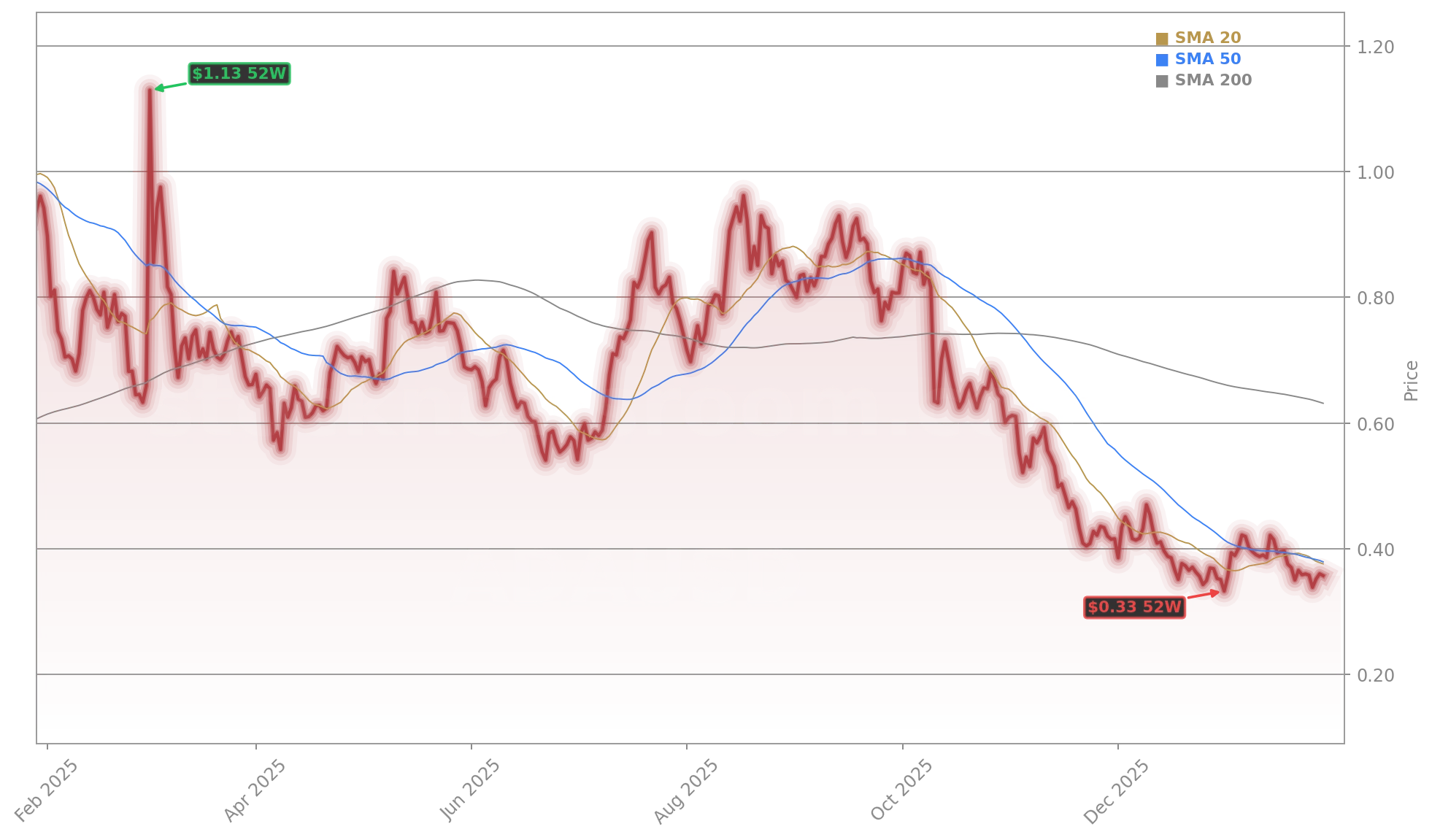
Cardano’s market cap stands at $5.8 billion — less than 1% of Ethereum’s and under 3% of Solana’s. Its 52-week high remains $0.31, far below its all-time peak of $3.09. By comparison, Solana (SOL) gained 87% in Q2 2026 on institutional DeFi inflows, while Ethereum’s staking yield rose to 4.2% amid ETH 2.5 upgrades. Cardano’s peer-reviewed development model hasn’t translated into developer traction: GitHub activity remains flat, while Solana and Arbitrum each added over 1,200 new smart contracts in June. Citigroup analysts noted in a July 3 research note that ‘Cardano’s governance strength is a theoretical advantage — but without measurable velocity in token utility, it remains a beta play on broader crypto sentiment, not a standalone alpha generator.’ Morgan Stanley’s latest crypto infrastructure report ranked Cardano seventh in ecosystem health — behind Avalanche, Polygon, and even Base.
What Comes After the RealFi Testnet?
The July 6 RealFi testnet is just the first phase. The Musashi Dojo testnet, launched June 23, already demonstrated parallel transaction throughput scaling from 10 to ~1,000 TPS. Next comes the van Rossem hard fork — pending community vote — which aims to cut smart contract deployment costs by up to 65%. But governance delays remain a structural risk: the Cardano Summit was defunded by treasury vote in May, signaling community fatigue. RBC Capital Markets reiterated its ‘Underperform’ rating on ADA last week, citing ‘persistent execution lag versus roadmap promises and declining on-chain economic activity.’ Still, the upgrade’s success could catalyze renewed developer grants, particularly if RealFi attracts partnerships with emerging-market central banks or microfinance institutions — a path that could differentiate ADA from pure speculative tokens.
Is This a Buy Signal — or a Bear Trap?
Cardano’s governance strength is a theoretical advantage — but without measurable velocity in token utility, it remains a beta play on broader crypto sentiment, not a standalone alpha generator.— Citigroup analysts, July 3, 2026 research note
ADA’s current $0.18 price reflects a 95% discount to its all-time high — but also a 40% June collapse and historically weak August seasonality. While the Cardano Upgrade creates near-term optionality, long-term upside remains capped without material TVL recovery or institutional inflows. The most optimistic price target cited in recent analyst work — $0.24 — implies just 33% upside from current levels. That’s less than half the return offered by comparable infrastructure tokens like Chainlink (LINK) or Polygon (MATIC) over the same horizon. For U.S. investors allocating to crypto within retirement or taxable accounts, ADA remains a high-conviction, low-probability bet — best approached via dollar-cost averaging rather than tactical entry. The RealFi testnet is not a catalyst in isolation; it’s a prerequisite for relevance.