
Are Cisco Earnings signaling a true AI supercycle for networking, or is Wall Street getting ahead of itself again?

How did Cisco Earnings move the market?
Cisco Systems, Inc. delivered one of the most impactful quarterly prints of this earnings season. Q3 revenue climbed 12% year over year to a record $15.84 billion, well ahead of consensus around $15.56 billion, while adjusted EPS of $1.06 beat estimates by roughly two cents. Net income jumped to $3.37 billion, up about a third from a year earlier, helped by operating leverage in its core networking franchises.
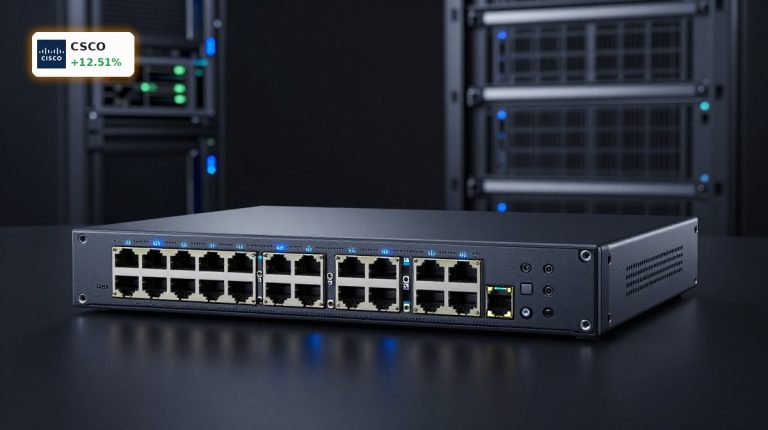
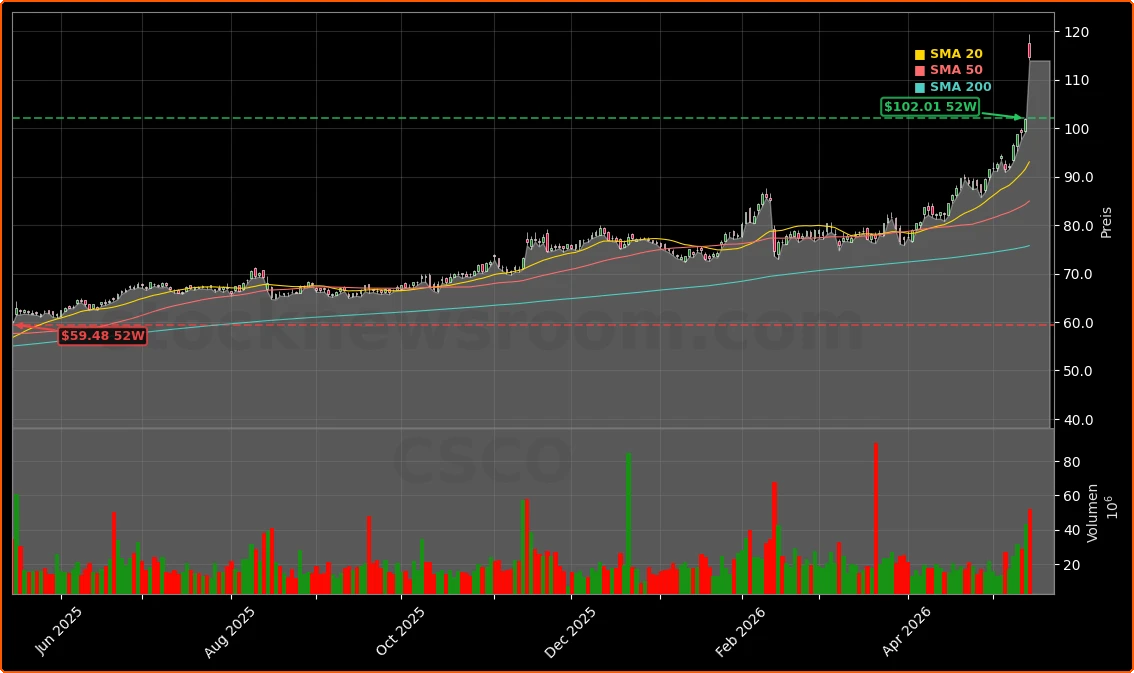
The blowout Cisco Earnings report immediately rippled across major indexes. CSCO was among the top gainers in the S&P 500, NASDAQ 100 and Dow Jones Industrial Average, supporting broader tech strength alongside AI leaders like NVIDIA. The stock’s intraday rally extended an already strong year-to-date run as investors re‑price Cisco as a key “picks and shovels” provider for AI data centers rather than just a legacy router vendor.
Momentum is being reinforced by a wave of analyst upgrades. Wells Fargo & Company lifted its price target from $95 to $130 with an “Overweight” rating, while firms such as UBS, JPMorgan, Bank of America, Citi, Goldman Sachs and KeyBanc all raised targets into a roughly $112–$132 range and maintained Buy or Overweight stances. TradingView data show the average 12‑month target moving up to about $109, and the stock now trades only modestly above that level despite the earnings‑driven spike.
What changed in Cisco’s AI outlook?
The real shock in the latest Cisco Earnings release was not just the beat, but how dramatically management lifted its AI infrastructure ambitions. Orders from hyperscalers – the largest cloud and data center operators – hit $1.9 billion in Q3 alone, up from $600 million a year earlier, pushing fiscal year‑to‑date AI orders to $5.3 billion. On the back of that surge, Cisco doubled its fiscal 2026 AI order target from $5 billion to $9 billion.
CEO Chuck Robbins framed Cisco as “critical infrastructure for the AI era,” highlighting strong demand for its Silicon One networking chips, Acacia optical products and next‑generation data center switches. Total product orders rose 35% year over year, and networking product orders climbed more than 50%, with data center switching up over 40% and campus networking orders reaching record levels. Management now expects at least $6 billion of hyperscale AI revenue recognition in fiscal 2027, separate from baseline portfolio growth.
This narrative directly intersects with the massive AI capex plans of U.S. megacaps like Apple and the large cloud platforms run by Microsoft, Alphabet and Meta. While those names still dominate AI compute headlines, Cisco’s numbers reinforce a broader thesis: as GPU deployments scale, networking and optical bandwidth become the new bottleneck – a segment where Cisco has long‑standing expertise and supply‑chain control.
How strong is the guidance after Cisco Earnings?
The Q3 beat was paired with an aggressive guidance reset that caught Wall Street’s attention. For fiscal Q4, Cisco projects revenue between $16.7 billion and $16.9 billion, roughly $1 billion above prior Street expectations, with adjusted EPS of $1.16 to $1.18. For full‑year fiscal 2026, the company now sees revenue of $62.8 billion to $63.0 billion (up from $61.2–$61.7 billion) and adjusted EPS of $4.27 to $4.29 (up from $4.13–$4.17).
Those targets position Cisco for double‑digit top‑line growth in an environment where many legacy hardware vendors are struggling to keep pace. Non‑AI businesses are growing at a mid‑single‑digit rate, but the AI and hyperscaler segment is now large enough to drive the overall profile higher. Annualized recurring revenue reached $31.2 billion, with product ARR up 4%, and remaining performance obligations rose to $43.5 billion, providing multi‑year visibility.
There are risks. Non‑GAAP gross margin slipped 260 basis points year over year to 66%, largely due to product mix and higher memory costs, and operating cash flow declined 7% to $3.8 billion as Cisco pulled forward investments to meet AI demand. In security, legacy products remain a drag as newer cloud offerings and the Splunk transition ramp, leaving that portfolio in flux during a crucial period for cybersecurity spending.
Why is Cisco cutting jobs while investing in AI?
Alongside the upbeat Cisco Earnings, management unveiled a restructuring plan of up to $1 billion in pretax charges, including cutting nearly 4,000 roles, or under 5% of the workforce. Robbins described it as a “rapid reallocation of resources” toward higher‑growth areas such as silicon, optics, security and internal AI tools. CFO Mark Patterson emphasized that the changes are intended to speed execution in markets where demand is strongest rather than simply reduce costs.
The move echoes broader patterns among large U.S. tech companies like Tesla and other AI‑focused names that are trimming headcount in slower segments to free up capital for AI and cloud investments. For investors, the key question is whether Cisco can deliver sustained revenue and margin expansion from this pivot, or whether AI‑driven orders prove cyclical. So far, the combination of a $0.42 quarterly dividend, $9.6 billion remaining in buyback authorization and strong balance sheet provides a buffer while the company retools its portfolio.
Related Coverage
For a deeper dive into the initial market reaction, including how hyperscaler orders helped spark a sharp post‑announcement rally, readers can review “Cisco Earnings +8% Surge After Hours as AI Orders Jump”. That analysis explores whether booming AI infrastructure demand and the Splunk acquisition are enough to justify Cisco’s rapid re‑rating or set the stage for increased volatility around future quarters.
Cisco delivered record quarterly revenue in Q3 and we saw very strong, broad-based demand for our products, demonstrating the relevance of our technology for connecting and securing AI.— Chuck Robbins, Chair and CEO of Cisco Systems, Inc.
In summary, the latest Cisco Earnings report confirms that the company has firmly joined the front line of the AI infrastructure boom, pairing record results with a sharply upgraded outlook and a focused restructuring. For U.S. investors seeking exposure to AI beyond chip leaders, Cisco now offers a networking‑centric angle with a dividend and active buybacks. The next few quarters will show whether hyperscaler orders and margin trends can sustain this momentum and keep Cisco near the top of Wall Street’s AI winners list.