Can the Palantir Rackspace Partnership turn AI pilots into real enterprise revenue before Wall Street loses patience with PLTR?

What Does the Palantir Rackspace Partnership Solve?
Many regulated enterprises—including U.S. healthcare systems, federal contractors, and critical infrastructure operators—struggle to move AI from pilot to production. Palantir Technologies Inc. CEO Alex Karp has publicly criticized runaway token costs and undisciplined experimentation, noting that budget overruns frequently kill AI initiatives before they deliver ROI. The Palantir Rackspace Partnership directly addresses that gap by bundling Palantir Foundry and Palantir’s AI Platform (AIP) with Rackspace’s governed private cloud, sovereign cloud environments, air-gapped on-prem infrastructure, and Federal Desktop Environment (FDE) certifications. Crucially, the framework is not a joint product—it’s an operating model: Rackspace delivers, manages, and governs the stack, while Palantir provides the AI orchestration layer that connects data to real-world processes and reduces hallucinations through ontology-driven architecture.
Why Regulated Sectors Matter for Wall Street
For investors, the Palantir Rackspace Partnership signals a deliberate pivot toward high-margin, sticky enterprise contracts—especially in sectors where compliance, data residency, and auditability are non-negotiable. Think U.S. Department of Energy grid operators, EU health authorities bound by GDPR, or defense primes managing classified workflows. Unlike cloud-native AI plays, this model avoids hyperscaler lock-in and prioritizes control—making it a structural counterweight to offerings from Tesla-adjacent AI infrastructure or public-cloud AI services. Rackspace has already trained 4,000 employees across sales and engineering on Palantir’s platform, and its first joint client—a U.S. solar tracking manufacturer—saw a 94% reduction in quote cycle time. That kind of operational impact resonates with S&P 500 industrial and healthcare investors seeking AI-driven efficiency, not just hype.
How Does This Compare to AI Peers?
While NVIDIA dominates chip-level AI acceleration and Apple bets on on-device intelligence, the Palantir Rackspace Partnership occupies a distinct niche: AI governance at scale. Competitors like C3.ai and DataRobot lack sovereign infrastructure and federal certifications; cloud vendors like AWS and Azure offer AI tools but not end-to-end managed AI operations for air-gapped environments. Palantir’s AIP—trading at a 39x price-to-sales multiple—relies on differentiation, not scale alone. Citigroup recently reaffirmed its ‘Buy’ rating on Palantir Technologies Inc., citing ‘unmatched ontology layering’ as a defensible moat. Meanwhile, RBC Capital Markets upgraded Rackspace Technology to ‘Outperform’, highlighting ‘revenue visibility from AI infrastructure contracts’ as a key catalyst for the next 12 months.
What’s the Near-Term Market Impact?
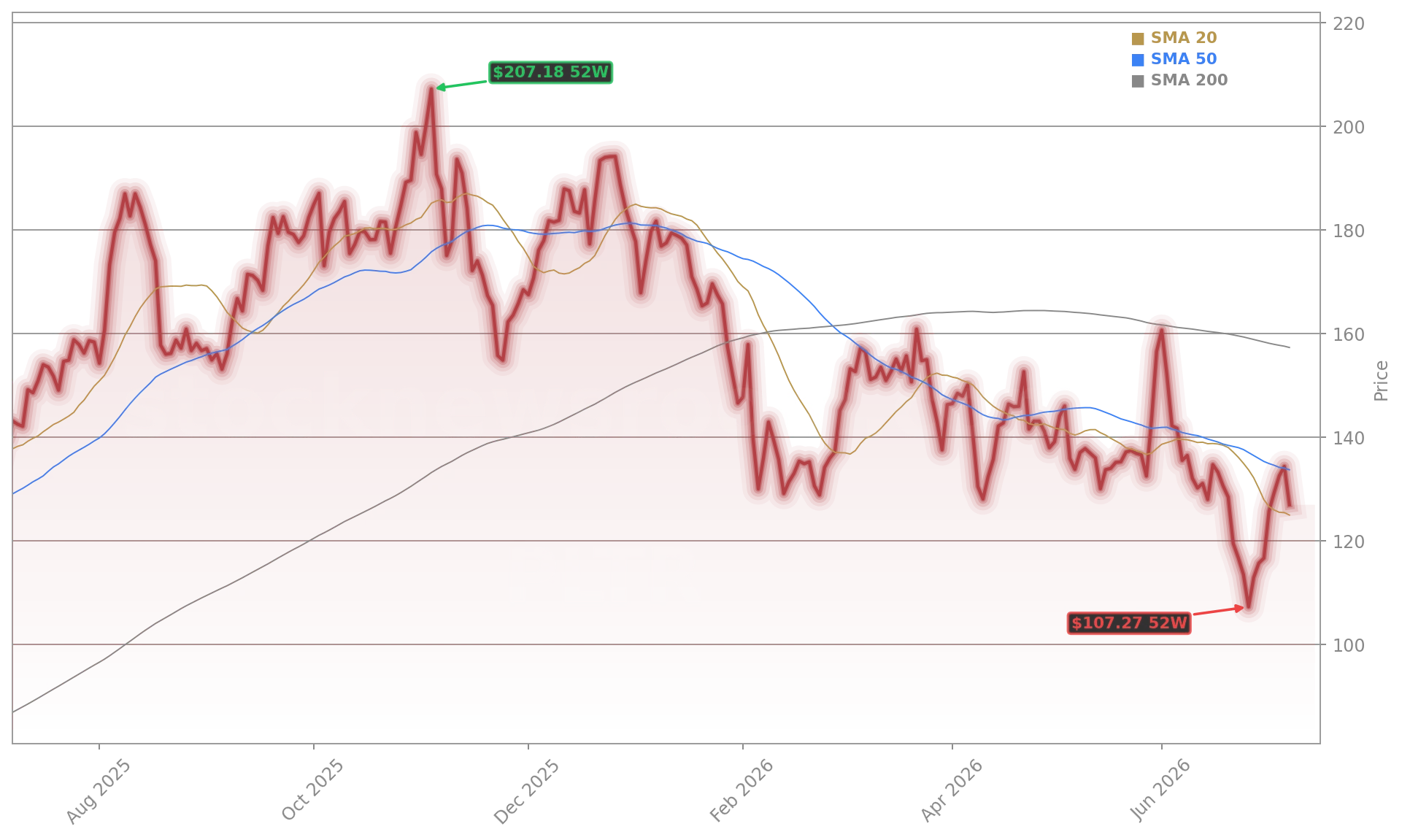
Despite the strategic strength of the Palantir Rackspace Partnership, PLTR shares fell sharply Thursday—down 3.58% to $127.14—amid broader tech volatility and persistent sentiment headwinds tied to geopolitical narratives. The stock remains well below its 52-week high of $189.25, reflecting investor caution on valuation and execution risk. Still, the framework’s first commercial win—and Rackspace’s commitment to deploy Palantir Foundry across 70% of its own back-office operations—suggests early monetization. Analysts at Morgan Stanley note that ‘if just 5% of Rackspace’s $3.2B enterprise client base adopts the framework at $2M+ annual contract value, that’s $320M in incremental ARR by FY2027.’ That kind of pipeline visibility could offset near-term price pressure and re-anchor investor focus on fundamentals.
While most regulated enterprises have an AI strategy, they often lack the operating model to put AI into production safely and at scale. This effort by Rackspace closes that gap.— Gajen Kandiah, CEO of Rackspace Technology
Related Coverage: While Palantir’s valuation remains a flashpoint, yesterday’s analysis Palantir Rebound -3% as Valuation Warning Tests AI Bull Case explored whether AI momentum can overcome Wall Street skepticism. Meanwhile, the broader AI infrastructure theme remains strong—AMD Forecast +7.4% Surge as AI Demand Lifts Q2 Outlook highlights how chip-level demand continues to lift the entire stack. Both pieces underscore that Palantir Technologies Inc. operates in a high-stakes, high-reward segment where execution—not just vision—will determine long-term winners.