Is Super Micro’s massive capital raise fueling its AI future, or signaling deeper stress beneath the $39 billion backlog?

Why is Super Micro Equity Raise alarming investors?
Despite record demand, Super Micro Computer, Inc.’s $7 billion equity financing — comprising $1.25 billion in common stock, $3.75 billion in depositary shares tied to mandatory convertible preferred stock, and a $2 billion at-the-market (ATM) program launching no earlier than Q3 2026 — triggered immediate dilution concerns. J.P. Morgan, Goldman Sachs & Co., and Citigroup are acting as lead joint bookrunning managers. The offering is not contingent on any other tranche, increasing execution flexibility but also amplifying uncertainty. With a current market cap of just $24 billion, this Super Micro Equity Raise represents nearly 30% of its total valuation — a level of dilution rarely seen outside early-stage biotech or SPACs. For S&P 500 and NASDAQ-focused portfolios, SMCI’s volatility now poses a meaningful beta risk amid broader tech sector rotation.
How does this compare to Alphabet and Meta?
Super Micro Computer, Inc. joins a growing cohort of AI infrastructure leaders tapping equity markets at unprecedented scale. Alphabet recently announced an $85 billion equity issuance — including $40 billion via ATM — while Meta signaled plans for a multi-billion-dollar raise to fund its AI data center expansion. Unlike those mega-cap peers, however, Super Micro Computer, Inc. carries a single-digit gross margin and has reported negative free cash flow of $6.8 billion over the past 12 months. Competitors like Dell Technologies — down 2.5% in pre-market trading — benefit from deeper balance sheets and diversified enterprise portfolios. Meanwhile, NVIDIA continues to capture the highest-margin AI value chain layer, with its data center revenue up 427% year-over-year in Q1 2026.
What’s behind the $39 billion backlog — and can it be delivered?
The $39 billion in AI server orders includes advanced Data Center Building Block Solutions for over 20 customers, many of whom are building sovereign AI stacks or expanding inference capacity. Recent collaborations with Arm on agentic AI-optimized CPUs signal strategic diversification beyond NVIDIA-centric architectures. Yet execution risk remains high: component costs — especially memory chips — have tripled in recent months, per CEO Charles Liang’s May commentary. Supply chain constraints and renewed regulatory scrutiny also loom large. A recent 8-K filing highlights ongoing investigations by the SEC, DOJ, and BIS related to export controls and related-party vendor concentration — issues that could delay shipments or trigger penalties.
Is the Super Micro Equity Raise a sign of strength — or stress?
On one hand, the financing validates explosive AI demand and positions Super Micro Computer, Inc. to capture near-term infrastructure spend. Its Q3 FY2026 revenue hit $10.2 billion — more than double Q3 FY2025 — and guidance for Q4 points to $11.0–$12.5 billion in sales. On the other, the capital intensity reveals structural challenges: low margins, high working capital needs, and exposure to geopolitical volatility. RBC Capital Markets recently downgraded the stock to ‘Underperform’, citing ‘unsustainable cash burn relative to near-term earnings visibility.’ Citigroup maintains a ‘Neutral’ rating but slashed its 12-month price target to $42 — down from $68 — citing ‘dilution overhang and margin pressure.’
What does this mean for US investors and the S&P 500?
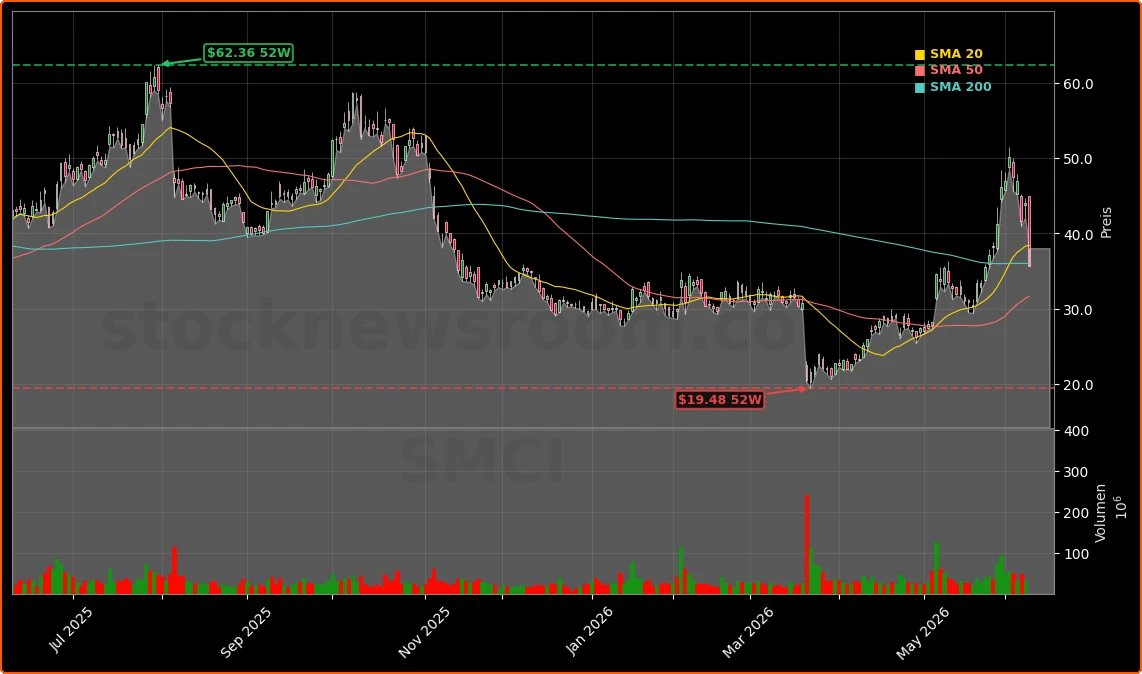
As one of the most volatile NASDAQ-listed names, Super Micro Computer, Inc. has contributed significantly to tech sector beta in 2026 — up 39% year-to-date before today’s selloff. Its weighting in AI-themed ETFs like the iShares U.S. Technology ETF (IYW) and the SPDR S&P Semiconductor ETF (XSD) means broader index exposure is now tied to its execution. With the S&P 500 tech sector trading at 32x forward P/E — near its highest level since 2000 — the Super Micro Equity Raise serves as a timely stress test for AI infrastructure valuations. Investors should watch for follow-on financing signals from peers like Tesla and Apple, both of which are accelerating AI infrastructure investments in 2026.
Related coverage: Can Super Micro’s massive capital raise secure its AI backlog, or will dilution and execution risk keep crushing sentiment? Super Micro Financing -7.16% After Hours on $7B Raise dives deep into the trade-offs between order visibility and shareholder value erosion. For investors evaluating exposure across the AI stack, this analysis is essential reading ahead of next week’s Federal Reserve meeting and Q2 earnings season.
Super Micro Equity Raise is not just a corporate finance event — it’s a market-wide signal about the capital sustainability of the AI boom. For investors, the core question is no longer whether demand exists, but whether companies can convert $39 billion in orders into durable earnings without sacrificing equity value. The next quarterly earnings will show whether Super Micro Computer, Inc. can stabilize margins and de-risk its supply chain — and whether Wall Street rewards execution over ambition.
The AI boom has driven up demand for servers but left Super Micro short of cash as it struggles to meet the spike in demand.— George Glover, Barron’s
Fazit folgt.