UPS Earnings beat expectations, so why did the stock still slide and what does that say about the parcel giant’s new strategy?

Why did United Parcel Service shares fall?
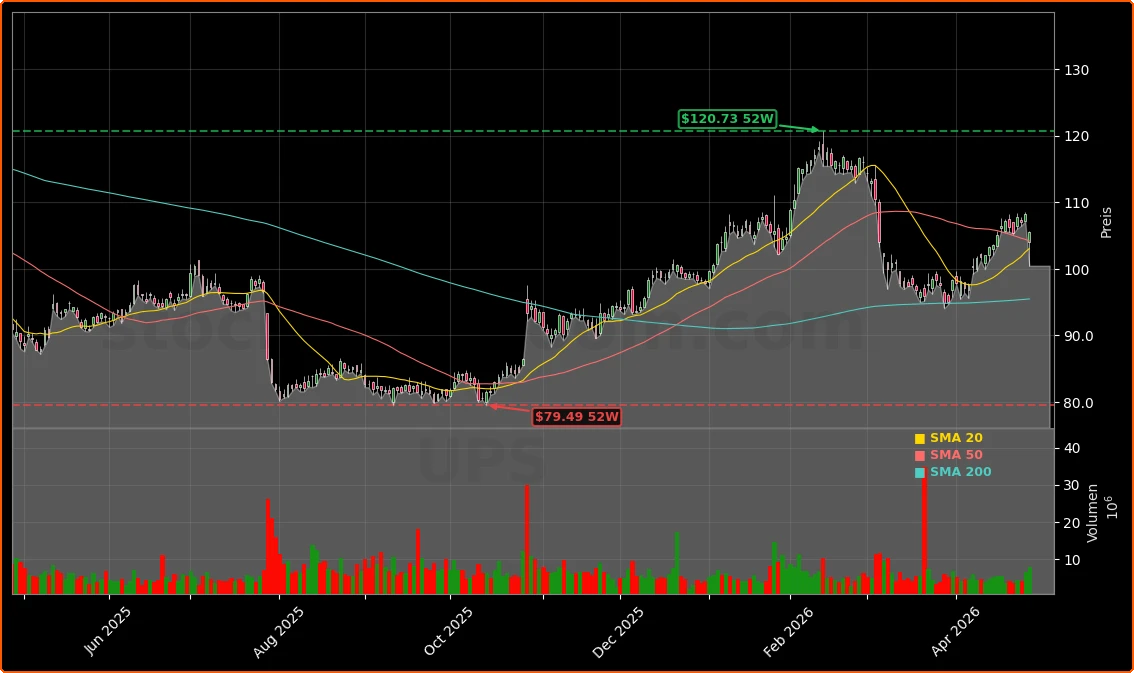
United Parcel Service (UPS) shares traded lower despite a headline beat. The stock recently changed hands around $105.50, down roughly 2.5% from the previous close of $108.38, underperforming the broader S&P 500. In early trading after the Q1 release, losses at one point deepened to about 5%–7% as investors reacted to soft U.S. profitability and a conservative stance on the outlook.
Several Wall Street desks flagged that the market had moved into the report with elevated expectations after a strong run in industrial and logistics names. Citigroup argued that the share price weakness reflects disappointment over weaker‑than‑expected U.S. domestic margins and the decision not to raise guidance, especially when rival FedEx has already lifted its forecast this year. Barclays also highlighted structural headwinds from the deliberate reduction of lower‑margin Amazon volume and the high fixed‑cost base in the U.S. network.
For portfolio managers benchmarking against the S&P 500, the reaction reinforces that earnings beats alone are not enough if the quality of the beat and the trajectory of margins do not clearly improve. UPS now has to prove that near‑term pain from its restructuring will translate into durable earnings power.
How strong were the UPS Earnings numbers?
On the headline level, the latest UPS Earnings were solid. Adjusted earnings per share came in at $1.07, ahead of the roughly $1.02–$1.03 consensus. Revenue reached $21.2 billion, slightly above expectations of around $20.99–$21.0 billion, but still down modestly year over year. Net income on a GAAP basis fell to $864 million, or $1.02 per share, from $1.19 billion, or $1.40 per share, a year earlier as restructuring and transition costs weighed on results.
Operating trends were mixed beneath the surface. U.S. Domestic revenue declined about 2%–3% to $14.1 billion, and operating profit in that segment was nearly cut in half to $515 million. Management cited short‑term cost headwinds of roughly $350 million, including temporary aircraft leases linked to the retirement of the MD‑11 fleet and transition expenses related to outsourced products. By contrast, International revenue grew 3.8% to $4.5 billion, supported by more than 10% growth in revenue per piece, even though operating profit there also eased to $547 million from $641 million.
CEO Carol Tomé described the quarter as “a critical transition period” in which UPS had to execute several major strategic actions at once. She emphasized that with those moves largely behind the company, management expects a return to consolidated revenue and operating profit growth, and a step‑up in adjusted operating margin beginning in the second quarter of 2026.
What is UPS changing in its business model?
The latest UPS Earnings also shine a light on a significant strategic pivot. UPS is intentionally reducing its exposure to lower‑yield e‑commerce shipments, particularly from Amazon, to focus on higher‑margin segments such as small and midsize businesses, B2B customers, and complex healthcare logistics. These premium segments generated a record $3 billion in quarterly revenue, underscoring the potential of the new mix.
At the end of Q1, Amazon represented only about 8.8% of UPS revenue, down from more than 13% not long ago. UPS closed 23 buildings in the quarter as part of a broader network reconfiguration and plans to close dozens more, eventually taking out 30,000 jobs to better align capacity with demand. The company has already captured roughly $600 million of a planned $3 billion cost‑reduction program slated to be completed by the end of 2026.
Management is challenging the traditional industry view that scale alone drives profitability, instead prioritizing revenue quality, automated hub efficiency and better delivery density. The completion of the U.S. Postal Service transition and investments in automated facilities are expected to improve cost per piece over time, even as volumes shift away from bulk, low‑margin contracts.
How does United Parcel Service stack up against rivals?
For U.S. investors who own logistics names alongside large‑cap tech such as Apple, NVIDIA or Tesla, the main comparison point for UPS is FedEx. While UPS is reaffirming a cautious full‑year outlook, FedEx has already upgraded its guidance after its own restructuring program delivered meaningful cost savings. Over the last 12 months, UPS shares have lagged both FedEx and the S&P 500, reflecting skepticism over how quickly its transformation will pay off.
Some analysts, including those at JPMorgan, stress that UPS now faces a steeper ramp in U.S. margins to reach its second‑quarter guidance range of 7.5%–8.5%. However, others see value emerging: with Wall Street models pointing to potential GAAP earnings of roughly $7 per share in 2026 and the stock trading near $105, UPS could be on a mid‑teens forward P/E and offering an attractive dividend yield if management hits its targets.
Looking beyond the logistics peer group, the stock’s risk‑reward will also be judged against defensive income plays across the S&P 500 and high‑growth opportunities on the NASDAQ. That makes execution on cost cuts, network rationalization and premium volume growth the key catalysts to watch into the back half of 2026.
The first quarter of 2026 marked a critical transition period for UPS in which we needed to flawlessly execute several major strategic actions and we delivered.— Carol Tomé, CEO of United Parcel Service, Inc.
For now, UPS is sticking with its full‑year 2026 outlook of about $89.7 billion in revenue and a non‑GAAP adjusted operating margin of 9.6%, alongside expected capital expenditures of $3 billion and roughly $5.4 billion in dividends, subject to board approval. If the next UPS Earnings report confirms a clear inflection in revenue growth and margins, investor sentiment toward the stock could shift quickly.