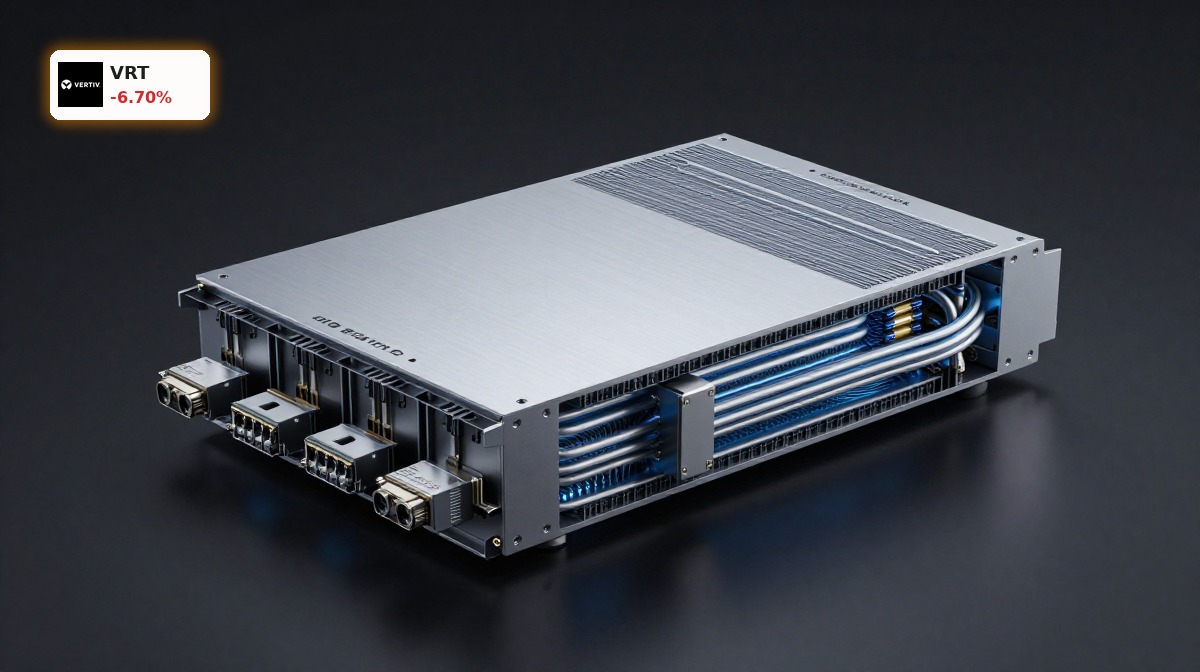

Can Vertiv Data Center turn its 800VDC and liquid-cooling lead into lasting gains after a sharp 6.7% stock drop?

What does 800VDC mean for Vertiv Data Center strategy?
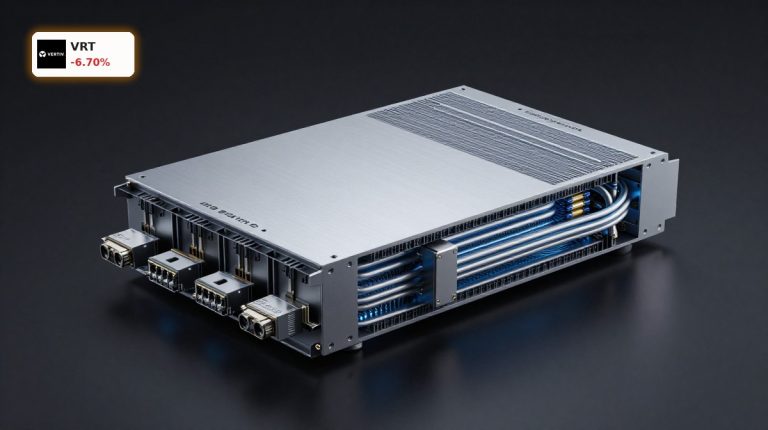
Vertiv Holdings Co is spearheading the industry’s shift from legacy 48V and 380VDC architectures to 800VDC power distribution — a critical enabler for next-gen AI racks consuming 100+ kW per server. As Scott Armul, Chief Product and Technology Officer, confirmed at its recent investor conference, Vertiv expects commercial rollout to begin in Q1 2027, followed by a ‘steady ramp’ through the year as supply chain scalability and customer integration mature. The architecture — designed in deep collaboration with NVIDIA — converts grid AC to 800VDC at the rack level and includes proprietary DC-to-DC power shelves, battery-backed storage, and ultra-fast thermal response systems. This isn’t incremental: 800VDC cuts power loss by up to 40% versus 48V, a decisive advantage as hyperscalers like Meta and Amazon scale AI training clusters.
How does Vertiv compare to Eaton and Schneider?
While Eaton (ETN) and Schneider Electric dominate broader industrial power markets, Vertiv Holdings Co remains singularly focused on digital infrastructure — a distinction that amplified its FY2025 results. Revenue hit $10.2 billion, up 27.7% year-over-year, with net income soaring to $1.3 billion (13.0% margin) — more than double FY2024’s $495.8 million. Eaton trades at a Forward P/E of 30.4x versus Vertiv’s 49.1x, reflecting Wall Street’s premium on AI infrastructure exposure. Yet that premium carries risk: Vertiv’s 0.9x debt-to-equity and $1.9 billion in FY2025 free cash flow provide flexibility, but its reliance on just five hyperscaler clients — including Microsoft, Amazon, and Alphabet — makes it more sensitive to capex shifts than Eaton’s diversified aerospace, grid, and industrial portfolio.
Why is Wall Street watching Vertiv’s liquid-cooling execution?
Liquid cooling isn’t optional anymore — it’s mandatory for 800VDC-enabled AI racks. Vertiv Data Center thermal systems now account for 38% of its product mix, up from 22% in FY2023. The company recently acquired two specialized cooling firms to accelerate immersion and direct-to-chip deployment, targeting 65% liquid-cooling penetration among new AI deployments by 2027. Competitors like nVent and GE Vernova are scaling rapidly, but Vertiv’s integrated power + cooling stack — validated in joint labs with Tesla and Meta — gives it a systems-level edge. Citigroup recently raised Vertiv’s price target to $345, citing ‘unmatched execution velocity in high-density thermal environments.’ RBC Capital Markets maintains an ‘Outperform’ rating, emphasizing ‘Vertiv Data Center’s embeddedness in NVIDIA’s Blackwell and Rubin platform roadmaps.’
What’s driving the recent 6.7% stock decline?
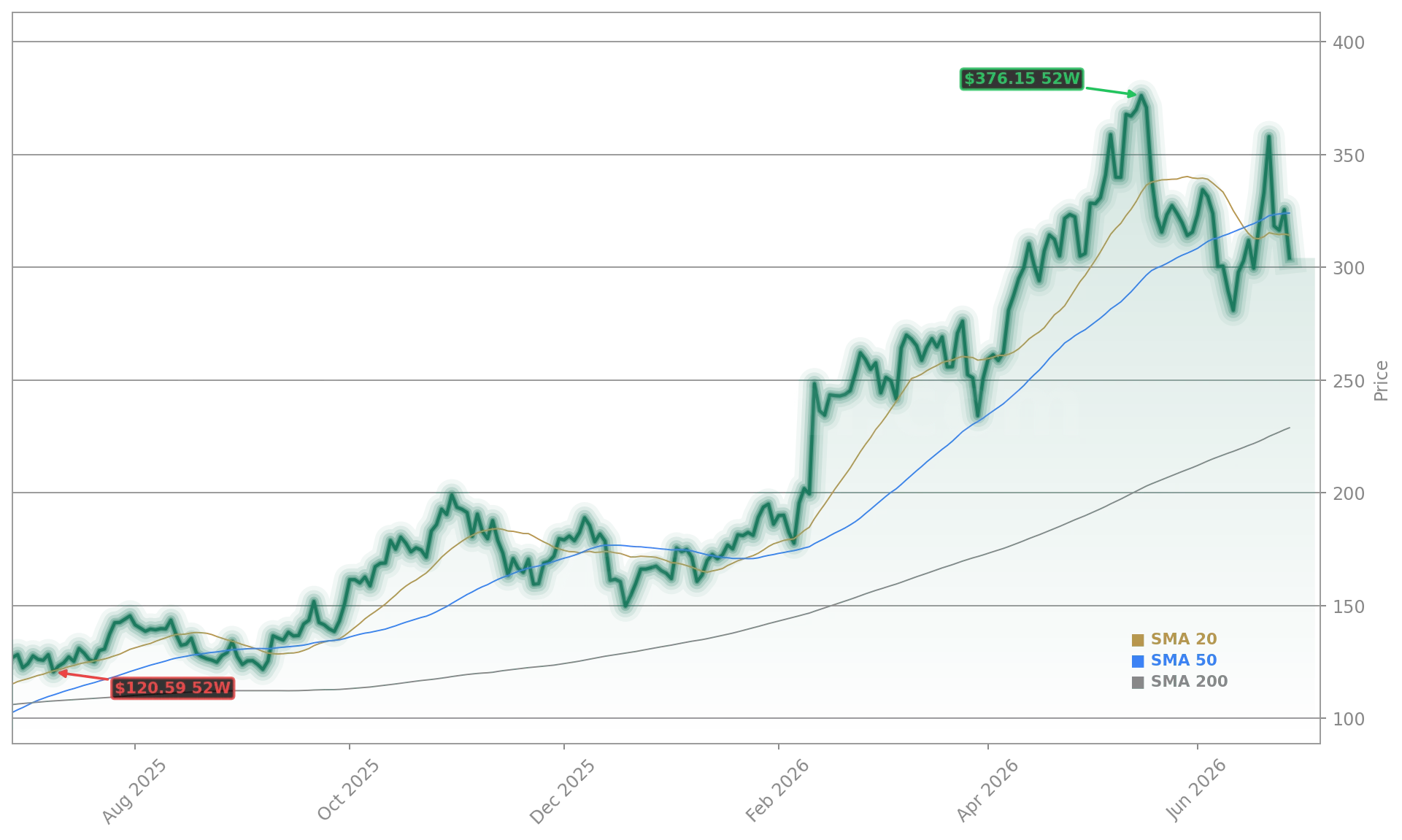
Vertiv Holdings Co shares fell to $303.75 in after-hours trading on Friday, June 26, 2026 — down from $325.57 at Thursday’s close — following broader NASDAQ tech profit-taking and rising bond yields. The dip occurred despite strong fundamentals: a $5.1 billion backlog (up 112% YoY), 94% gross margin on 800VDC modules, and a 22% increase in Q2 2026 design wins with Tier-1 cloud providers. Analysts at Morgan Stanley note the pullback creates ‘a tactical entry point ahead of 2027 commercialization,’ while Goldman Sachs highlights that Vertiv’s valuation remains below its 3-year median P/S ratio of 13.4x — even after its 2026 YTD 31% gain. The stock’s 52-week high stands at $362.80, indicating room for upside if 800VDC adoption accelerates as forecast.
How does this impact S&P 500 infrastructure exposure?
And from a timing standpoint, we expect a steady ramp throughout 2027 as we think about scaling and we think about … the supply chain robustness and the build-out that needs to happen.— Scott Armul, Chief Product and Technology Officer, Vertiv Holdings Co
Vertiv Holdings Co is not just a data center play — it’s a proxy for AI’s physical layer. Its performance directly influences infrastructure-weighted ETFs like the SPDR Industrial Select Sector Fund (XLI), where Vertiv’s market cap now exceeds 0.4% of the index. With the S&P 500’s tech and industrial sectors collectively responsible for 58% of index weight, Vertiv’s success in scaling 800VDC reinforces the broader thesis of ‘infrastructure as infrastructure-as-code’ — where power, cooling, and connectivity become programmable, modular, and interoperable. For US investors, Vertiv Data Center represents a concentrated, high-beta lever on AI’s real-world build-out — one that complements broader holdings in Apple and semiconductor leaders while avoiding direct chip-cycle volatility.