
Can AMD’s $2.7 billion UK AI bet turn sovereign infrastructure into its next major growth engine?

Why is AMD investing $2.7 billion in the UK?
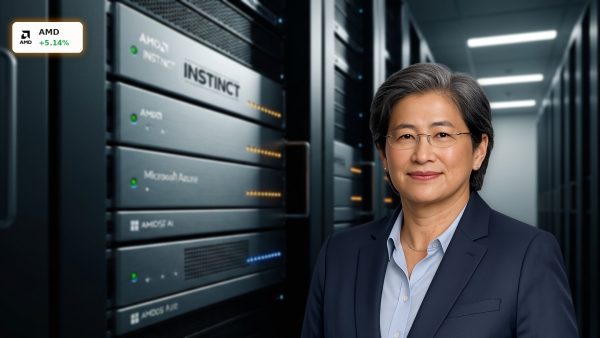
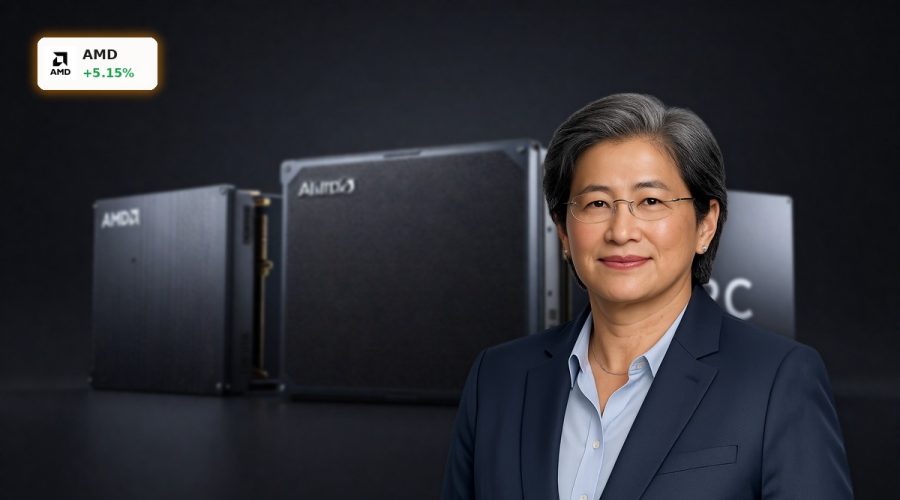
Advanced Micro Devices, Inc. unveiled its largest international AI infrastructure commitment to date during London Tech Week: up to £2 billion ($2.7 billion) over five years to accelerate sovereign AI development across British academia and national labs. The AMD AI Investment targets three high-impact pillars — AI supercomputing, nuclear fusion research, and photonic networking — with key partners including the University of Cambridge, Imperial College London, Oriole Networks, and Dell Technologies. Crucially, the initiative isn’t philanthropy: AMD will supply Instinct GPUs, EPYC CPUs, and ROCm software across all projects, locking in long-term platform adoption and generating recurring revenue streams. For Wall Street, this represents a structural shift — from competing for spot cloud contracts to embedding AMD as the foundational stack for national AI strategy.
How does this compare to NVIDIA and Intel?
While NVIDIA dominates AI training with its Hopper and Blackwell architectures, AMD’s UK push targets a different battleground: government-funded, mission-critical AI infrastructure where open software and energy efficiency matter more than raw peak FLOPs. Unlike Intel’s stalled Gaudi roadmap and NVIDIA’s Vera CPU — a new entrant still in validation — AMD is already delivering at scale: the Zenith AI supercomputer and Sunrise fusion AI system are operational or near-deployment. Critically, AMD’s partnership with Oriole Networks on the world’s first commercial photonic AI network — announced just days ago — directly challenges NVIDIA’s electrical interconnect dominance by slashing GPU idle time and power draw. In contrast, Intel’s recent data center struggles and NVIDIA’s $1.86 billion investment in Coherent Corp. highlight how fiercely contested the AI infrastructure layer has become.
What does this mean for AMD’s valuation and growth?
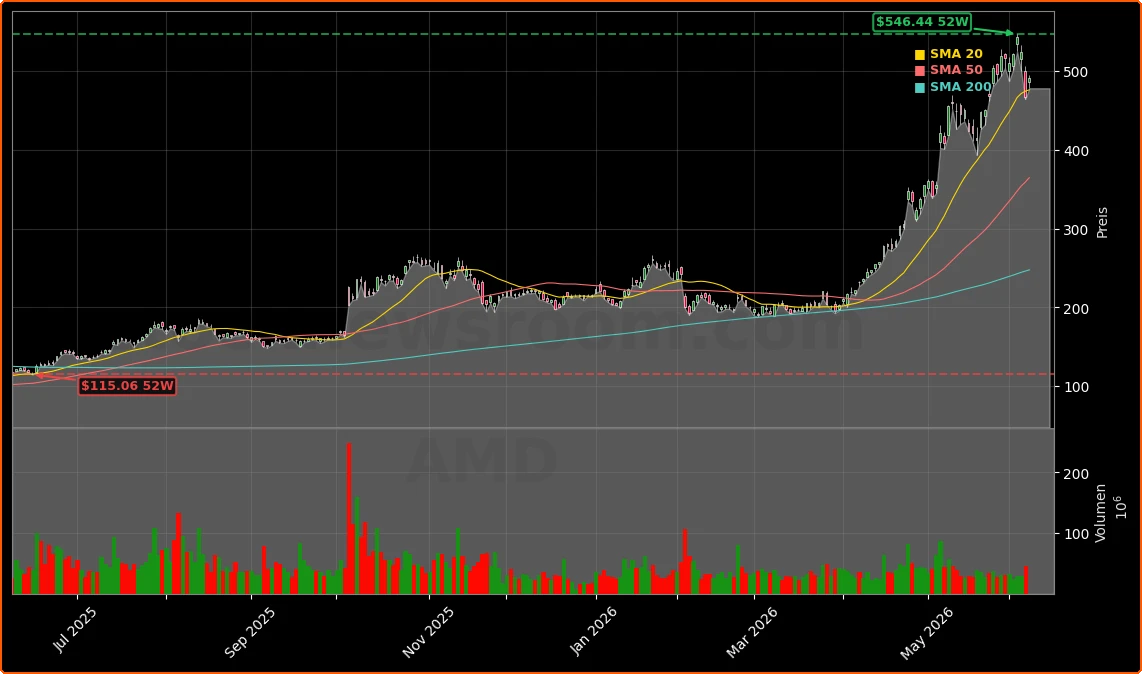
At $490.42, AMD trades at 68x forward earnings — rich, but justified by 91.2% trailing EPS growth and a 57% data center revenue surge to $5.78 billion in Q1. The AMD AI Investment strengthens the case for sustained 50%+ data center growth: the UK projects alone represent $500 million in annualized hardware and software procurement, with potential spillover into Germany, France, and Japan as sovereign AI policies accelerate. Morgan Stanley recently reiterated its ‘Overweight’ rating and raised its price target to $535, citing “increasing visibility into multi-year sovereign AI contracts.” Meanwhile, Citigroup upgraded AMD to ‘Buy’, noting that “the UK commitment de-risks 2027 revenue execution and validates ROCm’s enterprise readiness.” With 80% of Wall Street analysts holding Buy or Strong Buy ratings — and only zero Sell recommendations — the consensus is clear: this isn’t just capex, it’s pipeline insurance.
Is the UK move enough to offset China export risks?
Yes — but only partially. U.S. export controls cost AMD $440 million in FY2025 and remain the single largest overhang. However, the UK AMD AI Investment diversifies AMD’s customer base away from hyperscaler concentration and geopolitical volatility. Unlike China-bound MI308 GPUs, these UK deployments involve dual-use, civilian-grade infrastructure with strong government backing — making them far less vulnerable to policy shifts. Moreover, the UK’s AI Safety Institute and national semiconductor strategy provide regulatory tailwinds absent in other markets. Still, investors should monitor Q2 earnings on July 23 for signs of MI450 adoption velocity and whether OpenAI’s 6-gigawatt partnership and Meta’s MI450 rollout are translating into recognized revenue. RBC Capital Markets maintains its ‘Sector Perform’ rating, warning that “geopolitical execution risk remains elevated, but the UK initiative meaningfully offsets near-term exposure.”
AMD AI Investment: What’s next for U.S. investors?
Customer engagement around MI450 Series and Helios is strengthening, with leading customer forecasts exceeding our initial expectations.— Lisa Su, CEO of Advanced Micro Devices, Inc.
The $2.7 billion AMD AI Investment isn’t just about British labs — it’s a template for global sovereign AI partnerships. With the U.S. CHIPS Act and EU Chips Act driving parallel investments, AMD is now positioned to replicate this model in Washington, D.C., and Brussels. For American portfolios, that means exposure to government IT modernization, defense AI, and fusion energy — sectors where AMD’s hardware is increasingly non-substitutable. The stock’s 303% 52-week gain and 117.77% year-to-date return reflect this broader narrative, not just chip cycles. As the NASDAQ recovers from last week’s $1.3 trillion semiconductor selloff, AMD’s leadership in infrastructure — not just silicon — makes it a core holding for AI-focused investors. With Franklin Resources holding $1.02 billion in AMD shares and institutional ownership at 71.34%, the long-term conviction is unmistakable.