Is the bold eBay Acquisition by GameStop a genuine value opportunity or a dangerously overleveraged $56 billion gamble?

How is the eBay Acquisition moving markets?
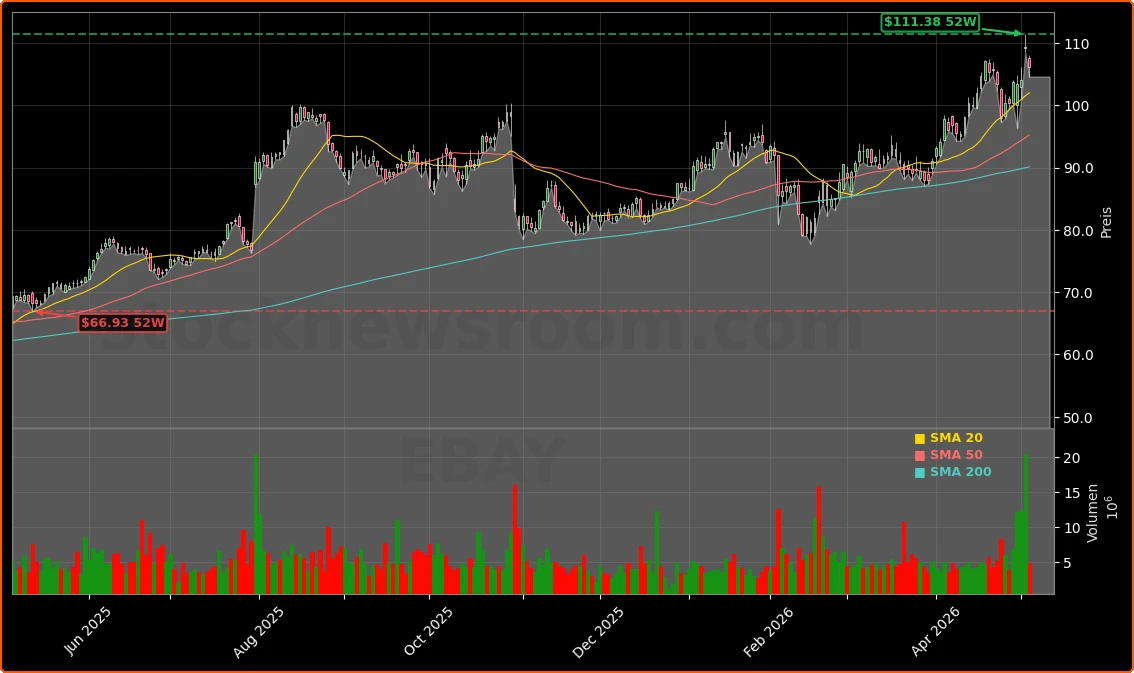
The eBay Acquisition drama is unfolding against a volatile backdrop for consumer and tech stocks on the NASDAQ. Today, eBay Inc. fell 2.93% to $106.13, retreating from recent gains sparked by GameStop’s unsolicited bid but still well above levels seen before the takeover speculation surfaced. GameStop (GME) edged 1.59% higher to $24.22, as traders tried to balance the potential strategic upside of a combined collectibles and resale powerhouse against the enormous financing burden required.
The headline proposal values eBay at $125 per share, implying a sizeable premium to the current price. Yet the fact that EBAY trades nearly $19 below the offer strongly suggests skepticism that the eBay Acquisition will be completed on its current terms or within the proposed cash‑and‑stock mix. Prediction markets and options flows echo that caution, even as some bullish call activity has appeared in longer‑dated contracts, including a notable January 2027 $90 call trade indicating interest in the stock’s medium‑term trajectory rather than in pure merger arbitrage.
Can GameStop really finance eBay?
The core question for institutional investors is whether GameStop can realistically fund a $55.5–$56 billion deal for a far larger rival. GameStop’s CEO Ryan Cohen has outlined a structure of roughly 50% cash and 50% stock, backed by about $9 billion in cash on hand and a $20 billion debt commitment from TD Securities or TD Bank entities. Even on paper, that leaves a substantial gap that would need to be closed with additional borrowing, equity issuance, or asset monetization.
Renowned investor Michael Burry has already exited his GameStop position, arguing that the proposed capital structure could push leverage to levels incompatible with his prior “Instant Berkshire” thesis for the company. Burry highlighted that debt of more than 5x EBITDA and weaker interest coverage would turn the eBay Acquisition into a debt‑driven gamble rather than a disciplined value play. Morningstar’s analysts echo these concerns, warning that the combined entity could end up at roughly 10.6x debt/EBITDA, a ratio that would sharply constrain flexibility just as the company tries to integrate a complex, global marketplace.
What does the eBay Acquisition mean for eBay’s strategy?
For long‑time EBAY shareholders, the takeover bid lands at a moment when management is already reshaping the business. The company recently announced it would cut about 800 jobs worldwide, roughly 6% of its workforce, in an effort to streamline operations and align costs with strategic priorities. At the same time, eBay has returned to modest top‑line growth and has guided for second‑quarter revenue above Wall Street expectations, helping the stock climb more than 50% over the past year.
Analysts remain broadly constructive even without a transaction. Deutsche Bank maintains a Buy rating on EBAY with a $124 price target, suggesting limited upside relative to the bid but still meaningful potential from today’s $106.13 quote. Stifel, by contrast, reiterates a Hold rating and a $98 target, signaling caution given the stock’s strong run and uncertainty around the eBay Acquisition. Several other firms, including TD Cowen, have recently nudged price targets higher while staying neutral, underscoring that the fundamental story—mid‑single‑digit growth, strong cash generation, ongoing buybacks—still stands on its own legs if the deal falls apart.
How does eBay stack up against U.S. e‑commerce peers?
For U.S. investors building exposure to digital marketplaces, the eBay situation also invites comparisons with giants like Amazon and vertical specialists such as Apple’s services ecosystem and NVIDIA’s AI‑driven commerce infrastructure. Unlike Amazon’s first‑party retail model or Tesla’s direct‑to‑consumer approach in autos, eBay remains primarily a third‑party marketplace with particular strength in resale, collectibles, and secondhand apparel. A takeover by GameStop would effectively fuse two secondary‑market brands, potentially boosting scale in high‑margin niches like trading cards, gaming hardware, streetwear, and luxury resale.
Fashion‑focused observers note that a change in control could ripple through the global preloved apparel market, where eBay competes with platforms such as Poshmark, Depop and Vinted. Brand trust and seller loyalty are critical in this space; aggressive cost cuts—GameStop has floated up to $2 billion in savings, including a 50% reduction in marketing—could undermine the very enthusiast buyers and sellers who power eBay’s most profitable verticals. Bloomberg has characterized the bid as an “awkward challenge” for eBay’s board: reject it and face renewed pressure to unlock value independently, or engage and risk a lengthy, uncertain process with a highly leveraged buyer.
Related coverage
For a deeper dive into how this saga started and whether GameStop’s bold move can truly reshape the e‑commerce landscape, readers can review our earlier analysis on the initial $56 billion eBay Acquisition shock bid. That piece explores the original market reaction, arbitrage spreads, and the strategic logic Ryan Cohen has put forward as he seeks to turn GameStop into a dominant player in online resale.
The Instant Berkshire thesis was never compatible with more than 5x Debt/EBITDA or weak interest coverage.— Michael Burry
In summary, the eBay Acquisition bid has thrust eBay Inc. into the center of Wall Street’s M&A debate, lifting the stock yet leaving it well below the indicated $125 offer as investors discount execution and leverage risk. For U.S. portfolios, EBAY now represents a complex mix of standalone fundamentals, takeover optionality, and macro‑sensitive consumer exposure. The next catalysts will be eBay’s formal response, any revised or competing bids, and fresh financials later this year that will show whether management can keep delivering growth—deal or no deal.