Can an $8.4 billion Army contract modification reignite the bull case for Lockheed Martin after recent defense-sector weakness?

What Does the Lockheed Martin Army Contract Mean for the Backlog?
The $8.4 billion modification increases the contract’s total cumulative value to $13.3 billion — a material uplift to Lockheed Martin Corporation’s $194 billion total backlog, which stands at 2.6x its 2025 revenue. Crucially, 27% of that backlog stems from F-35 sustainment — a high-margin, long-duration revenue stream. This latest Lockheed Martin Army Contract adds visibility across land-based precision strike systems, reinforcing the company’s role in the Pentagon’s modernization push. With the White House seeking $1.5 trillion in fiscal 2027 defense spending — half earmarked for procurement and weapons modernization — LMT’s expanded footprint in missile production positions it ahead of peers like Boeing and Northrop Grumman as the Army prioritizes long-range fires.
How Does This Compare to Competitors’ Recent Wins?
While Boeing grapples with FAA production restrictions and fixed-price contract losses, and Northrop Grumman faces margin pressure on B-21 development, Lockheed Martin Corporation is executing on scale. RTX (formerly Raytheon) and L3Harris were also summoned to the White House alongside LMT to discuss munitions restocking post-Iran conflict — but only Lockheed Martin received a multi-billion-dollar contract modification this week. Huntington Ingalls Industries recently secured a $417.7 million naval support contract, underscoring sector-wide tailwinds — yet LMT’s $8.4 billion award dwarfs that by over 20x. Notably, the contract includes obsolescence management and follow-on production — elements that lock in recurring revenue and software integration, a growing differentiator versus traditional hardware-focused peers.
Is the Stock Undervalued After Recent Weakness?
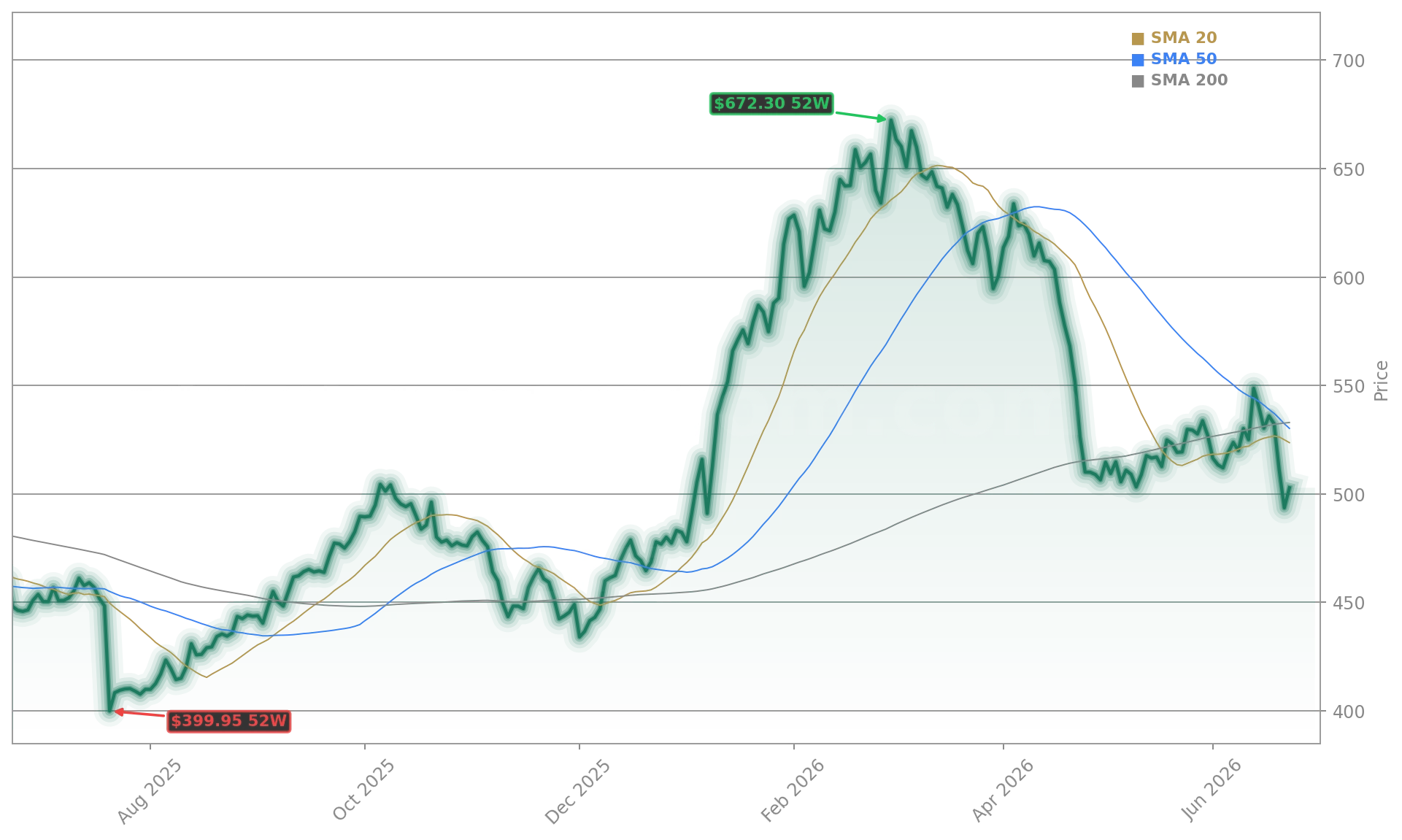
LMT’s 3.4% drop on Monday — its third straight loss — reflected broader defense sector rotation amid easing Middle East tensions and new Chinese procurement bans targeting 46 U.S. firms, including Lockheed Martin. Yet the market may be overlooking fundamentals: analysts project 7–8% annualized earnings growth over the next three to five years, and LMT trades at just 17x 2026 EPS estimates — below the sector average. Citigroup maintains a ‘Neutral’ rating with a $625 price target, while RBC Capital Markets recently reiterated its ‘Outperform’ stance citing ‘backlog quality and F-35 sustainment durability.’ The 2.7% dividend yield — backed by consistent cash flow — adds ballast. At $501, LMT is well below its 52-week high of $542, offering entry near a 7.5% discount to consensus targets.
What Role Does Cyber and AI Play in This Contract?
This Lockheed Martin Army Contract isn’t just about missiles — it’s a platform for AI and cyber integration. Lockheed Martin’s Sanctum™ advanced modular defense architecture, recently enhanced by Sentrycs’ Cyber-over-RF counter-drone tech, is designed to fuse sensor data, AI-driven threat analysis, and electronic warfare. The Precision Strike Missile program now incorporates AI-enabled targeting and cloud-enabled data fusion — capabilities that align with the Army’s Integrated Air and Missile Defense (IAMD) vision. As the Pentagon accelerates AI adoption across weapons systems, LMT’s software and sensor investments — alongside partners like Tesla and NVIDIA in AI infrastructure — strengthen its competitive moat beyond legacy hardware. Unlike SpaceX, which trades at a sky-high valuation, LMT delivers profitability, scale, and AI-readiness at a measured price.
Lockheed Martin Corporation’s $8.4 billion Lockheed Martin Army Contract modification is a decisive vote of confidence from the U.S. Army at a pivotal moment. It reinforces the company’s leadership in precision strike systems, expands high-margin production visibility through 2032, and offsets near-term geopolitical and supply chain headwinds. For U.S. investors, this award underscores LMT’s role as a defensive growth compounder in the S&P 500 — not just a cyclical defense play. The next catalyst will be Q2 2026 earnings, expected in mid-July, where investors will scrutinize free cash flow recovery and F-35 delivery cadence. With a strong dividend, manageable valuation, and unmatched backlog clarity, Lockheed Martin remains a core holding for long-term portfolios.