Is the Match Group Tinder Turnaround finally turning a troubled dating giant into a high-margin cash machine again for investors?

Is Match Group Tinder Turnaround finally convincing Wall Street?
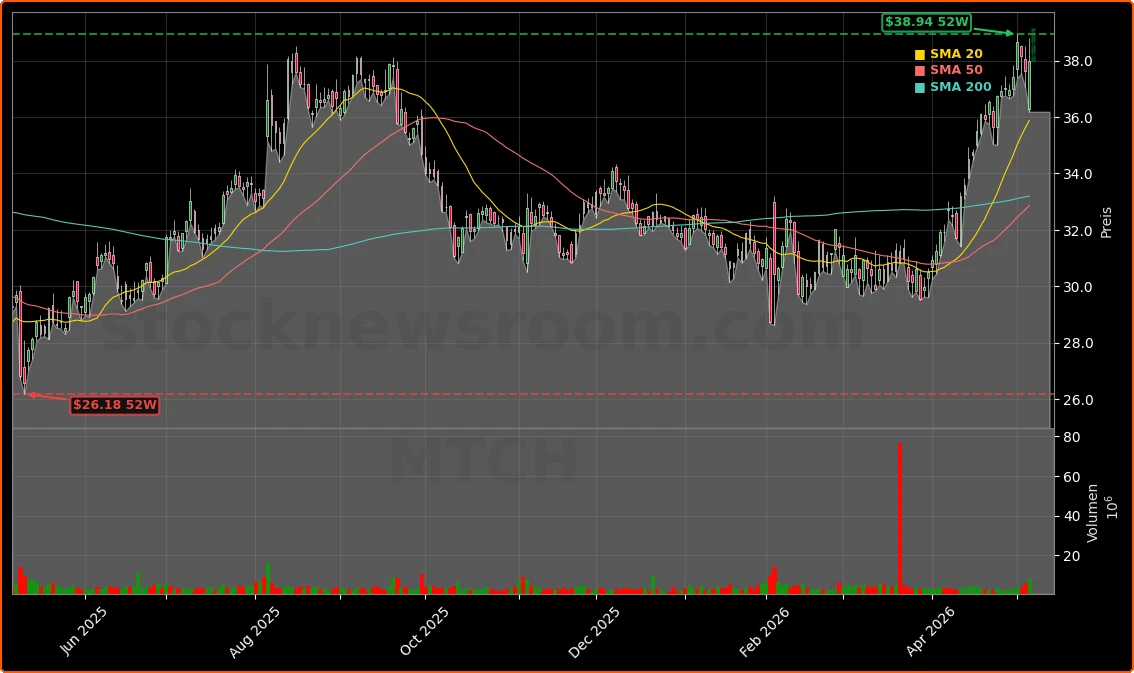
Match Group, Inc. shares closed at $38.00 on Wednesday and trade around $39.13 in early Thursday pre-market action, up nearly 3%, as investors digest improving fundamentals. Q1 2026 results showed a 42% surge in net income and a 25% increase in adjusted EBITDA, comfortably beating expectations and allowing the company to boost its quarterly dividend to $0.20 per share and return more cash via buybacks.
The Match Group Tinder Turnaround is central to this shift in sentiment. Management reports that declines in monthly active users at Tinder have eased to 7%, versus 10% previously, while paying users now fall only 5%, an improvement from an 8% drop in the prior quarter. Revenue at Tinder exceeded internal expectations, signaling that product changes are beginning to stabilize the core business that still drives the largest share of Match’s top line.
TD Cowen has responded by raising its price target on MTCH to $44 and keeping a Buy rating, explicitly framing the story around a nascent Tinder recovery and stronger portfolio growth. UBS has also lifted its target while remaining Neutral, underscoring that, although progress is real, many institutions still want to see several more quarters of execution before fully embracing the Match Group Tinder Turnaround narrative.
How is Match Group reshaping Tinder for Gen Z?
CEO Steve Bailey says the strategic focus at Tinder has shifted from near-term monetization to better “user outcomes” – more quality matches and sustainable engagement. A flagship example is the Double Date feature, which enables pairs of friends to match with other pairs. Among Gen Z women in the U.S., Bailey notes that roughly one in four are already using Double Date, and internal metrics show more “sparks” – six-way conversations that reflect deeper engagement.
This design direction responds to Gen Z’s demand for more authentic, lower-pressure ways to meet new people, rather than swipe-heavy experiences. The improved trends in new registrations – now rising for the first time in a long time – and slowing churn support the thesis that Match can rebuild Tinder’s brand without resorting solely to price hikes or aggressive paywalls. Bailey also highlights that one-off “à la carte” purchases within Tinder, previously a soft spot during macro headwinds, are improving again, suggesting product changes are helping to offset pressure from higher gas and healthcare costs on discretionary spending.
For U.S. tech investors familiar with engagement strategies at Meta or Apple, the pivot echoes a broader platform playbook: prioritize user utility first, then layer monetization on top. If sustained, this could underpin higher-quality recurring revenue at Tinder and make Match’s cash flows more resilient through the cycle.
Can Hinge offset Tinder’s past weakness?
While the Match Group Tinder Turnaround draws headlines, Hinge remains the growth engine. Bailey reports that Hinge delivered 28% revenue growth in the latest quarter, driven by strong adoption among Gen Z and young professionals, with average pricing around $20 per month. TD Cowen estimates Hinge could reach roughly $1 billion in annual revenue by 2027, which would materially rebalance Match’s portfolio away from a single-app dependency.
For NASDAQ-focused growth investors comparing MTCH to platform peers like NVIDIA or Tesla in their own segments, the Hinge trajectory offers a clearer, high-growth component to the thesis. Strong institutional ownership – including new stakes from Hussman Strategic Advisors and Artemis Investment Management – indicates that large investors are increasingly comfortable underwriting Match as a diversified dating platform rather than a one-app story.
At the same time, the company reiterates that its products have historically been relatively recession-resilient, with subscriptions around $20 per month proving stickier than impulsive in-app purchases. That positioning could appeal to portfolios seeking consumer-internet exposure with some defensive characteristics compared with more cyclical ad-driven names.
Where does Sniffies fit into Match Group’s strategy?
Beyond Tinder and Hinge, Match has moved to deepen its reach in niche segments. The company is investing $100 million into Sniffies, the number-two brand in the non-heterosexual male dating space with roughly 3 million users. The structure mirrors Match’s 2017 investment in Hinge: a minority stake now with an option to acquire the rest later if performance warrants.
Sniffies is not currently available in major app stores, but Match plans to help develop a “safe for work” version suitable for those channels. If successful, that could unlock substantial user growth and monetization opportunities in an underserved category, while also further diversifying revenue beyond Tinder. In parallel, Match is shutting down its Archer app, signaling a willingness to reallocate resources toward higher-conviction bets like Sniffies and Hinge.
Combined with board refreshment, including the planned addition of Raina Moskowitz, and ongoing debt reduction, these moves support a narrative of tighter capital discipline. For U.S. investors benchmarking MTCH against broader S&P 500 communication-services names, this cleaner strategic focus may justify higher multiples if execution continues.
We are focusing on user outcomes first at Tinder, and we are finally seeing that show up in better retention, more registrations and improved revenue trends.— Steve Bailey, CEO of Match Group, Inc.
In summary, the Match Group Tinder Turnaround, accelerating Hinge growth and the optionality from Sniffies position Match Group, Inc. for a more balanced growth profile. For American investors, MTCH is evolving from a single-franchise dating play into a multi-brand platform story, and the next few quarters will be critical in determining whether this Match Group Tinder Turnaround can fully re-rate the stock on Wall Street.