
Can the Uber World Cup Shuttle become a real growth driver, or will rising AI costs steal the spotlight?

Why does Uber World Cup Shuttle matter?
The market reaction was modest on Friday, with Uber shares up 0.58% in intraday trading, but the strategic message is larger than the move. Uber is introducing the Uber World Cup Shuttle from MetLife Stadium at $49 per seat and rides starting at $45 from venues in Dallas, Boston, and Miami. That matters because transportation costs have become part of the broader fan backlash around the tournament, alongside complaints about parking and ticket prices. By offering simpler, fixed-price event rides, Uber is trying to capture demand while reducing the uncertainty that often frustrates riders during major live events.
For investors, the product is less about one tournament and more about whether Uber can deepen its role in event mobility. Large-scale sports moments often act as test beds for new consumer behaviors, and success here could support similar offerings across concerts, leagues, and international events. It also reinforces Uber’s effort to become a broader mobility platform rather than just an on-demand ride app.
Can Uber turn events into a growth lane?
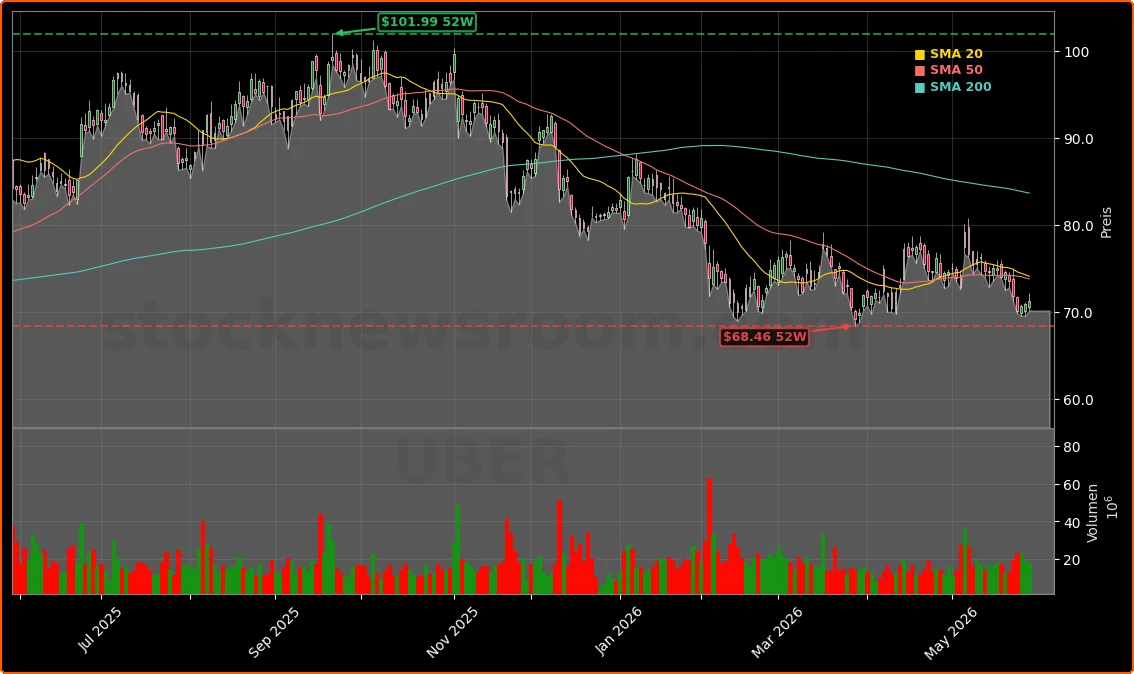
Uber’s event push arrives as Wall Street continues to weigh its growth outlook against execution risks. The company already showed strong first-quarter momentum earlier this month, though the stock fell after those results, highlighting how demanding expectations have become. Investors are now asking whether products like the Uber World Cup Shuttle can improve trip density, create premium use cases, and lift brand visibility in a competitive transport market.
The company is also launching a new feature that allows audio recording during rides, adding another layer to its safety positioning. That may not move revenue immediately, but trust and retention matter in a category where consumer choice can shift quickly. Relative to rivals and adjacent platform names such as Tesla, Apple, and NVIDIA, Uber’s appeal remains tied to execution, network effects, and its ability to build practical services that users adopt at scale.
Analyst views remain important here. Citigroup, RBC Capital Markets, Goldman Sachs, and Morgan Stanley are among the firms investors typically watch closely on Uber, especially when the debate turns to margins, autonomous vehicle exposure, and valuation after sharp stock runs. No fresh rating change accompanied Friday’s developments, but product expansion and user engagement remain central variables in those firms’ long-term models.
Is AI spending becoming a bigger issue for Uber?
A more complicated discussion for investors is emerging around artificial intelligence spending. Uber is a customer of Anthropic, and Chief Operating Officer Andrew Macdonald said the company used up its entire 2026 AI budget in just four months. That comment raises a key question for the market: can Uber generate enough productivity, automation, or product gains to justify such rapid cost absorption?
That issue matters beyond Uber alone. It also touches suppliers and ecosystem winners tied to enterprise AI demand, including names such as NVIDIA and software providers benefiting from model adoption. If large customers begin questioning returns on AI spending, Wall Street may become more selective in how it values both platform companies and infrastructure vendors. For Uber, the near-term challenge is proving that heavy AI investment will support efficiency, pricing, support tools, or new customer features rather than simply inflate operating costs.
Related Coverage: Investors looking for a broader read on the company’s recent financial momentum can revisit this breakdown of Uber’s record Q1 results and the stock’s post-earnings decline. That earlier report examined how strong operating performance and robotaxi ambitions were not enough to prevent a negative immediate share reaction, a useful backdrop as the Uber World Cup Shuttle adds another growth angle to the story.
The Uber World Cup Shuttle shows Uber is still leaning into practical, high-visibility product launches while balancing safety upgrades and rising technology costs. For investors, the next test is whether these initiatives translate into stronger engagement and durable margins. If Uber can turn global events into repeatable mobility opportunities, the stock could keep attracting attention on Wall Street.