Can Visa Stablecoin turn regulated blockchain rails into the next major growth engine for one of Wall Street’s most trusted payment giants?

What does Canton Network mean for Visa Stablecoin?
On June 3, 2026, Visa Inc. announced a collaboration with Brale to explore Visa Stablecoin-enabled settlement using the SBC token on the Canton Network — a privacy-preserving, interoperable blockchain infrastructure designed for regulated financial institutions. The proof of concept focuses on programmable, near-instant cross-border settlement while enabling granular control over data visibility — a critical requirement for banks and central banks evaluating digital settlement rails. Unlike public, permissionless stablecoin networks, Canton’s architecture aligns with Visa’s regulatory-first approach, allowing institutions to retain custody, compliance, and auditability. This isn’t a crypto experiment; it’s infrastructure modernization with direct implications for Visa’s $1.2 trillion annual data processing revenue stream.
How does Replit change Visa’s developer moat?
Just days later, on May 29, Visa Inc. revealed a multi-year partnership and strategic investment in Replit — the AI-powered agentic software development platform used by over 25 million developers. The integration brings Visa Intelligent Commerce tools directly into Replit’s agent-building workflows, embedding payment logic, fraud signals, and real-time settlement APIs into the earliest stages of application development. Crucially, Visa and Replit are co-developing pathways for AI agents built on Replit to join the Visa Stablecoin-aligned Trusted Agent Protocol registry — a move that could seed the next decade of embedded finance. For U.S. investors, this positions Visa Inc. not against Apple or Tesla, but alongside emerging infrastructure leaders like NVIDIA in the AI stack — where developer adoption is the ultimate competitive moat.
Why are analysts raising targets now?
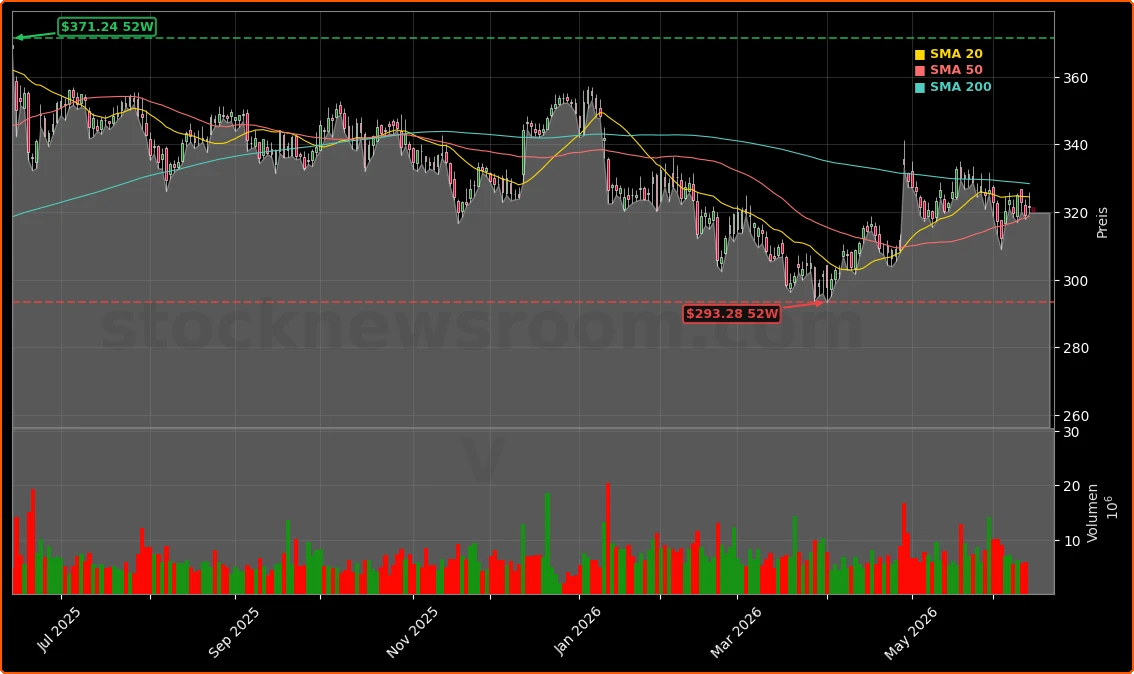
Truist analyst Matthew Coad raised Visa Inc.’s price target to $371 from $361 on May 27 — citing not just stronger Data Processing growth, but also the inorganic lift from Prisma/Newpay and elevated demand for marketing and analytics services ahead of the FIFA World Cup. Coad maintained a Buy rating, emphasizing that the Visa Stablecoin infrastructure plays are de-risking long-term revenue streams against disruption from fintech and big tech. Meanwhile, Morgan Stanley upgraded the stock to Overweight in early June, highlighting Visa’s unique ability to monetize AI-native commerce without sacrificing regulatory trust — a dynamic that sets it apart from pure-play payments disruptors. With a forward P/E of 26 and free cash flow yield near 3.4%, the valuation reflects confidence in execution, not just hype.
How does this impact S&P 500 and NASDAQ investors?
As a top-10 S&P 500 component and a key liquidity anchor for the NASDAQ financials sub-index, Visa Inc.’s pivot toward programmable settlement has portfolio-wide implications. Unlike volatile crypto-linked equities, Visa’s Visa Stablecoin strategy strengthens its role as a systemic utility — increasing correlation with infrastructure spend and decreasing sensitivity to consumer payment volume fluctuations. With $615 billion market cap and 25% five-year ROIC, Visa’s stability makes it a rare hedge inside growth-oriented tech portfolios. That said, rising competition from Meta’s Diem successor and JPMorgan’s JPM Coin means execution velocity matters — and Q2 2026 will be the first earnings cycle where stablecoin-related revenue contributions appear in segment disclosures.
Related Coverage: Can Visa’s new Flexible Credential keep buy-now-pay-later disruptors on its rails instead of losing volume to alternative payment apps? Visa Product Launch: Flexible Credential Shocks Card Market. Meanwhile, the broader capital markets backdrop remains supportive: Goldman Sachs IPO Boom: $60B Deals Power Record Fee Outlook signals strengthening financial infrastructure demand — a tailwind for Visa’s commercial solutions growth.
Visa Inc. remains the most trusted and scalable bridge between legacy finance and AI-native commerce. For U.S. investors, the Visa Stablecoin initiative is no longer theoretical — it’s driving tangible upgrades to settlement efficiency, developer engagement, and regulatory alignment. The next catalyst will be the Q2 2026 earnings report, expected in early July, where management is likely to detail early traction with Canton and Replit integrations. For long-term portfolios, Visa’s combination of cash flow discipline, global scale, and infrastructure leadership makes it a core holding in any diversified U.S. equity strategy.
This isn’t a crypto experiment; it’s infrastructure modernization with direct implications for Visa’s $1.2 trillion annual data processing revenue stream.— StockNewsRoom Senior Analyst
Fazit folgt.